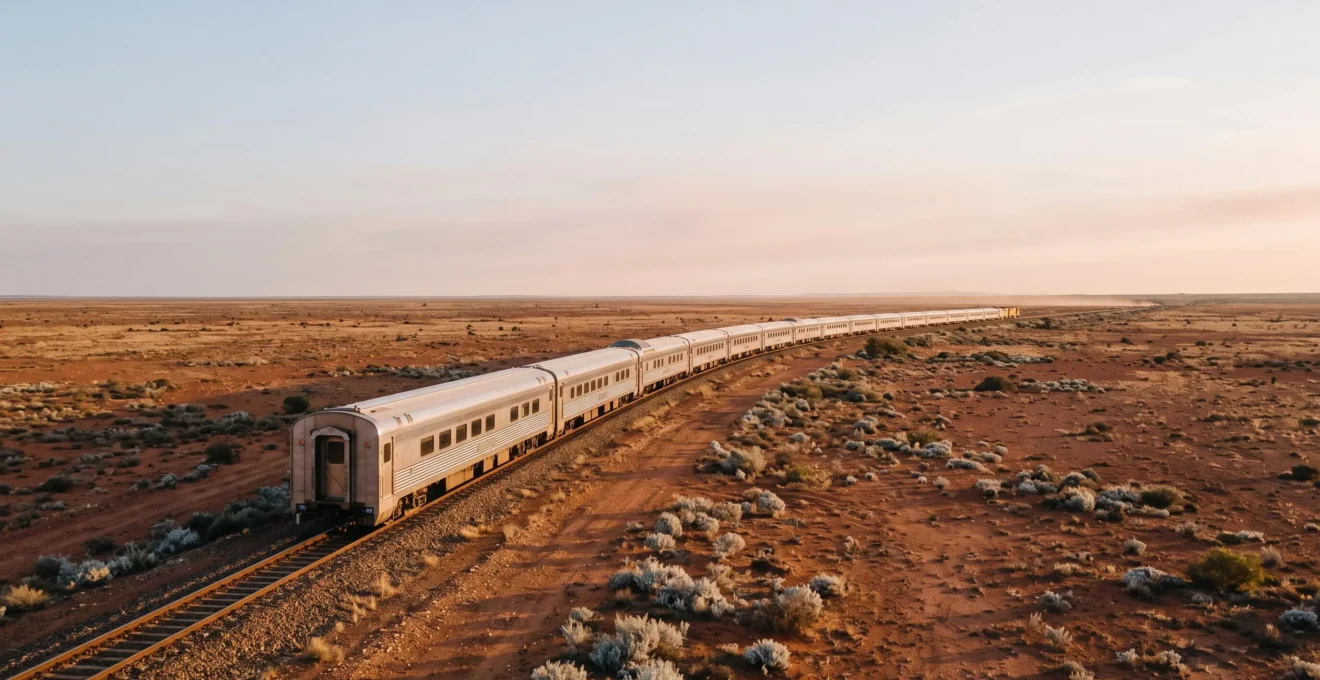
Choosing an Australian rail journey is less about the destination and more about embracing a slower, more profound way of seeing the country.
- Iconic routes like The Ghan or Indian Pacific are designed for contemplative travel and cultural immersion, not for matching the speed of flights.
- The quality of your experience is defined by your choice of cabin, the specific itinerary length, and the season you travel.
Recommendation: Reframe your « transit time » as the core of your holiday and select a route that matches your desire for either epic scenic immersion or deep cultural encounters.
Fly over Australia, and the continent reveals itself as a vast map of ochre dust and simmering emptiness. From 35,000 feet, the sheer scale is impressive but abstract, a landscape scrolled past on a screen. This perspective leads many to see the country as a series of destinations connected by the fastest possible means. When trains enter the conversation, they are often framed by a single, seemingly negative, attribute: they are slow. This comparison to air travel, however, misses the fundamental purpose of Australia’s great rail journeys.
But what if the slowness is the point? What if the days spent crossing the Nullarbor Plain are not a bug, but the central feature? The true value of Australian rail travel lies not in its efficiency as transport, but in its power as a tool for immersion. It is a deliberate act of recalibrating your sense of time and scale, transforming the continent’s vastness from a logistical problem into a meditative experience. It’s about feeling the subtle shifts in the landscape, from the coastal heathlands to the deep red centre, in a way that is physically impossible from the air.
This guide is for the traveller who values the journey as much as the destination. We will explore why these rail journeys offer a contemplative experience flights cannot replicate and how to choose the right route for your travel style. We will also address practicalities like budget, managing speed expectations, and strategically combining train travel with other transport to create a truly unforgettable Australian odyssey. This is not about getting there; it’s about being there, every kilometre of the way.
To help you navigate these choices, this article breaks down everything you need to know about selecting and planning an immersive Australian train experience. Explore the sections below to find the answers that will shape your journey.
Summary: A Guide to Experiencing Australia’s Epic Rail Journeys
- Why Australian Rail Journeys Deliver Contemplative Experiences Flights Cannot Match?
- How to Choose Australian Rail Routes for Landscape Variety or Iconic Bucket-List Status?
- Sleeper Cabins or Daytime Rail Services: Which Australian Train Experience Suits Your Budget?
- The Rail Speed Expectation That Australian Trains Match European High-Speed Networks?
- Why Australian Domestic Flights Cover Distances Equal to International Routes Elsewhere?
- How to Combine Domestic Flights, Trains, and Coaches for Optimal Australian Routing?
- When to Book Iconic Australian Rail Journeys for Availability and Peak Landscape Beauty?
- How to Navigate Australia’s Transport Options Without Wasting Days in Transit
Why Australian Rail Journeys Deliver Contemplative Experiences Flights Cannot Match?
The core difference between rail and air travel in Australia is not speed, but presence. A flight detaches you from the landscape, presenting it as a distant abstraction. A train, however, immerses you within it, engaging the senses in a process of kinetic contemplation. It’s the gentle rock of the carriage, the rhythmic clatter of wheels on the track, and the ever-unfolding panorama just outside your window. This environment encourages a mental slowing-down, a forced digital detox where the main event is simply watching the world go by. This isn’t just a romantic notion; a 2024 study of 450 travellers found a significant link between the desire for mindfulness and the decision to undertake trips that disconnect from digital life.
This slow-burn immersion allows you to witness the subtle, gradual transformations of the continent. One moment you’re traversing the green hills outside Adelaide, and hours later, the colour palette has shifted to the stark reds and purples of the Flinders Ranges. You develop a ground-level appreciation for the country’s vastness that a flight path simply cannot provide. It’s an experience of « being in » the landscape, not just flying over it. As one traveller described their journey on The Ghan, it’s a unique opportunity for reflection.
Recalling a long train journey from Melbourne to Alice Springs via The Ghan, a traveller describes watching the soil gradually shift in colour outside the window, explaining that on board « you have plenty of time to read and contemplate » as the scale of the continent slowly reveals itself.
– Traveller Account, National Museum of Australia
This journey fosters a state of geographical humility, where the sheer scale of the land dictates the pace. You aren’t conquering distance; you are surrendering to it. This shift in mindset is the very essence of contemplative travel, turning what could be seen as empty space into a canvas for reflection and observation.
How to Choose Australian Rail Routes for Landscape Variety or Iconic Bucket-List Status?
Once you’ve embraced the philosophy of slow rail travel, the next step is choosing a route that aligns with your travel aspirations. Australia’s iconic journeys can broadly be divided into those celebrated for their staggering, monolithic landscapes and those offering a richer tapestry of cultural or geographical variety. Your choice will define the very character of your trip, so it’s crucial to understand what each has to offer.
For those seeking a bucket-list experience of iconic, almost meditative emptiness, the Indian Pacific is unparalleled. Its signature feature is the crossing of the Nullarbor Plain, where the Trans-Australian Railway includes the world’s longest stretch of dead-straight track at 478 kilometres. This journey is a masterclass in scale and minimalism, where the destination becomes the horizon itself. The seemingly unchanging landscape forces a state of introspection, making the journey a deeply personal and contemplative one.
Conversely, if your goal is a journey marked by cultural depth and changing scenery, The Ghan is the quintessential choice. Travelling from Adelaide to Darwin (or vice versa), it cuts a vertical line through the continent’s heart, transitioning from the green south through the red centre to the tropical north. More than just a scenic trip, it is structured as a cultural immersion. As highlighted in the case of its off-train tours, the experience is deliberately curated to connect passengers with the land and its ancient history.
Case Study: The Ghan’s Cultural Excursions
Off-train tours built into The Ghan itinerary, such as the guided visit to Nitmiluk Gorge near Katherine, introduce passengers to the rock art and cultural significance the site holds for the Jawoyn people, while stops in Alice Springs offer further engagement with Arrernte culture and history, turning a scenic rail trip into a deeper cultural encounter.
Action Plan: Selecting Your Ideal Rail Journey
- Assess Your Priority: Decide if your primary goal is meditative landscape immersion (Indian Pacific) or cultural discovery and scenic variety (The Ghan).
- Review Off-Train Itineraries: Examine the specific excursions offered. Do they align with your interests, such as Indigenous culture, wildlife, or regional food and wine?
- Consider Direction of Travel: Travelling north on The Ghan reveals the tropics gradually, while travelling south builds anticipation for the settled coastline.
- Evaluate Your Time Commitment: A full coast-to-coast crossing on the Indian Pacific is a significant time investment, whereas shorter legs of the journey are also possible.
- Check Seasonal Highlights: Research whether your travel dates coincide with unique events like wildflower season in Western Australia or the lush ‘green season’ in the Top End.
Sleeper Cabins or Daytime Rail Services: Which Australian Train Experience Suits Your Budget?
The romance of Australian rail is deeply intertwined with the classic experience of a sleeper cabin, but this is also the most significant factor influencing the budget. Deciding between an all-inclusive sleeper service and more economical daytime options is a choice between luxury immersion and practical transport. The premier long-distance trains like The Ghan and Indian Pacific are primarily built around the all-inclusive sleeper model, where your ticket covers a private cabin, all meals in the dining car, beverages, and included Off-Train Excursions.
This model reframes the train not as a mode of transport but as a moving hotel and a curated experience. Waking up to a desert sunrise from your own private window is an unforgettable moment that defines this style of travel. As travel writer Melissa Woodley notes for Time Out Australia, the allure lies in the seamless blend of comfort and scenery.
contemporary sleeper cabins that let you wake up to stunning sunrises right outside your window
– Melissa Woodley, Time Out Australia
For travellers on a tighter budget, or those making shorter journeys along the east coast, state-based operators offer more conventional daytime rail services with seating options. Services like the NSW TrainLink XPT (Sydney-Melbourne) or Queensland Rail’s Spirit of Queensland (Brisbane-Cairns) offer a way to see the landscape at ground level without the premium price tag of a sleeper. While they lack the all-inclusive luxury, they still provide a far more connected and scenic experience than flying. Ultimately, the choice depends on your priority: are you seeking a once-in-a-lifetime, fully immersive holiday, or a comfortable and scenic way to travel between two points?
The Rail Speed Expectation That Australian Trains Match European High-Speed Networks?
One of the most common misconceptions for international visitors is expecting Australian trains to operate at speeds comparable to Europe’s or Japan’s high-speed networks. It is crucial to set this expectation aside. Australian long-distance rail is not about speed; it’s about endurance and navigating a continent defined by immense distances and challenging geography. The goal is not to shrink the country, but to experience its true, humbling scale.
To put it in perspective, the Indian Pacific is not a short inter-city hop; it is a transcontinental expedition. The very fact that this incredible 4,352-kilometre crossing takes multiple days is a testament to the sheer size of the landmass it traverses. The operational speeds are a deliberate and necessary adaptation to the environment. The focus is on a smooth, comfortable, and safe journey across terrain that can be harsh and unforgiving, allowing passengers to settle into the rhythm of the journey.
This « slower » pace is not a result of a lack of ambition but a direct consequence of the engineering realities of the Australian outback. The history of the railway itself is a story of battling the elements, a fact that underscores why speed has never been the primary objective. The challenges faced by early engineers are still relevant today and shape the nature of the journey.
Case Study: The Engineering Challenge of the Nullarbor
The original Trans-Australian line across the Nullarbor suffered severe problems with track flexing and settling in the desert sands, making early crossings slow and arduous; the line was entirely rebuilt in 1969 to standardise rail gauges, a reminder that outback conditions, not lack of ambition, shape rail speeds even today.
Embracing this deliberate pace is key to enjoying the experience. The time on board is not downtime between places; it is the experience itself. It’s an invitation to read, socialise, dine, and watch as one of the world’s most ancient landscapes unfolds at a human pace.
Why Australian Domestic Flights Cover Distances Equal to International Routes Elsewhere?
To truly grasp why slow travel by rail offers such a unique Australian experience, one must first comprehend the immense scale of the country. For many visitors, the distances between major cities are a genuine shock. A domestic flight in Australia can easily cover a distance equivalent to a major international flight in Europe or North America. This geographical reality is the foundation upon which all Australian travel planning must be built.
A classic example is the flight between the country’s western and eastern hubs. According to travel data, a nonstop flight between Perth and Sydney takes around 4 hours and 36 minutes, covering approximately 3,297 kilometres. This is comparable to flying from London to Cairo or from New York to Bogotá. When you fly, this immense distance becomes a sterile number on a screen, a block of time to be endured. The thousands of kilometres of desert, farmland, and mountain ranges below are reduced to a vague, blurry texture.
This is precisely what you miss from 35,000 feet: the detail, the texture, and the feeling of the land. The rail journey, by contrast, grounds you in this reality. Every one of those 3,000+ kilometres is experienced, not skipped. You see the soil change colour, the vegetation thin out, and the horizon expand. This ground-level perspective is not just scenic; it is educational. It builds a mental map of the country that is rich with sensory detail, providing a profound understanding of place that a flight, by its very nature, erases. Choosing the train is choosing to engage with the distance, not just to conquer it.
How to Combine Domestic Flights, Trains, and Coaches for Optimal Australian Routing?
An immersive Australian holiday rarely relies on a single mode of transport. The most rewarding itineraries are often a thoughtful blend of rail, air, and road travel. Viewing the train not as an end-to-end solution but as a foundational pillar of a larger journey opens up a world of possibilities. The key is to use each mode of transport for what it does best: flights to cover the truly vast « empty » distances efficiently, and trains to turn specific, iconic landscapes into the centrepiece of the trip.
For example, you might fly from an international gateway like Sydney to Alice Springs, saving days of travel. From there, you could embark on the southern leg of The Ghan to Adelaide, fully immersing yourself in the Flinders Ranges and the desert landscapes. This « fly-rail » combination allows you to be strategic with your time while ensuring the most scenic part of the journey is experienced at a contemplative pace. The iconic rail journeys themselves often provide a model for this multi-modal approach through their off-train excursions.
Case Study: The Ghan as a Multi-Modal Template
The Ghan itinerary already blends the train with guided off-train excursions, such as tours of Nitmiluk Gorge and Alice Springs, showing how rail travel can be deliberately combined with 4WD or coach-based side trips to deepen outback immersion rather than being treated as a self-contained mode of transport.
This logic can be extended to your own planning. Consider using regional coach services to explore areas around a train’s terminus. After arriving in Perth on the Indian Pacific, a coach tour down to the Margaret River wine region is a popular and logical next step. By thinking in modules—a scenic rail module, a regional coach module, and a long-distance flight module—you can construct an itinerary that is both time-efficient and experientially rich, ensuring you don’t miss the ground-level detail that makes Australian travel so special.
When to Book Iconic Australian Rail Journeys for Availability and Peak Landscape Beauty?
Booking an iconic Australian rail journey requires forward planning, not just to secure a spot but to align your travel with the optimal seasonal experiences. These are not commuter trains; they are highly sought-after holiday experiences that often book out months, or even a year, in advance, especially for peak seasons. The « when » of your booking affects both availability and the very nature of the landscape you’ll witness.
Seasonality plays a dramatic role in what you see from the window. The journey across the Nullarbor on the Indian Pacific, for example, is transformed during the brief wildflower season in Western Australia (around August-September), when the arid landscape can be carpeted in colour. Conversely, travelling The Ghan during the tropical « green season » (around November-April) in the Top End means witnessing a landscape that is lush, vibrant, and alive with waterfalls, a stark contrast to the parched beauty of the « dry season. » Researching the peak landscape beauty for your chosen route should be a primary consideration.
Furthermore, the operators are continually evolving their offerings, meaning your booking choice extends beyond just a date. It can also involve selecting a specific itinerary that offers a different level of immersion. A longer journey on the same route can provide a completely different, more in-depth experience, making it a worthwhile consideration during the booking process.
Case Study: Journey Beyond’s Evolving Itineraries
Journey Beyond’s extended five-day, four-night Indian Pacific itinerary adds all-inclusive off-train experiences in Kalgoorlie, the Barossa Valley and the Blue Mountains, illustrating how a different booking choice (itinerary length and season) can transform the same route into a fuller, more immersive experience with more time in each landscape.
The key is to treat the booking process as an integral part of your travel planning. Start early, define your desired seasonal experience, and explore the different itinerary options available. This proactive approach will ensure your journey is not just available, but is also the richest and most rewarding experience possible.
Key Takeaways
- Australian rail is designed for scenic immersion and contemplative travel, not for competing with the speed of flights.
- Choosing a route like The Ghan or the Indian Pacific depends on whether you prioritise cultural depth and variety or vast, meditative landscapes.
- The concept of « transit time » should be reframed; on these journeys, the days spent travelling are the holiday itself, not a period to be minimised.
How to Navigate Australia’s Transport Options Without Wasting Days in Transit
The phrase « wasting days in transit » is common among time-poor travellers, but it reflects a fundamental misunderstanding of what Australian rail journeys offer. The solution is not to find a faster train, but to entirely reframe the concept of « transit ». On journeys like The Ghan and the Indian Pacific, the days spent on board are not wasted; they are the core of the holiday. The travel *is* the experience. This mental shift is the single most important step in navigating Australia’s vast transport landscape.
These journeys are intentionally designed as all-inclusive, multi-day experiences. The time is filled with fine dining, socialising, exceptional service, and carefully curated off-train excursions that break up the journey and connect you with the local culture and landscape. Journey Beyond, the operator of these iconic trains, explicitly positions them as holidays in their own right, where the movement across the continent is the main event.
Case Study: The Journey as the Destination
Journey Beyond positions its rail journeys as multi-day, all-inclusive experiences encompassing meals, off-train tours and onboard hospitality across thousands of kilometres, reinforcing the idea that for routes like these, the time spent travelling is the holiday itself, not a gap to be minimised between two destinations.
When you adopt this mindset, the question is no longer « How do I avoid wasting time? » but « How do I best invest my time to appreciate this continent? » The answer becomes clear: you use flights to bridge the less critical gaps and you dedicate a protected block of time to a rail journey, savouring every moment. As travellers who have made the crossing often reflect, the days on the train become the most memorable part of the trip, providing a profound and lasting appreciation for the country’s scale.
Describing a long train journey from Melbourne to Alice Springs, a traveller recalls watching the soil change colour outside the window and explains that the experience helped them « appreciate the vastness of this amazing continent, » framing the days on board not as transit but as the core of the journey itself.
– Traveller Account, National Museum of Australia
Begin planning your journey today by exploring the itineraries of Australia’s great trains, and choose an experience that promises not just a destination, but a deeper connection with the continent itself.