Hiring the right Australian campervan isn’t about finding the ‘best’ vehicle; it’s about matching its specific capabilities to your planned route and experience level.
- The vast distances and variable road quality in Australia mean a European-style motorhome can be unsuitable or unnecessarily expensive.
- Failing to understand insurance excess can expose you to thousands of dollars in liability for even minor damage.
Recommendation: Before looking at a single campervan, map out your must-see destinations. Your route’s ‘DNA’—sealed roads, outback tracks, or coastal highways—is the single most important factor in choosing the right, most cost-effective vehicle.
Scrolling through Australian campervan rental sites can be overwhelming. You’re faced with a seemingly endless parade of vehicles, from compact pop-tops to hulking six-berth motorhomes, each promising the ultimate road trip adventure. The common advice you hear— »book early, » « get a 4WD, » or « bigger is more comfortable »—is often too simplistic for Australia’s unique challenges. This leads first-timers to make one of two costly mistakes: either overpaying for a high-spec 4WD they’ll only drive on sealed coastal roads, or hiring a basic van that’s dangerously under-equipped for the remote outback.
But what if the key wasn’t finding the ‘best’ van, but the ‘right’ van for *your* specific trip? The secret lies in a shift in mindset. Instead of starting with the vehicle, you need to start with the journey. This guide is built around a practical, specialist approach: the trip-to-tyre audit. It’s a framework for meticulously matching a van’s features—its layout, power systems, and durability—to the non-negotiable realities of your planned Australian route. Forget the marketing hype; this is about making an informed decision that saves you money and ensures your vehicle is a reliable partner, not a source of stress.
We’ll walk you through this process, starting with why Australia demands a different class of vehicle. We’ll then break down how to choose a layout, match the equipment level to your itinerary, and navigate the confusing world of insurance. By the end, you’ll be equipped to hire with confidence, knowing you’ve secured the perfect rig for your adventure without paying a dollar more than you need to.
Summary: A Practical Guide to Selecting an Australian Campervan Rental
- Why Australian Campervan Rentals Need Different Specs Than European Motorhome Hire?
- How to Choose Campervan Layouts for Your Party Size and Living Space Priorities?
- Basic Campervans or Fully Equipped Motorhomes: Which Rental for Your Australian Route?
- The Campervan Insurance Assumption That Leaves You Liable for £4,000 Excess After Minor Damage?
- When to Hire Campervans for Availability and Best Rates Versus Peak Season Price Gouging?
- Powered or Unpowered Sites: Which Campervan Park Option Suits Your Rig and Budget?
- Why Australian Road Trips Demand More Vehicle Preparation Than European Road Trips?
- How to Choose Campervan Parks with Great Facilities and Welcoming Traveler Communities
Why Australian Campervan Rentals Need Different Specs Than European Motorhome Hire?
The first thing to understand is that Australia is not Europe. The scale is different, the roads are different, and the environment is far less forgiving. A standard motorhome that’s perfectly comfortable on a trip through France can quickly become a liability in the Australian outback. The primary reason is the sheer distance and terrain variability. You can drive for hundreds of kilometres between towns, with road surfaces changing from smooth asphalt to corrugated red dirt without warning. This isn’t an edge case; it’s a fundamental part of the Australian road trip experience.
This demanding environment requires vehicles with specific features. It’s not just about luxury; it’s about durability and self-sufficiency. Features like robust suspension, better sealing against dust, larger water tanks, and dual-battery systems are not optional extras; they are essential for safety and comfort in many parts of the country. As the experts at National Geographic Traveller point out, the vehicle choice is entirely route-dependent:
If you’ll be off-roading in remote areas, you need a 4WD variety.
– National Geographic Traveller (UK), A practical guide to campervanning in Australia
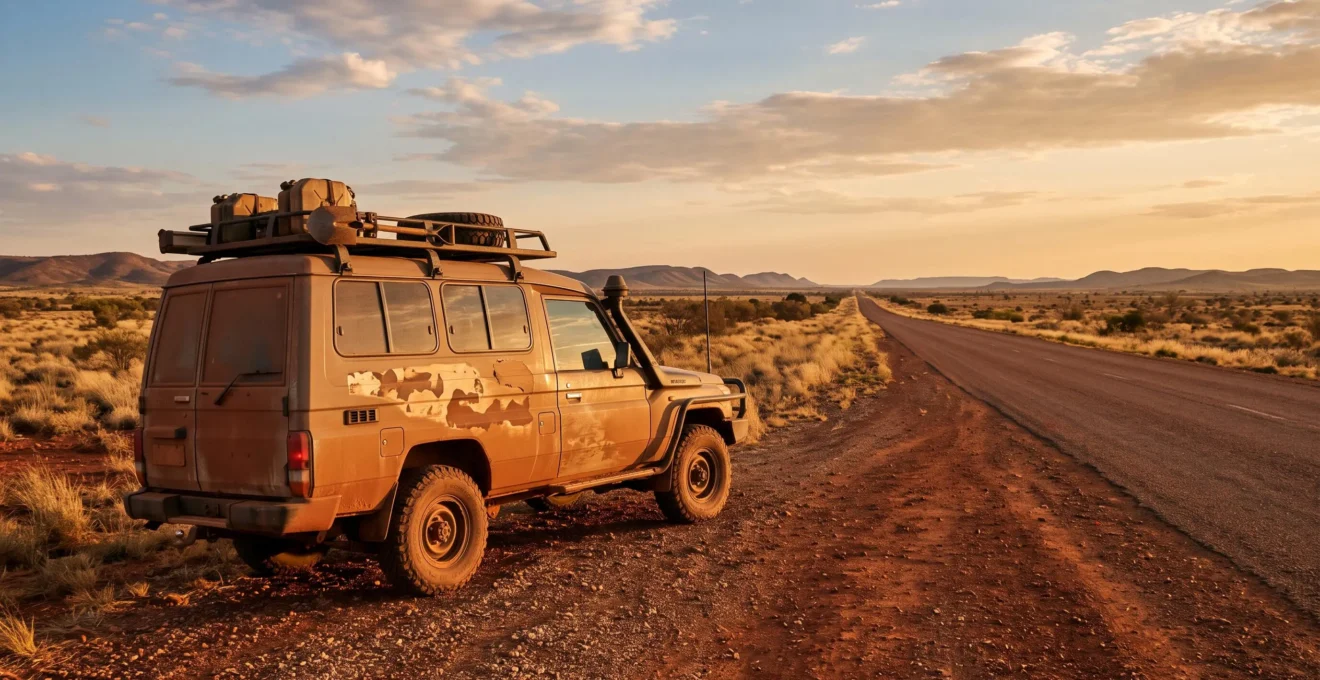
The visual below starkly illustrates the kind of terrain your rental might face. Fine, pervasive red dust and bone-rattling corrugated roads demand a vehicle built to withstand them. This is the capability mismatch we aim to avoid: taking a standard van into an environment that requires a purpose-built machine.
Therefore, your first step in the ‘trip-to-tyre audit’ is to honestly assess your route’s DNA. Will you be sticking to the sealed highways of the East Coast, or are you dreaming of the Gibb River Road? The answer dictates whether you need a basic 2WD camper or a rugged 4WD explorer.
How to Choose Campervan Layouts for Your Party Size and Living Space Priorities?
Once you’ve aligned your vehicle class with your route, the next decision is layout. This is a personal choice that balances the number of travellers with your priorities for living, sleeping, and cooking space. As a first-timer, it’s easy to think bigger is always better, but a larger motorhome can be more difficult to drive, park, and manoeuvre, especially in towns or on narrow roads. The key is to think about how you will *actually* use the space.
Campervan layouts in Australia generally fall into a few categories. Compact models, often pop-tops, are ideal for solo travellers or couples who plan to spend most of their time outdoors and just need a comfortable place to sleep. Mid-range vans offer more internal height and a dedicated internal kitchen, providing a good balance for longer trips. Large motorhomes, as noted by National Geographic, can accommodate up to six people and come with all the bells and whistles, including onboard bathrooms and separate living areas. These are great for families or groups who value indoor comfort but come with a significant increase in rental cost and fuel consumption.
Your living space priority is crucial here. Do you envision cooking gourmet meals inside, or are you happy with a simple external BBQ setup? Do you need a dedicated space to work or relax during the day, or will the van primarily be for sleeping? The contrast is stark: an external-kitchen pop-top is perfect for a breezy coastal trip, while a fully-enclosed hard-shell motorhome offers a vital refuge from the flies and dust of the outback.
Ultimately, don’t pay for space you won’t use. A solo traveller in a six-berth motorhome is likely wasting money that could be better spent on experiences. Be realistic about your needs and choose a layout that feels efficient and functional for your party size and travel style.
Basic Campervans or Fully Equipped Motorhomes: Which Rental for Your Australian Route?
The choice between a basic campervan and a fully-equipped motorhome is a financial one, but the real calculation goes far beyond the daily rental rate. A basic, ‘cheap’ van without an onboard toilet, shower, or robust power system can end up costing you more in the long run, depending on your route. This is where your Route DNA analysis becomes critical. A trip along the heavily populated East Coast, with its abundance of caravan parks, is very different from a journey across the Nullarbor.
A basic campervan often requires you to stay at powered caravan park sites every night to run appliances and charge devices. While these sites are plentiful in tourist areas, their cost adds up. According to an analysis of park fees, a powered site can range from $30 to $50 per night, whereas unpowered sites are cheaper. A fully self-contained motorhome with its own solar panels, house battery, and water tanks gives you the freedom to use these cheaper unpowered sites or even ‘free camp’ in designated areas, drastically reducing your nightly accommodation costs.
The right choice is entirely dependent on your itinerary. The table below, based on common rental fleet recommendations, provides a clear framework for matching your vehicle’s feature payload to your trip.
| Route Type | Recommended Vehicle Class | Why |
|---|---|---|
| East Coast Cruise | Basic 2WD campervan | Plentiful sealed roads and powered caravan parks reduce the need for full self-containment |
| Red Centre Loop | Mid-range 2WD/4WD with fridge & A/C | Longer distances between services demand reliable cooling and food storage |
| WA / Top End Remote | Fully self-contained 4WD motorhome | Unsealed roads and vast distances between towns require independent water, power and durability |
Think of it as an equation: the savings on a basic van’s daily rate can be quickly erased by an extra $20 per night for powered sites over a 30-day trip. Perform the ‘trip-to-tyre’ audit: map your route, identify the availability of services, and then choose the vehicle with the appropriate level of self-sufficiency.
The Campervan Insurance Assumption That Leaves You Liable for £4,000 Excess After Minor Damage?
This is arguably the most critical and misunderstood part of hiring a campervan in Australia. Many first-timers assume the « included » insurance provides comprehensive cover, only to discover they are personally liable for a massive excess payment after a minor incident like a chipped windscreen or a scraped panel. The standard excess on Australian rentals can be shockingly high. In fact, a recent industry analysis found that the average extra liability for theft and damage was about AU$4,334. This is your excess exposure: the maximum amount you’ll have to pay out of pocket if the vehicle is damaged, regardless of who is at fault.
Rental companies will offer you options to reduce this liability at the checkout counter, but these policies can be expensive, often costing $30-$50 per day. This can add over $1,000 to the cost of a month-long hire. The assumption that you’re « fully covered » is a dangerous one; the base-level insurance is designed to protect the rental company, not your wallet. A single piece of flying gravel from a road train can crack a windscreen, an event that could instantly cost you thousands and wipe out any savings you made by choosing a cheaper rental.
Understanding your options before you get to the rental desk is vital. You are not just choosing insurance; you are choosing your level of financial risk. To make an informed decision, you need to audit your risk tolerance against the cost of reducing it.
Your Action Plan: Choosing the Right Excess Coverage
- Standard (No Cover): Accept the full excess risk to minimise daily costs. This is only for experienced travellers who fully understand and can afford the potential financial exposure.
- Excess Reduction: Lower your liability without paying for the full all-inclusive package. This is a middle ground for budget-conscious travellers who want some protection against a catastrophic bill.
- All-Inclusive: Pay a higher daily rate for complete peace of mind. This typically reduces your excess to zero (or a minimal amount like $500), includes a low bond, and often bundles extras like camping chairs or extra drivers.
- Check Policy Limits: Always verify the duration caps on any policy. Many third-party or even rental company policies have limits (e.g., 31 or 60 days) and may not cover a single, very long trip.
- Review Inclusions/Exclusions: Critically check what is and isn’t covered. Tyres, windscreens, and underbody/roof damage are common exclusions in standard policies—precisely the types of damage most likely to occur on Australian roads.
Do not leave this decision to the last minute. Assess the options, read the fine print, and choose the level of cover that lets you sleep at night.
When to Hire Campervans for Availability and Best Rates Versus Peak Season Price Gouging?
Timing your campervan hire in Australia can have a dramatic impact on both price and availability. The market is highly seasonal, with prices soaring during school holidays (especially the Christmas to January summer break) and Easter. During these peak times, you’re not just paying more; you’re also competing for a limited pool of vehicles. This is when you’re most likely to encounter peak season price gouging, where not only the daily rates are inflated, but the cost of ‘extras’ at the rental desk can also spiral.
Booking in the « shoulder » seasons (spring and autumn) is often the sweet spot. The weather is pleasant across most of the country, the crowds are smaller, and rental companies are more competitive with their pricing. This is the simplest way to save hundreds, if not thousands, of dollars. However, for the truly flexible and adventurous traveller, there’s an even better hack: relocation deals.
Rental companies constantly need to move their fleet around the country to meet demand. If a van is in the wrong city, they will offer it at a ridiculously low rate for someone to drive it to its destination. According to VroomVroomVroom, a major rental comparison site, these deals can be as low as $1 a day. The catch? You have a fixed route and a limited number of days to complete the journey. However, as one documented case study shows, it’s possible to string these deals together for an incredibly cheap cross-country adventure. The trade-off is a loss of spontaneity for extreme savings.
Case Study: A$1/day Coast-to-Coast Relocation
The relocation platform Imoova documents a case where two travellers booked consecutive relocation legs at A$1 a day. This allowed them to complete a near-free coast-to-coast Australian road trip. The schedule provided was generous enough to include a detour through the stunning Great Australian Bight and cover long outback stretches, perfectly illustrating both the extreme savings and the fixed-route trade-off of these deals.
So, the best time to hire depends on your priorities. If you have fixed dates during holidays, book as far in advance as possible to mitigate the cost. If you have flexibility, aim for the shoulder seasons. And if you’re a true bargain hunter with a taste for a set challenge, keep a sharp eye out for relocation deals.
Powered or Unpowered Sites: Which Campervan Park Option Suits Your Rig and Budget?
Your choice of campervan directly influences your nightly accommodation budget. As we touched on earlier, a basic van without good battery storage or solar panels will likely chain you to expensive powered sites. A self-sufficient motorhome, on the other hand, gives you the freedom to choose cheaper unpowered sites or even go off-grid. A key part of your ‘trip-to-tyre’ audit is forecasting these nightly costs.
Powered sites provide a 240v hook-up, allowing you to run air conditioning, charge laptops, use microwaves, and power any other high-draw appliances without draining your van’s house battery. Unpowered sites are simply a patch of ground with no electrical connection. While cheaper, relying on them requires your vehicle to have a robust 12v system, typically comprising a deep-cycle house battery and, ideally, solar panels on the roof to keep it topped up. During peak tourist seasons, the price gap widens, and the financial case for being self-sufficient becomes even stronger. In popular spots, prices for powered sites can escalate by as much as 50% compared to the off-season.
However, the choice isn’t just between traditional caravan parks. Australia offers a fantastic alternative: station stays. These are working cattle or sheep stations that offer camping to travellers, providing a more authentic outback experience. They often have better pricing and a more relaxed atmosphere than crowded coastal parks.
Case Study: Bullara Station Stay Alternative
GoRV highlights the value of station stays like Bullara Station in Western Australia. They charge around $50 per night for a powered site or $36 for an unpowered one. This demonstrates that station stays can not only undercut the pricing of standard caravan parks in tourist hotspots but also offer a unique and memorable experience far from the crowds.
The decision is a blend of your van’s capability and your budget. If your rig can handle it, mixing in unpowered sites and station stays is a brilliant way to manage costs and experience a different side of Australia. If you’re in a basic van and travelling in summer, factor in the non-negotiable cost of a powered site to run the A/C.
Why Australian Road Trips Demand More Vehicle Preparation Than European Road Trips?
The sheer scale and remoteness of Australia mean you simply cannot afford to be unprepared. In Europe, you are rarely more than an hour away from a major town. In Australia, you can be a full day’s drive from the nearest mechanic, mobile phone signal, or even petrol station. This reality elevates trip planning from a convenience to a critical safety procedure. You are your own support vehicle, and your preparation is your first line of defence.
This preparation starts with information. Knowing where you can get fuel, find potable water, and legally camp overnight is not something you can leave to chance. While paper maps are still a wise backup, technology has provided an indispensable tool for the modern Australian road-tripper: WikiCamps. This app is less a simple guide and more a crowdsourced ‘bible’ for life on the road in Australia.
The numbers speak for themselves. According to its Google Play Store listing, the WikiCamps app lists over 65,000 sites, including everything from free camps and caravan parks to public toilets, dump points, and water taps. It’s a comprehensive, user-vetted database of the infrastructure that underpins a successful road trip. Its most critical feature, however, is its ability to work offline. As the app’s developers highlight, it’s designed for the realities of the Australian continent:
No signal, no problem: You can explore sites and your trip plans even when you have no phone reception with Offline Mode.
– WikiCamps Australia, WikiCamps Australia app listing
Beyond digital tools, physical preparation is key. This means doing a full vehicle check before you leave any major town. Check your tyres (including the spare), top up all your fluids, and make sure you have an emergency supply of water and non-perishable food. It’s not about being paranoid; it’s about being a responsible and self-reliant traveller in an environment that demands respect.
Key Takeaways
- Your Route is King: The single most important decision is your route. Define it first, then choose a van with the right durability and self-sufficiency to match.
- Audit the True Cost: Don’t be seduced by a low daily rental rate. Factor in the cost of powered sites for basic vans and the high price of excess reduction insurance.
- Embrace Self-Sufficiency: In Australia, features like solar panels, large water tanks, and an onboard toilet are not luxuries; they are tools that buy you freedom, save you money, and enhance your safety.
How to Choose Campervan Parks with Great Facilities and Welcoming Traveler Communities
After a long day of driving, a good caravan park is more than just a place to park; it’s a sanctuary. It’s a chance to have a hot shower, do your laundry, and connect with other travellers. But not all parks are created equal. Some are soulless patches of dirt, while others are vibrant hubs with fantastic facilities and a warm, welcoming community. Finding the latter can transform your trip.
So how do you tell the good from the bad before you pull in? Once again, the answer lies in the collective wisdom of the travelling community. Tools like WikiCamps have become the de facto source for this information. With a massive user base, it provides a reliable picture of what to expect. The app’s authority is clear: AppBrain analytics show WikiCamps Australia has 1.6 million downloads and a 4.25-star rating from over 21,000 reviews, reflecting how deeply travellers trust its community intelligence.
The real gold is in the user reviews. As the team at MyRig Adventures explains, this is where you get the unvarnished truth about a place. Are the bathrooms clean? Is the camp kitchen well-equipped? Is the manager friendly? Are the sites level? These are the details that make or break a stay, and they are exactly what fellow travellers comment on. A park with hundreds of recent, glowing reviews is a safe bet. One with no reviews, or a handful of negative ones, is probably best avoided.
Look for parks that foster a sense of community. The best ones have well-maintained communal areas like camp kitchens, BBQ spots, or fire pits. These are the places where you’ll swap stories, get tips on the road ahead, and form the temporary friendships that are one of the great joys of life on the road.
By now, you should see that hiring the right campervan is not a lottery. It’s a deliberate process of self-assessment and research. By embracing the ‘trip-to-tyre’ audit, you move from being a passive consumer to an empowered planner. Start with your dream route, be honest about your comfort and budget needs, and then select the vehicle that is purpose-built for your adventure. Your perfect Australian road trip awaits.