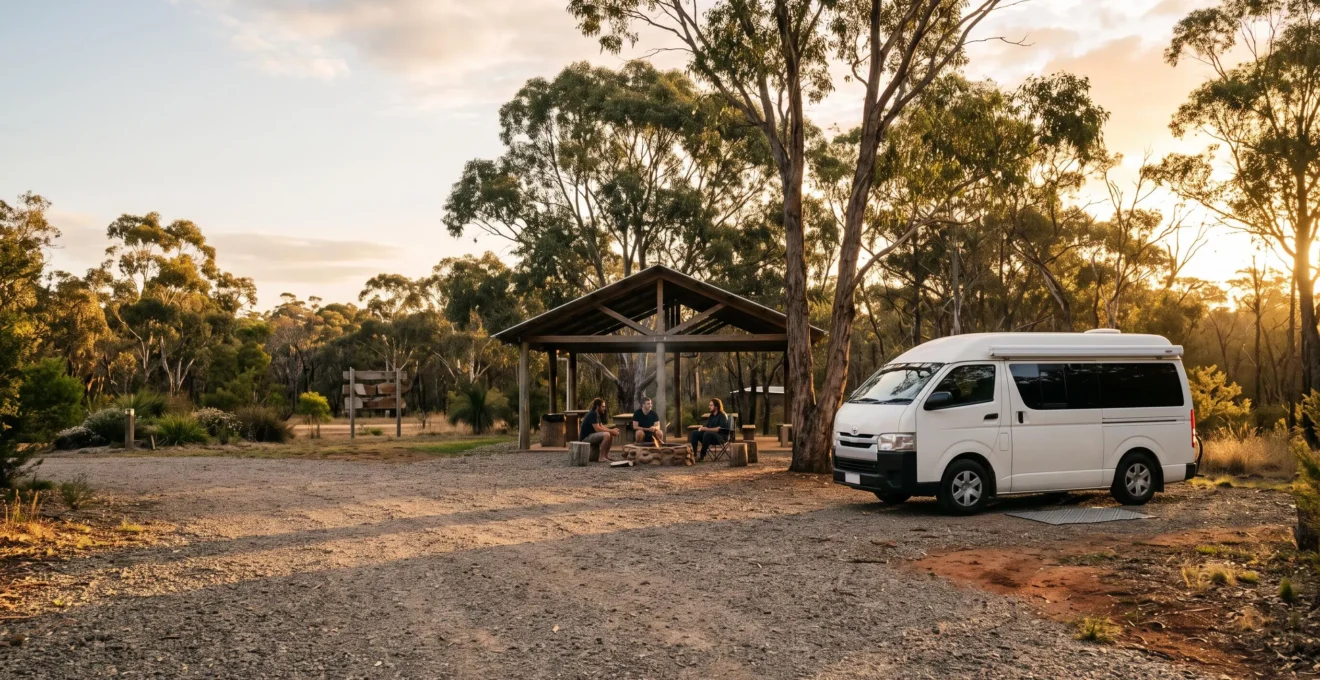
The best campervan park isn’t the one with the longest list of amenities; it’s the one whose facilities are intelligently designed to create the specific travel experience you’re looking for.
- Decode a park’s target audience by looking for « structural clues » like adults-only pools versus family splash pads.
- Analyse the camp kitchen’s event schedule—programmed happy hours signal a social hub, while their absence suggests a more functional, transient space.
- Match your rig’s capabilities (self-contained or not) to the site type to strategically balance budget with comfort.
Recommendation: Master an « accommodation rhythm » by alternating between feature-rich holiday parks for community and recharging, and free camps for solitude, to create a richer, more balanced Australian road trip.
The allure of a campervan trip through Australia is rooted in freedom—the open road, the shifting landscapes, the promise of serendipitous connections. Yet, many travellers find this dream hitting a wall when they pull into a holiday park that feels sterile, mismatched, or simply like an overpriced car park. The common advice is to look at a checklist of facilities: does it have a pool, a kitchen, a laundry? This approach, however, misses the most critical element: the park’s DNA. It’s not about *what* facilities a park has, but *how* they are designed, managed, and used by its inhabitants.
Choosing a park is less like ticking boxes and more like reading a language. The layout of the amenities, the rules in the fine print, and the events on the calendar are all clues that reveal a park’s true character. Is it a bustling social hub engineered for interaction, a quiet sanctuary for couples, or a high-turnover base for families on the move? The key isn’t finding a park with « good » facilities, but one with the *right* facilities for your style of travel. This guide moves beyond the brochure to teach you how to decode a park’s structural and social signals, ensuring you don’t just find a place to park, but a place to connect and thrive.
This article will provide a specialist’s framework for assessing campervan parks. We will explore the unique community culture in Australian parks, learn how to identify a park’s vibe before you arrive, weigh the critical choice between powered and unpowered sites, and understand the booking mistakes that can derail your plans. By the end, you’ll be equipped to choose accommodation that actively enhances your journey.
Summary: A Guide to Choosing Campervan Holiday Parks
- Why Australian Campervan Parks Build Traveler Communities European Campgrounds Don’t Match
- How to Identify Family-Friendly or Adult-Only Campervan Parks Before You Book
- Powered or Unpowered Sites: Which Campervan Park Option Suits Your Rig and Budget?
- The Holiday Park Booking Mistake That Leaves You Without Sites During Peak Seasons
- When to Stay in Holiday Parks for Community or Seek Free Camping for Solitude?
- Why Mixing Accommodation Types Delivers Better Australian Experiences Than One Category
- Basic Campervans or Fully Equipped Motorhomes: Which Rental for Your Australian Route?
- How to Hire Campervans Suited to Australian Conditions Without Overpaying for Unused Features?
Why Australian Campervan Parks Build Traveler Communities European Campgrounds Don’t Match
The Australian love affair with road travel is a significant cultural and economic force. It’s an industry where Australians took 17.3 million caravan and camping trips in a single year, spending billions. This sheer scale fosters a different kind of campground. Unlike many European sites designed for short, functional stopovers, Australian holiday parks have evolved into destinations in their own right, with a unique focus on building a programmed community. This isn’t about leaving social connection to chance; it’s about actively engineering it.
The quintessential example is the evolution of the camp kitchen. In many places, it’s a simple, utilitarian space. In Australia, it is often the vibrant, beating heart of the park. Park management deliberately uses these spaces as social engines. For instance, at many BIG4 parks, the large camp kitchen and barbecue area becomes a bustling social setting at mealtimes. At some locations, it’s the designated venue for a regular Friday night happy hour or a communal pancake breakfast. These aren’t just amenities; they are scheduled events designed to turn strangers into temporary neighbours.
This approach transforms a functional facility into a social hub. It creates a predictable, low-pressure environment for travellers to connect, share stories, and offer advice. Understanding this concept is the first step in assessing a park’s value beyond its price. You are not just paying for a patch of grass and a power outlet; you’re often investing in a curated social environment.
As seen in the lively atmosphere of a communal kitchen, these spaces are designed for interaction. The choice to centralize cooking and dining encourages travellers to step outside their vans and engage, which is a fundamental difference in the philosophy of Australian park design compared to many of their international counterparts. It’s a structural clue that the park values community over complete privacy.
How to Identify Family-Friendly or Adult-Only Campervan Parks Before You Book
Once you understand that parks are designed with a specific guest in mind, the next skill is learning to identify that target audience from afar. A park’s website will rarely state « we prefer quiet couples over large families, » but the clues are embedded in the park’s design and marketing. Your task as an assessor is to look for these structural clues that reveal the intended demographic long before you read a single guest review. The most obvious signal is the architecture of leisure spaces, particularly the swimming pools.
For example, a park that advertises a single, large resort-style pool with a nearby playground is clearly catering to families. In contrast, a park with what it calls an « adults-only ‘Sanctuary' » or a separate quiet pool is sending a clear message that it values and protects adult-oriented tranquility. Esk Caravan Park in Queensland, for instance, explicitly invites guests to choose between the « family pool » and the « tropical adults-only ‘Sanctuary’. » This physical division of space is a powerful indicator of the park’s DNA and the experience it aims to provide.
Beyond the pool, scrutinize the photo galleries on booking sites. Are the images dominated by kids on jumping pillows and in splash pads, or do they feature couples sitting around fire pits and clinking glasses? The people featured in the marketing are a direct signal of who the park considers its ideal customer. By combining these visual cues, you can build an accurate profile of a park’s atmosphere.
This table breaks down the key signals to look for when trying to determine if a park aligns with your desire for a vibrant family atmosphere or a peaceful adult retreat.
| Signal | Family-Friendly Park | Adult-Oriented Park |
|---|---|---|
| Pool setup | Shared family pool with playground nearby | Separate adults-only zone or ‘Sanctuary’ pool |
| Camp kitchen events | Pancake breakfasts, kids’ activities | Friday night happy hour, live entertainment |
| Photo feed content | Children, splash areas, family groups | Couples, fire pits, adult social gatherings |
Powered or Unpowered Sites: Which Campervan Park Option Suits Your Rig and Budget?
The choice between a powered and an unpowered site seems simple: one offers convenience, the other saves money. However, the decision has deeper implications for your budget, comfort, and overall travel rhythm. The financial incentive is significant; a traveller staying in caravan parks every night can expect to spend $400–$700+ per week, while a strategic mix of sites can lower that to $200–$400. To unlock these savings, you must first conduct an honest assessment of your vehicle’s off-grid capabilities.
Opting for an unpowered site is only viable if your campervan is genuinely equipped to handle it. This means having a robust 12V battery system, ideally supplemented by solar panels, to run your fridge, lights, and water pump. It also means having sufficient water storage and, crucially, being certified as « self-contained » if you plan to mix park stays with free camping. A truly self-contained rig gives you the ultimate flexibility, but it’s a term that requires careful definition in Australia.
Instead of viewing it as an all-or-nothing choice, think in terms of an « accommodation rhythm. » The smartest strategy for many is to alternate between site types. Spend a few nights on unpowered sites or at free camps, then book a powered site for a night or two. This allows you to fully recharge your batteries, do laundry, enjoy a long hot shower, and empty your greywater and toilet cassettes at a dump station. This rhythm provides the perfect balance of cost-saving, freedom, and creature comforts. Before you can plan this rhythm, you must know your vehicle inside and out.
Your Off-Grid Capability Checklist: A Pre-Booking Self-Audit
- Confirm Self-Containment: Does your van legally qualify? In Australia, this requires an onboard toilet, and separate freshwater and greywater tanks with sealed waste storage.
- Assess Power Reserves: Evaluate your battery bank capacity (in Amp-hours) and solar input (in watts) against the power draw of your essential appliances like the fridge and lights. Can you last 2-3 days without shore power?
- Plan Your Rhythm: Don’t commit to a single site type. It’s recommended to alternate between freedom camping and powered sites every few days to recharge amenities and manage waste systems properly.
- Run the Numbers: Compare the nightly price difference between a powered and unpowered site at your target park. Does this saving justify the upfront cost of any off-grid gear (like solar panels) you might need?
The Holiday Park Booking Mistake That Leaves You Without Sites During Peak Seasons
There’s nothing more frustrating than meticulously planning a route only to find there are no available sites, especially during school holidays, long weekends, or the summer peak season. The most common mistake isn’t a lack of planning, but a misunderstanding of a critical park policy: the minimum stay requirement. While you might prefer short, one or two-night stops, many popular parks won’t even consider your booking for less than a set period during high demand times.
These requirements can be surprisingly strict. A park might have a standard one-night minimum in the off-season, but this can jump dramatically when demand is high. For example, it is common for parks to enforce policies where the peak summer requires a minimum stay of 7 nights, school holidays mandate 4 nights, and even a long weekend might require a 3-night booking. This policy is designed to maximize occupancy and revenue for the park, but it can completely disrupt the plans of a touring traveller.
This exact issue is a frequent source of frustration for many on the road, who find their desired travel style is incompatible with park rules during the most popular times to travel. As one traveller noted:
We tend to travel in our van, preferring to stay 1-2 nights in one place, not park our van at an expensive caravan park for 3-7 nights minimum, which I am finding I am coming up against especially during school holidays.
– expandasdownunder.com Forum Member
A second, related mistake is what can be called « platform exclusivity blindness »—relying solely on one major booking app or aggregator. Many smaller, independent, or family-run parks do not list their inventory on these platforms at all. To get a true picture of availability, you must broaden your search. Always check the park’s own website for the most accurate information and consider calling them directly. Furthermore, searching the websites of local tourism associations can uncover hidden gems that operate outside the major booking networks, potentially offering more flexible terms.
When to Stay in Holiday Parks for Community or Seek Free Camping for Solitude?
The Australian road trip is a tale of two desires: the search for vibrant community and the longing for profound solitude. Your choice of where to park your van each night directly serves one of these needs. Holiday parks are the epicentres of community, while free camping (or « freedom camping ») is the gateway to solitude. The data shows that most trips are relatively short and leisure-focused, with 77% of caravan and camping trips taken for holidays and averaging just 3.7 nights. This trend makes full-featured holiday parks the logical and popular choice for the majority.
Holiday parks offer a safety net of services, social opportunities, and security. They are the ideal choice when you need to recharge—both your batteries and your social energy. They provide the infrastructure for a comfortable and connected experience. Free camping, on the other hand, is about stripping that all away. It’s about immersing yourself in nature, away from the crowds, and being fully self-reliant. It offers unparalleled views and a deep sense of peace that no holiday park can replicate.
However, this solitude comes with responsibilities and risks. Before venturing off-grid, a thorough risk assessment is non-negotiable. Free camping in Australia exposes you to sudden weather changes and unexpected encounters with wildlife. Furthermore, many remote and beautiful locations have no mobile phone or internet service, making physical maps and a reliable communication plan essential. You must also be diligent about compliance, ensuring your vehicle is certified self-contained to avoid significant fines, and plan your resources carefully, knowing you’ll eventually need a paid park to manage waste and power.
The most rewarding journeys often find a rhythm between these two extremes. They use holiday parks as strategic bases for comfort and community, interspersed with forays into the wild for solitude and adventure. The key is not to choose one over the other, but to know when to seek out each type of experience to create a balanced and memorable trip.
Why Mixing Accommodation Types Delivers Better Australian Experiences Than One Category
Committing to a single category of accommodation for an entire Australian road trip is a strategic error. A far better approach is to develop an « accommodation rhythm, » strategically mixing stays in full-featured holiday parks, basic national park campgrounds, and designated free camps. This hybrid model allows you to tailor your lodging to your location, activities, and budget, creating a richer and more adaptable travel experience. Australia’s sheer size and geographical diversity demand this flexibility.
The vast majority of the country’s iconic landscapes are located outside of major cities. In fact, an overwhelming 91% of camping holiday nights are spent in regional Australia. In these areas, infrastructure can be sparse. A basic campervan that relies on park facilities may be perfect for a coastal trip hopping between well-serviced towns, but it can become a liability in the Outback or remote national parks where campgrounds are rudimentary at best. For these stretches, a more self-sufficient vehicle is not a luxury, but a necessity.
This is where matching your vehicle to your route becomes paramount. As experts advise, the type of rig you need is dictated by the journey you’re undertaking. The National Geographic Traveller (UK) puts it succinctly when discussing vehicle choice for remote travel:
Larger campervans, often with built-in kitchens and bathrooms, are more comfortable, especially for long trips through the outback… if you’re staying on rudimentary campsites, such as in some national parks, you’ll be more comfortable with built-in bathroom facilities.
– National Geographic Traveller (UK), A practical guide to campervanning in Australia
Therefore, your accommodation strategy should be fluid. Use full-service holiday parks in populated areas to enjoy the community and amenities. When you venture into a national park, your self-contained motorhome allows you to stay comfortably at a basic site close to the trails. When you find a beautiful, remote free camp, your setup allows you to enjoy the solitude for a night or two. This mix-and-match approach ensures you always have the right level of comfort and self-sufficiency for your environment.
Basic Campervans or Fully Equipped Motorhomes: Which Rental for Your Australian Route?
The vehicle you hire is the single biggest factor determining your accommodation choices and overall travel style. The decision between a basic campervan (like a JUCY Crib or a converted van) and a fully-equipped, self-contained motorhome is not just about budget; it’s about the very nature of the experience you want to have. Each vehicle type is designed for a different kind of journey and a different relationship with your surroundings.
A basic campervan is often more nimble, easier to drive on narrow coastal roads, and can fit into tighter campsites. However, it creates a high dependency on park facilities. You’ll be using the communal camp kitchen to cook and the amenity block for showers and toilets. This forces an « exterior » lifestyle, encouraging you to be outside your van and interacting with the park’s community and environment. It’s an excellent choice for social travellers and those sticking to well-serviced coastal routes.
A fully-equipped motorhome, conversely, is your self-sufficient bubble. With an internal kitchen, shower, and toilet, it offers maximum privacy and freedom from park infrastructure. This makes it ideal for tackling the Outback, staying in remote national parks, or simply for travellers who prefer a more private, « interior » living experience. Its larger size can make it less agile, but it grants you the ability to be comfortable almost anywhere. The choice fundamentally shapes your social exposure and your dependency on paid campgrounds.
This table summarizes the essential trade-offs, helping you align your vehicle choice with your desired travel style and intended route.
| Criteria | Basic Campervan | Fully-Equipped Motorhome |
|---|---|---|
| Park dependency | High — relies on park kitchens/bathrooms | Low — self-sufficient on facilities |
| Road suitability | Narrow coastal roads, tight national park sites | Major highways, less agile in tight spaces |
| Social exposure | Encourages exterior living and interaction | Encourages interior living and privacy |
Key Takeaways
- The best Australian parks « program » community through social spaces like camp kitchens with scheduled events.
- Decode a park’s vibe by analyzing structural clues: separate adult pools signal a quiet park, while large family play areas signal a lively one.
- Adopt an « accommodation rhythm, » alternating between powered sites for recharging and unpowered/free camps for budget and solitude.
How to Hire Campervans Suited to Australian Conditions Without Overpaying for Unused Features?
Hiring the right campervan is a balancing act between features and cost. The most crucial—and often misunderstood—feature is « self-containment. » Paying the premium for a certified self-contained vehicle only makes sense if you understand what it legally unlocks and if you actually plan to use that freedom. In Australia, the definition is strict: the vehicle must have an onboard toilet, as well as separate freshwater and greywater tanks for storing waste. An external setup, like a portable toilet used in a tent, does not count.
Failing to meet this standard means you are legally prohibited from using the thousands of designated freedom camping spots across the country, and you risk a significant fine if caught. Therefore, the first step is to confirm the vehicle’s certification. The second is to weigh the rental premium against your planned itinerary. If you intend to stay in full-featured holiday parks every night, paying extra for self-containment is a waste of money. If you plan to embrace the « accommodation rhythm » and spend many nights at free camps, the feature pays for itself very quickly.
The financial savings unlocked by genuine self-containment are staggering for long-term travellers. By strategically using free camps, a traveller can dramatically reduce their accommodation expenses. The difference in cost between staying in parks every night versus mixing in free camps can be substantial. In fact, for a full-time traveller, the savings can range from $5,000 to $25,000 over a year on the road. This is the tangible financial return on investing in a properly equipped rig. When hiring, don’t be swayed by bells and whistles you won’t use. Focus on the core features that align with your intended route and accommodation style—and for Australia, self-containment is the feature that offers the greatest potential for both freedom and savings.
By moving beyond simple price comparisons and learning to decode the DNA of parks and vehicles, you transform your role from a mere tourist to a strategic traveller. You can now design a journey that perfectly balances community, solitude, comfort, and budget. Assess your needs, plan your rhythm, and choose the parks and vehicles that will not just house you, but actively enhance your Australian adventure.