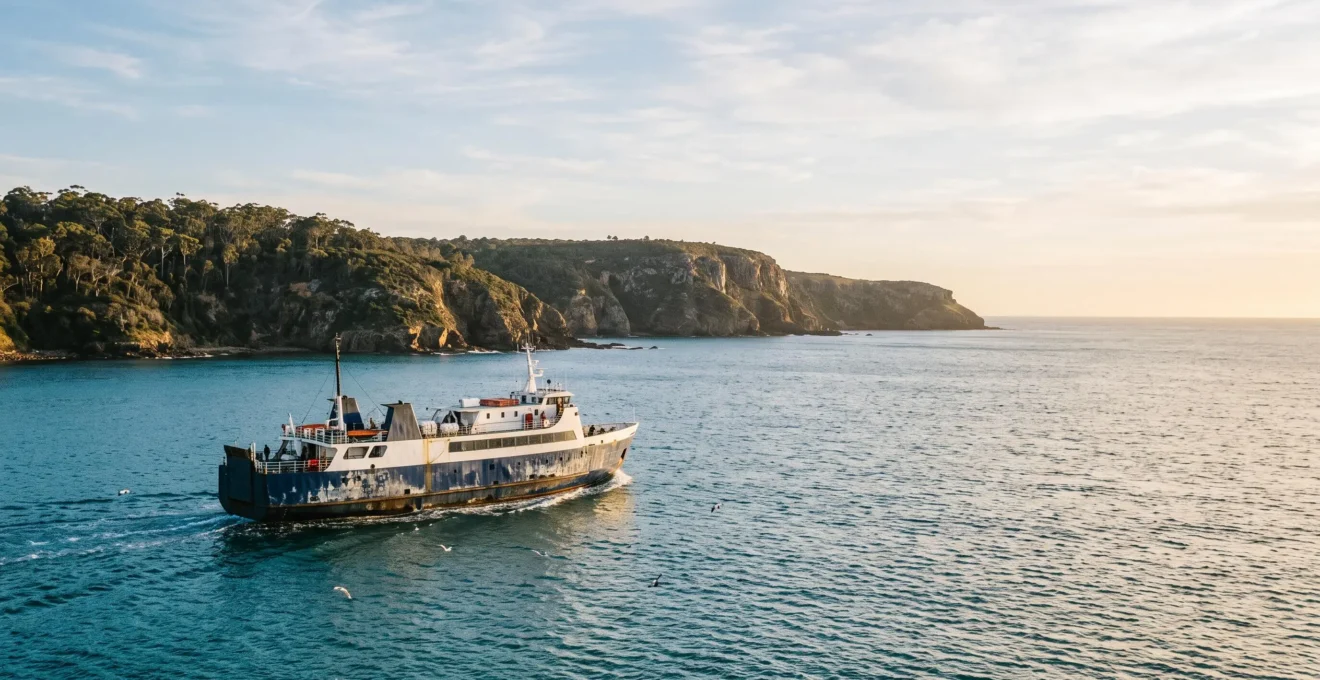
The key to successful Australian island travel is treating ferries as maritime logistics, not scenic cruises.
- Vehicle and passenger capacity is finite; peak season travel requires booking months in advance based on operational schedules, not just your holiday dates.
- Route choice dictates the experience: an overnight ‘mini-cruise’ to Tasmania versus a rapid, functional transfer to a Great Barrier Reef island.
Recommendation: Shift your mindset from a passive passenger to a proactive logistics planner, focusing on vessel capacity, seasonal conditions, and access control to build a truly seamless itinerary.
The vision of an Australian island-hopping adventure often involves sun-drenched decks and idyllic coastlines gliding by. For many travellers, the ferry is a romanticised part of this picture, a gentle transition to paradise. Yet this perception frequently clashes with the reality of sold-out vehicle decks, unexpectedly rough seas, and itineraries built on flawed assumptions. The common advice to « book early » or « check the weather » barely scratches the surface of the strategic planning required.
The truth is that Australia’s vast network of coastal and island ferries operates less like a tourist attraction and more like a critical piece of national infrastructure. These vessels are maritime bridges, governed by the unyielding principles of capacity management, seasonal weather patterns, and logistical efficiency. Understanding this is the first step toward mastering your journey. But what if the secret to a seamless trip wasn’t just about booking a ticket, but about fundamentally changing how you view the journey itself?
This guide abandons the tourist-brochure narrative. Instead, it provides a logistics-focused framework for navigating Australia’s ferry systems. We will deconstruct the difference between utilitarian transport and experiential journeys, provide actionable strategies for securing high-demand vehicle space, and analyse the critical factors—from swell height to resort access—that determine the success of your maritime travel. By adopting the mindset of a logistics specialist, you can transform potential travel headaches into a well-executed plan.
This article provides a complete logistical breakdown for planning your journey. Explore the sections below to understand the core principles of Australian ferry travel, from booking strategies to choosing the right experience for your goals.
Summary: A Logistics-Focused Guide to Australian Ferry Travel
- Why Australian Ferries Are Essential Island Transport, Not Scenic Cruise Alternatives?
- How to Book Vehicle Ferries to Tasmania and Islands Months Ahead for Peak Season Availability?
- Spirit of Tasmania or Reef Island Ferries: Which Australian Ferry Experience to Prioritize?
- The Ferry Booking That Ignores Rough Bass Strait Crossings and Motion Sickness Risk?
- When to Take Australian Coastal Ferries for Calm Seas and Marine Wildlife Encounters?
- Why Island Reef Resorts Deliver Better Marine Access Than Mainland Reef-Tour Bases?
- How to Combine Domestic Flights, Trains, and Coaches for Optimal Australian Routing?
- How to Choose Great Barrier Reef Resorts for Dive Access, Not Just Beach Lounging
Why Australian Ferries Are Essential Island Transport, Not Scenic Cruise Alternatives?
The most common mistake travellers make is viewing all ferries through the same lens. In reality, an Australian ferry can be anything from a workhorse commuter vessel to a destination in its own right. The key is to identify the primary purpose of your intended route. Is it a functional ‘maritime bridge’ for vehicles and supplies, or is it a curated ‘experiential journey’? Confusing the two leads to mismatched expectations and poor planning.
For example, the public ferry network in Sydney is a model of utilitarian efficiency. It’s a core part of the city’s transport infrastructure, with Sydney’s public ferry fleet carrying over 15 million passengers annually for commuting and budget sightseeing. In contrast, the Spirit of Tasmania is an experiential journey, an overnight mini-cruise designed to bridge the mainland and a Tasmanian road trip. Then there are purely functional connectors, like the SeaLink ferry to Kangaroo Island, where the 45-minute crossing is a means to an end: getting your vehicle and yourself to the island as efficiently as possible.
Understanding this distinction is fundamental. Expecting cruise-ship level amenities on a short, functional crossing is unrealistic. Likewise, treating an overnight experiential ferry as a simple ‘bus ride’ means missing out on the unique features of the journey. The first step in your logistical planning is to correctly categorize the ferry you intend to take.
To help with this crucial first step in your planning, this table breaks down the different categories of ferry services you’ll encounter across Australia.
| Ferry Category | Example Route | Primary Purpose | Passenger Experience |
|---|---|---|---|
| Utilitarian Connector | Kangaroo Island SeaLink (Cape Jervis–Penneshaw) | Essential vehicle & passenger logistics | 45-minute crossing, functional, vehicle-deck priority |
| Scenic Commute | Sydney F1 Manly Ferry | Budget sightseeing / daily commuting | 30-minute harbour transit past the Opera House and Harbour Bridge at a flat fare |
| Experiential Journey | Spirit of Tasmania (Geelong–Devonport) | Mini-cruise / road-trip bridge | 9–11 hour overnight crossing with cabins, dining and entertainment |
This framework allows you to manage expectations and align your travel goals with the right service, preventing disappointment and ensuring a smoother journey.
How to Book Vehicle Ferries to Tasmania and Islands Months Ahead for Peak Season Availability?
Securing a spot for your vehicle on a popular Australian ferry during peak season is a lesson in supply and demand. These are not limitless services; they are vessels with finite vehicle deck space. For routes like the Spirit of Tasmania, which connects the mainland to an entire state, this capacity is booked out months, sometimes even a year, in advance for Christmas, Easter, and school holiday periods.
The scale of these operations is immense; for instance, the current Spirit of Tasmania fleet already operates over 850 sailings a year, and new, larger ships are being introduced to cope with demand. However, even with these upgrades, the principle remains: deck space is a scarce resource during popular travel windows. This is also true for island services like those to Kangaroo Island or North Stradbroke Island, especially on long weekends or during local events.
Case Study: SeaLink’s Fleet Renewal
In 2026, SeaLink South Australia is set to christen Wanggami, the first of two new vessels forming part of a $57 million investment in renewing the Kangaroo Island ferry service. This capacity upgrade illustrates a critical point for the logistics-minded traveller: booking windows and vessel availability are not static. They shift year to year based on fleet upgrades, maintenance schedules, and demand. Monitoring operator announcements is crucial when planning peak-season vehicle crossings well in advance.
Thinking like a logistics planner means you don’t just book for your holiday dates; you book based on capacity availability. This may involve shifting your travel dates by a few days, or even a week, to find a sailing with vehicle space. Flexibility is your greatest asset. Waiting until the last minute is a recipe for being stranded on the wrong side of the water.
Action Plan: Securing Your Ferry Booking
- Book as early as possible, as ferries fill quickly during peak periods. Monitor booking release dates from the operator.
- If vehicle space is unavailable, immediately investigate the fallback plan: hiring a car on the island.
- Schedule your arrival at the terminal for at least 30 minutes before departure to allow for check-in and boarding queues.
- Before finalizing payment, review the cancellation policies for both the ferry and your accommodation to understand your financial risk.
- Check the ferry operator’s website for scheduled annual maintenance periods (often mid-year), which can reduce service capacity.
This proactive approach separates the successful planner from the disappointed traveller, ensuring your vehicle has a guaranteed place on board.
Spirit of Tasmania or Reef Island Ferries: Which Australian Ferry Experience to Prioritize?
The choice between a long-haul ferry like the Spirit of Tasmania and a short-hop reef ferry is not a simple comparison of routes; it’s a fundamental decision about the role of the journey in your overall trip. Your priority should be determined by a single question: Is the journey the destination, or is the destination the only thing that matters?
The Spirit of Tasmania is firmly in the ‘journey as destination’ category. It’s an experience in itself, a mini-cruise where the 9-11 hours spent crossing Bass Strait are part of the holiday. Passengers choose between day and night sailings, book cabins, enjoy onboard dining, and watch a movie. The vessel is designed for a comfortable, extended stay. This is the choice for the traveller who wants to seamlessly transition their mainland road trip to Tasmania without the hassle of airports and car rentals.
Conversely, the high-speed catamarans that service the Great Barrier Reef islands are the epitome of ‘destination is the point’. The goal is to minimize transit time and maximize time on the reef or island. These are functional, rapid transfers. The experience is about the wind in your hair and the anticipation of arrival, not about lingering onboard. You prioritize this type of ferry when your objective is diving, snorkelling, or relaxing at an island resort, and the boat is simply the necessary tool to get you there.
For a major undertaking like the Spirit of Tasmania, even the time of day can fundamentally alter the experience. The choice between a day or night sailing is a significant logistical decision.
| Aspect | Day Sailing | Night Sailing |
|---|---|---|
| Availability | September to April only | Operates year-round |
| Passenger volume | Busier, family-oriented | Typically quieter, fewer passengers, more relaxed atmosphere |
| Onboard experience | Daylight views of Bass Strait from the deck, full use of entertainment and facilities | Sunset sail, dinner, a movie, then retiring to a cabin and waking at the destination |
Prioritizing the right type of ferry journey ensures your expectations are aligned with reality, setting the stage for a successful and enjoyable trip.
The Ferry Booking That Ignores Rough Bass Strait Crossings and Motion Sickness Risk?
Booking a ferry, especially across notoriously temperamental waters like the Bass Strait, without consulting a detailed marine forecast is a significant gamble. The generic advice to « check the weather » is insufficient. A sunny day does not guarantee a calm sea. For the logistics-minded traveller, understanding the difference between weather and sea state is crucial to mitigating the risk of a deeply uncomfortable journey.
The primary culprits of motion sickness are not rain or wind, but ocean swell. Swell is the energy moving through the water, creating long, rolling waves that can persist long after the storm that created them has passed. A large swell hitting the ferry on its side (a ‘beam sea’) will produce a corkscrewing motion that is particularly challenging for passengers. Therefore, the key metrics to check on a marine forecast are not just wind speed, but also swell height and swell direction.
Australia’s Bureau of Meteorology provides detailed marine forecasts that are invaluable for this purpose. Before booking, a savvy planner will look at the multi-day forecast for the specific crossing area, paying close attention to these factors. If you are prone to motion sickness, it is far better to book during a predicted calmer window, even if it means adjusting your itinerary. For Bass Strait, it’s widely acknowledged that the calmest sailing window falls between December and May, when long-period swell is generally less pronounced.
To avoid a rough crossing, you need to learn how to interpret a marine forecast like a ship’s captain. Look for these key indicators:
- Swell Height: Anything over 3-4 metres suggests a significant and potentially uncomfortable swell.
- Swell Direction: Check the direction relative to the ship’s course. A southwesterly swell is more likely to create a beam sea for the Spirit of Tasmania.
- ‘Seas’ vs ‘Swell’: ‘Seas’ refers to local, wind-driven chop, while ‘swell’ refers to the powerful, long-period ocean waves. Swell is the more critical factor for a large vessel.
- Wind Speed: Sustained winds above 20-25 knots will contribute to a rougher sea state and can make being on the outer decks unpleasant.
This level of analysis transforms your booking from a hopeful guess into a calculated logistical decision, significantly increasing your chances of a smooth and enjoyable crossing.
When to Take Australian Coastal Ferries for Calm Seas and Marine Wildlife Encounters?
Just as you schedule a Bass Strait crossing to avoid winter swells, you can schedule coastal ferry journeys to maximize the chances of marine wildlife encounters. This is where the logistics planner’s mindset pays dividends, turning a simple transit into a potential whale-watching expedition. The key is to align your travel dates with the predictable migration patterns of marine megafauna.
The east coast of Australia is a major highway for humpback whales as they travel north to warmer breeding grounds and then south again with their calves. This creates a long and predictable viewing season. For travellers on ferries along the Queensland coast, this means that a journey taken between June and November has a high probability of including whale sightings. According to tour operators, the 2026 whale watching season runs from June through November along the Queensland coast, offering a wide window for opportunistic sightings from ferries and dedicated tours alike.
However, a true logistics planner will go a level deeper. Different regions along the coast have different peak seasons. For instance, Hervey Bay is renowned as a resting place for mothers and calves on their southern journey, making its July-October peak particularly special. Further north, the waters off Cairns are famous for encounters with the smaller, inquisitive Dwarf Minke whales, with a peak season in June and July. By cross-referencing your ferry route and travel dates with these specific regional peaks, you can dramatically increase your chances of a memorable encounter.
To optimize your chances, it’s essential to understand the regional nuances of the whale migration season along Queensland’s ferry routes.
| Region | Peak Season | Notable Species |
|---|---|---|
| Hervey Bay | July–October | Humpback whales (regarded as Australia’s whale-watching capital) |
| Cairns & Port Douglas | June–September (Minke peak June–July) | Dwarf Minke whales, migrating humpbacks |
| Townsville / Gold & Sunshine Coasts | June–November | Humpback whales along the migration corridor |
This strategic timing transforms a simple ferry transit into a cost-effective opportunity for one of nature’s greatest spectacles.
Why Island Reef Resorts Deliver Better Marine Access Than Mainland Reef-Tour Bases?
When planning a trip to the Great Barrier Reef, a critical logistical decision is whether to base yourself on the mainland (e.g., Cairns, Port Douglas) or stay at an island resort. While mainland bases offer more choice in accommodation and dining, island resorts hold a powerful, often overlooked advantage: superior access control to the marine environment. Staying on an island effectively buys you time and proximity to the reef’s best sites.
Mainland-based day tours are subject to a strict schedule. A significant portion of the day is consumed by the return boat journey, which can be 90 minutes or more each way. This limits your actual time in the water and concentrates activity at a few high-traffic pontoon sites. In contrast, staying at an island resort like those on Lizard Island, Heron Island, or Lady Elliot Island places you directly within the marine park. You can snorkel or dive straight off the beach, join half-day boat trips to exclusive nearby sites, and experience the reef at dawn or dusk—times when the day-trippers are long gone.
This exclusivity and superior access come at a price, of course. Rates are higher because you are not just paying for a room; you are paying for a prime logistical position. While mainland tours offer value, the experience can be crowded. The premium paid for an island resort is an investment in crowd-free access and more intimate marine encounters. It is a strategic trade-off between budget and quality of access.
Case Study: The Gateway-Control Model
The dynamic of reef access is mirrored in other Australian ferry networks. For example, SeaLink holds a long-term lease on the Cape Jervis ferry terminal, giving it near-exclusive control over vehicle sea access to Kangaroo Island. This illustrates a broader pattern: whoever controls the terminal, private jetty, or landing rights effectively controls access to the destination’s most pristine and less-crowded sites. Island resorts operate on this same principle, using their private jetties as gateways to a superior reef experience that day-trippers from the mainland simply cannot match.
Ultimately, the choice depends on your priority: if maximizing time and quality of experience on the reef is your goal, the logistical advantage of an island resort is undeniable.
How to Combine Domestic Flights, Trains, and Coaches for Optimal Australian Routing?
An Australian holiday rarely relies on a single mode of transport. The sheer scale of the country demands a multi-modal approach, where ferries are just one piece of a larger logistical puzzle. The savvy traveller doesn’t think in terms of separate trips but orchestrates a seamless flow between flights, trains, coaches, and ferries to maximize efficiency and minimize cost and hassle.
The most classic example of this is the Tasmania-mainland connection. Many travellers fall into the trap of thinking it’s an either/or choice: either fly to Tasmania and rent a car, or take your own car on the Spirit of Tasmania. A logistics-focused mindset sees the third option: a combined itinerary. You might drive the Great Ocean Road, put your car on the overnight ferry from Geelong to Devonport, tour Tasmania, and then fly from Hobart back to your starting point on the mainland, shipping the car back separately or as part of a one-way rental agreement. This avoids a lengthy return drive and allows you to use different entry and exit points.
Case Study: Avoiding Redundant Costs
A family planning a Tasmanian road trip can leverage the Spirit of Tasmania to eliminate several costs associated with a fly-and-rent model. By taking their own vehicle, they avoid the cost of flights for the whole family, the expense of a large rental vehicle, and often exorbitant fees for extras like child seats or extra insurance. Furthermore, there are no restrictive airline baggage limits; they can pack the car with everything needed for the trip. The ferry ticket cost is offset by these significant savings, turning the journey itself into a value proposition.
This principle extends to smaller islands. For Kangaroo Island, the choice is between a 45-minute ferry crossing from Cape Jervis or a short flight from Adelaide. A multi-modal approach might involve flying to the island to save time, hiring a car for a few days, and then taking the ferry back to the mainland to continue a road trip along the Fleurieu Peninsula. The key is to see each transport link not in isolation, but as a component in a flexible, interconnected network.
By thinking about the entire journey holistically, you can design an itinerary that is more efficient, cost-effective, and enjoyable.
Key Takeaways
- Ferries Are Logistics: Reframe your view from ‘scenic cruise’ to ‘maritime bridge’. The function of the ferry—utilitarian, scenic, or experiential—dictates the entire experience.
- Plan for Capacity: Book vehicle ferries based on available deck space and seasonal demand, not just your preferred dates. Flexibility is your most valuable asset.
- Prioritize Your Goal: Decide if the journey is the destination (e.g., Spirit of Tasmania) or simply a means to get there (e.g., Reef Island transfers). This single choice will define your itinerary.
How to Choose Great Barrier Reef Resorts for Dive Access, Not Just Beach Lounging
For the serious diver or snorkeller, choosing a Great Barrier Reef resort is a critical logistical decision that extends far beyond the quality of the poolside cocktails. The primary consideration should be the quality and type of dive access the resort provides. Many beautiful island resorts are geared more towards general tourism and beach relaxation, with limited or outsourced diving operations. A true dive-focused traveller must look deeper.
The first step is to investigate the resort’s on-site dive operation. Does it have its own dedicated dive centre, boats, and instructors? Or does it simply act as a booking agent for a mainland operator? An in-house operation is almost always superior, offering more flexibility, smaller group sizes, and access to exclusive, less-crowded local dive sites. They can cater to different experience levels and often offer advanced courses or specialized dives (e.g., night dives, shark dives) that are impossible on a standard day trip.
The ultimate dive-access model is the liveaboard vessel, which essentially functions as a floating hotel and dive centre. As a case in point, some Great Barrier Reef dive operators run multi-night liveaboard trips departing from Cairns. This model combines the transfer journey with the diving experience, eliminating the ‘commute’ to the reef altogether. This approach, often used for Dwarf Minke whale and Coral Sea shark dive expeditions, demonstrates how the transfer can be fully integrated into the core experience for maximum efficiency. For divers, this offers unparalleled access to remote outer reefs, with the ability to do multiple dives per day. In the dry season, these efforts are rewarded, as dry-season conditions can deliver visibility of up to 30 metres.
When researching resorts, look for key indicators of a strong dive focus: a comprehensive dive menu on their website, guest reviews that specifically mention the quality of the dive team and sites, and PADI 5-star certification. Don’t be swayed by generic promises of « reef access »; demand specifics about the logistics of getting in the water.
Apply this logistical framework to your resort selection and transform your Great Barrier Reef trip from a simple holiday into a world-class diving expedition.