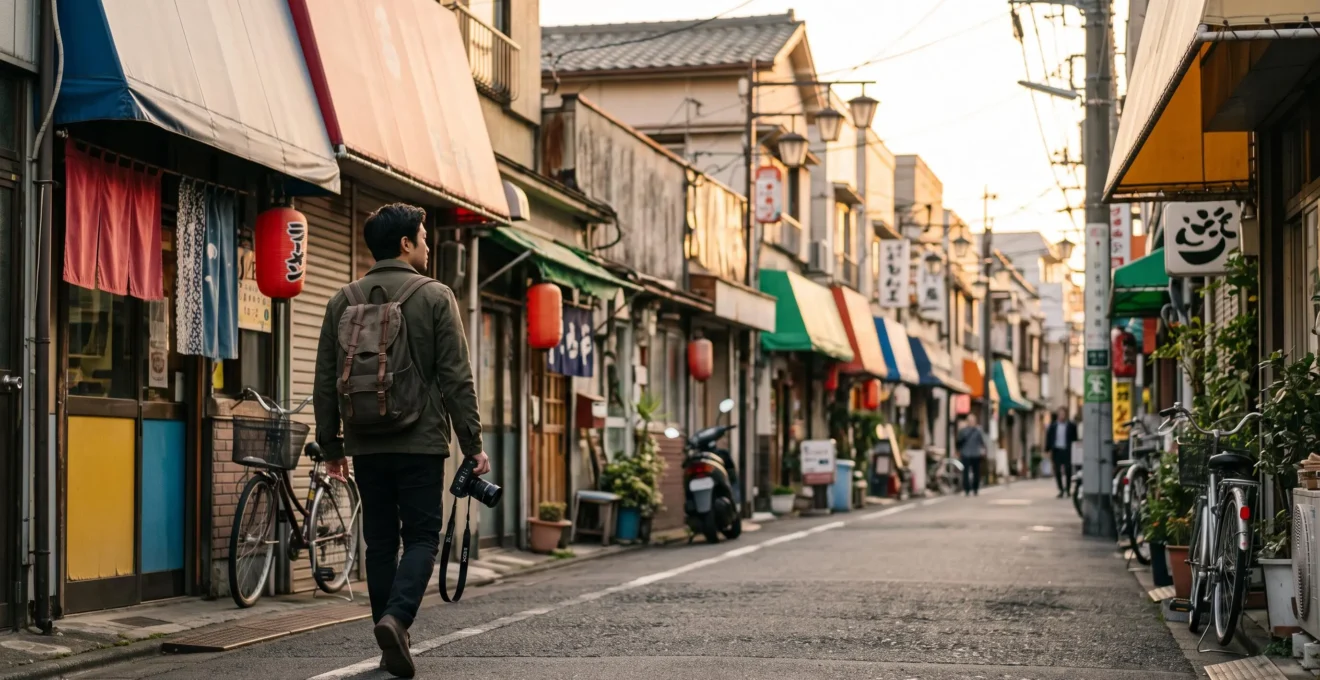
To authentically experience Australia’s multicultural neighborhoods, you must shift from being a ‘food tourist’ to a ‘cultural ecologist’—understanding these places as living systems, not just culinary destinations.
- Australia’s multiculturalism is a result of deliberate post-1973 policy, creating integrated communities rather than isolated ethnic ghettos.
- Respectful exploration involves intentional spending at local businesses and recognizing your presence can either support or displace the community.
Recommendation: Prioritize everyday immersion over crowded festivals and learn to recognize modern Australian cuisine as a unique Asian-Indigenous fusion, not a relic of British fare.
For many travelers, exploring Australia’s multicultural suburbs means one thing: food. It’s a journey through pho-scented laneways in Melbourne or spice-filled markets in Sydney, a quest for the most « authentic » banh mi or baklava. This approach, while delicious, often reduces vibrant, living communities to a consumable checklist. It treats neighborhoods as theme parks and their residents as extras in a culinary show. The common advice to « be respectful » and « talk to locals » feels hollow without a deeper understanding of the context.
But what if the key to a truly profound experience wasn’t just about what you eat, but about *how* you see? The real story of these neighborhoods isn’t just in their restaurants; it’s in their history, their social fabric, and the delicate balance they maintain against urban pressures. Australia’s multicultural landscape is fundamentally different from the historic ethnic quarters of Europe or North America, shaped by a unique and relatively recent history of immigration.
This guide offers a different perspective. It asks you to become a cultural ecologist, not a tourist. It’s about learning to read the landscape—to understand the forces that shaped these communities, to recognize the subtle signs of both resilience and gentrification, and to make choices that genuinely support the people who call these places home. By understanding the ‘why’ behind the ‘what’, you move beyond mere consumption and towards meaningful cultural exchange. This article will deconstruct what makes these neighborhoods unique, provide a framework for respectful exploration, and redefine what Australian cuisine truly is today.
To guide you on this journey from tourist to cultural ecologist, this article is structured to build your understanding step by step. Below is a summary of the key areas we will explore to equip you with the knowledge for a more respectful and enriching experience.
Summary: A Guide to Respectful Cultural Exploration in Australia
- Why Australian Multicultural Neighborhoods Feel Different from European Ethnic Quarters
- How to Explore Multicultural Neighborhoods Respectfully, Not as a Cultural Tourist Attraction
- Cabramatta or Footscray: Which Multicultural Neighborhood Delivers Genuine Asian-Australian Life?
- The Gentrification Pattern That Kills Authentic Ethnic Neighborhoods Within 10 Years
- When to Visit Multicultural Neighborhoods for Festivals or Everyday Cultural Immersion?
- Why Australian Food Is Now Asian-Indigenous Fusion, Not British Pub Fare
- Why Residential Neighborhood Stays Reveal More Real Australia Than CBD Hotels
- How to Recognize Australian Cuisine as Fusion Innovation, Not British Colonial Food
Why Australian Multicultural Neighborhoods Feel Different from European Ethnic Quarters
Unlike the centuries-old ethnic quarters of European cities, which often grew from segregated working-class districts, Australia’s most vibrant multicultural hubs are a product of a more modern, deliberate policy. The key difference lies in their formation. Many were not born from exclusion but from a conscious national pivot towards multiculturalism. The real turning point came with a policy shift that valued cultural maintenance over forced assimilation, shaping communities that are integrated and porous rather than walled-off.
This unique character is a direct result of a post-war migration strategy that culminated in a landmark policy change. Evidence shows that Australia’s multicultural society was profoundly shaped by decisions made in the latter half of the 20th century. The idea was not to create isolated pockets of foreign cultures, but to weave new threads into the national fabric. This is why you often find a Vietnamese bakery next to a classic Aussie butcher shop, or an Italian café across from a Lebanese greengrocer—it’s a layered identity, not a monolithic one.
This history is crucial because it changes how you should approach these spaces. They are not historical curiosities or ghettos preserved in time. They are dynamic, evolving residential suburbs where daily life happens. Understanding that their existence is a relatively recent and celebrated outcome of policy—specifically, since the 1973 Universal Migration Policy replaced older, assimilationist views—helps frame them as living examples of a successful, if complex, social experiment. This makes a respectful visit less about observing an « other » and more about appreciating a vital part of modern Australian identity.
How to Explore Multicultural Neighborhoods Respectfully, Not as a Cultural Tourist Attraction
Once you understand the unique history of Australia’s multicultural suburbs, the next step is to adjust your mindset from that of a consumer to that of a conscious participant. The goal is to engage with a place in a way that supports its cultural ecology rather than simply extracting an « authentic » experience. This begins with recognizing that every dollar you spend is a vote for the kind of community you want to see exist.
The principle of intentional spending is paramount. It means actively choosing to support small, family-run businesses, local grocers, and independent artisans over larger chains or establishments designed to cater primarily to outsiders. This isn’t just a feel-good gesture; it’s a powerful economic tool. When you buy from a local baker or dine at a neighborhood eatery, your money circulates within that community, supporting families, creating local jobs, and preserving the very fabric you came to experience. The global trend reflects this growing awareness, as sustainable and responsible travel is now important to 83% of travelers worldwide.
To put this into practice, consider the following principles:
- Prioritize local ownership: Seek out family-run shops, restaurants, and services. Ask yourself, « Is this business for the community, or just for tourists? »
- Engage, don’t just observe: Instead of taking photos from a distance, strike up a conversation with a shopkeeper about their products. Genuine human interaction provides more insight than any guidebook.
- Seek community-run initiatives: When looking for tours or experiences, give preference to operators that are female-owned or community-run, ensuring the benefits flow directly back to the residents.
- Be a patron, not a critic: These are not theme parks. They are real neighborhoods. Approach your interactions with humility and curiosity, not with the expectation of a perfectly curated performance.
Cabramatta or Footscray: Which Multicultural Neighborhood Delivers Genuine Asian-Australian Life?
Asking which neighborhood is « more authentic » is the wrong question. Instead, a cultural ecologist asks, « How does this place’s unique story shape the life I see today? » Comparing Sydney’s Cabramatta and Melbourne’s Footscray offers a perfect lesson in this. Both are celebrated hubs of Asian-Australian life, yet they feel completely different, each shaped by distinct waves of migration and urban development.
Cabramatta is often called « Little Vietnam, » and for good reason. Its identity is deeply tied to the mass resettlement of Vietnamese, Cambodian, and Laotian refugees in the post-1970s era. This created a concentrated commercial core that feels historically preserved, centered around landmarks like the Pai Lau gateway. The environment is dense, with a distinct and powerful Southeast Asian character that makes it a singular cultural destination. In contrast, Footscray in Melbourne is a story of layers. While it has a significant Vietnamese population, it’s also a major hub for Ethiopian and other African and Asian communities, resulting in a more blended, evolving multiculturalism.
This visual difference in density and character is palpable. Where Cabramatta feels like a deep dive into a specific heritage, Footscray offers a cross-section of global migration stories existing side-by-side. The best way to understand these nuances is to compare them directly, as seen in a recent analysis of these urban centers.
| Feature | Cabramatta (Sydney) | Footscray (Melbourne) |
|---|---|---|
| Dominant heritage | Vietnamese, Cambodian, Laotian (post-1970s refugee resettlement) | Vietnamese, Ethiopian, and other African and Asian communities |
| Character | A concentrated, historically preserved ‘Little Vietnam’ commercial core | An evolving, layered multicultural hub with over 130 restaurants representing multiple continents |
| Housing pattern | Three- and four-storey apartment buildings around a commercial core | Mixed residential and post-industrial redevelopment near the market |
| Signature landmark | Freedom Plaza and the Pai Lau gateway | Footscray Market and Australia’s largest Chinese temple, the Heavenly Queen |
The Gentrification Pattern That Kills Authentic Ethnic Neighborhoods Within 10 Years
The very « authenticity » that attracts cultural explorers is fragile. It can be easily eroded by a process known as gentrification, where the influx of more affluent residents and commercial interests displaces the original community. As a visitor, it’s crucial to understand this dynamic, as your choices can either help preserve a neighborhood’s character or accelerate its demise. This process often follows a predictable, decade-long pattern.
It starts when a working-class or immigrant neighborhood is « discovered » by outsiders for its « gritty, » « authentic » charm and affordable food. This discovery is often amplified by digital media—food blogs, Instagram, and recommendation apps guide affluent urbanites to these areas. What begins as a search for an authentic meal can quickly morph into a material reconfiguration of the space. Landlords see an opportunity to attract wealthier tenants, raising rents for both residents and small business owners. The local, family-run grocer is replaced by a chic cafe.
Case Study: The Role of Digital Media in « Planetary Gentrification »
Research on the intersection of food, digital media, and urban change highlights a worrying trend. It shows that as affluent city dwellers use apps and social media to hunt for « authentic » culinary experiences in immigrant neighborhoods, their very presence—and the digital trail they leave—reconfigures these spaces. This process not only changes the narrative around a neighborhood but often leads to the material displacement of the communities that made it desirable in the first place.
This creates a feedback loop where the neighborhood begins to perform an idea of itself for the newcomers. As one cultural analyst noted, these spaces often start to project a curated image to attract a new clientele.
Spaces often « fabricate an aura of authenticity » to appeal to white gentrifiers.
– Sharon Zukin (paraphrased in analysis by JHI Blog), Journal of the History of Ideas Blog
The result is a hollowed-out version of the original community, where the aesthetic of multiculturalism remains, but the people who created it can no longer afford to live there. Recognizing your gentrification footprint means choosing to support businesses that have long-standing community ties, rather than the trendy new arrivals that cater to outsiders.
When to Visit Multicultural Neighborhoods for Festivals or Everyday Cultural Immersion?
Choosing *when* to visit a multicultural neighborhood is just as important as choosing where to go. The experience of a neighborhood during a major cultural festival is vastly different from the rhythm of its daily life. Both have value, but they serve different purposes for a cultural ecologist seeking genuine connection.
Festivals like Lunar New Year in Cabramatta or the Pako Festa in Geelong are spectacular, vibrant displays of culture. They are curated events designed to showcase music, food, and traditions to a wide audience. They offer an incredible, high-energy introduction to a community’s heritage and are a fantastic way to celebrate with thousands of others. However, they are a performance of culture. While enjoyable, they don’t always reflect the quieter, more nuanced reality of day-to-day life.
For deeper, more subtle immersion, consider visiting on a regular weekday or weekend. This is when the neighborhood is simply being itself. It’s when you can observe the un-staged interactions: the morning grocery run, the elderly residents chatting on a bench, the rhythm of a local market that isn’t performing for tourists. These moments of « everyday immersion » offer a more authentic glimpse into the community’s social fabric.
Case Study: Footscray’s Unofficial Sunday Market
A perfect example of everyday immersion can be found in Footscray. Every Sunday, an unofficial but community-protected street market springs up opposite the main Footscray Market. It’s not advertised or commercialized. It’s a low-key gathering where locals trade produce and goods. For a visitor, observing or quietly participating in this micro-event offers a far more genuine glimpse into the daily life of the community than a large, scheduled festival ever could.
The choice is not about which is « better. » The ideal approach is to do both. Visit a festival to celebrate, but return on a quiet Tuesday morning to support the local bakery and truly feel the pulse of the neighborhood.
Why Australian Food Is Now Asian-Indigenous Fusion, Not British Pub Fare
For decades, Australian cuisine was stereotyped as an echo of its British colonial past: meat pies, fish and chips, and heavy pub fare. This image is now profoundly outdated. The true, dynamic heart of modern Australian food is a vibrant fusion, born from the intersection of successive waves of Asian migration and a growing appreciation for the country’s native, Indigenous ingredients.
This culinary movement isn’t a gimmick; it’s a logical and delicious evolution. Chefs, particularly those with Asian heritage, discovered that the unique flavours of Australia’s native botanicals—like the citrusy pop of finger limes, the salty crunch of saltbush, or the herbal notes of lemon myrtle—were perfectly suited to their traditional cooking techniques and flavour profiles. It was a natural culinary partnership waiting to happen.
Celebrated chef Kylie Kwong has been a pioneer of this movement, demonstrating how seamlessly these two worlds connect.
Indigenous ingredients are « completely and utterly sympatico » with Asian recipes.
– Kylie Kwong, SBS Food
The Dish That Launched a Movement: The Crispy Saltbush Cake
In 2012, at her renowned Sydney restaurant Billy Kwong, chef Kylie Kwong made a pivotal substitution. Instead of using traditional spring onions in a classic Cantonese dish, she used native Australian saltbush to create her crispy saltbush cakes. This single, innovative dish is widely credited with helping to launch the modern culinary movement, perfectly merging contemporary Chinese-Australian cooking with the unique terroir of native greens.
This fusion is the authentic taste of contemporary Australia. It’s a cuisine that tells the story of the nation’s modern identity—one that respects the deep history of the land while celebrating the rich contributions of its migrant communities. To explore Australia’s food culture is to seek out these innovative connections, not the colonial clichés of the past.
Why Residential Neighborhood Stays Reveal More Real Australia Than CBD Hotels
The principle of respectful immersion extends beyond what you do during the day; it fundamentally includes where you choose to sleep at night. Opting for accommodation within a residential, multicultural neighborhood instead of a generic hotel in the Central Business District (CBD) is one of the most impactful choices a cultural ecologist can make. It transforms your visit from a series of day trips into a genuine, albeit temporary, residency.
Staying in a neighborhood allows you to experience its full daily cycle. You witness the morning rush to the train station, the quiet of midday, and the evening return of residents. You become a temporary part of the local ecosystem, frequenting the corner store for milk, grabbing a coffee from the local cafe, and contributing to the neighborhood economy in a more holistic way. This directly supports the principle of intentional spending, keeping your money circulating locally where it has the greatest impact.
The economic benefit of this choice is significant. It’s not just about the cost of your room; it’s about the ripple effect. Studies on tourism economics show that money spent directly in a local community multiplies. In fact, it’s estimated that for every dollar generated by travel, more than two dollars ripple through the local economy. By staying in a residential area, you ensure this multiplier effect benefits the neighborhood directly, rather than a multinational hotel chain headquartered offshore.
Your Checklist for Choosing Community-Supportive Accommodation
- Analyze spending circulation: Does this accommodation option (e.g., a family-run guesthouse, a locally-owned apartment) keep my spending within the neighborhood economy?
- Consider seasonality: Can I choose an off-peak or shoulder-season stay to reduce pressure on local housing and infrastructure, especially in popular areas?
- Assess your daily needs: Will my stay encourage me to use everyday local services like public transport, small shops, and laundromats, rather than only tourist-focused venues?
- Prioritize small-scale options: Am I looking for stays connected to small businesses, homestays, or family-run establishments rather than large, anonymous chains?
- Check community connection: Does the host or establishment have clear ties to the local community, or is it an absentee investment property?
Key Takeaways
- Australia’s multiculturalism is a product of modern, integrationist policy, not historical segregation.
- Respectful exploration means using intentional spending to support local, family-run businesses and minimizing your « gentrification footprint. »
- Modern Australian cuisine is a dynamic fusion of Asian culinary traditions and Indigenous native ingredients, a direct reflection of the country’s evolving identity.
How to Recognize Australian Cuisine as Fusion Innovation, Not British Colonial Food
You now understand the history, the ethics, and the flavours that define modern Australia. The final step is to apply this knowledge in the wild. As a cultural ecologist, your role is to learn how to distinguish genuine culinary innovation from mere novelty. It’s about recognizing the thoughtful fusion that tells a story, a skill that elevates a meal from simple consumption to an act of cultural appreciation.
This culinary shift is a direct reflection of Australia’s changing demographics. The post-war era saw a dramatic change in the country’s population makeup. For instance, data shows the proportion of Australians from English-speaking countries fell significantly, demonstrating how successive migration waves built today’s culinary palate. This demographic evolution is written on the menus of the nation’s most innovative restaurants.
Case Study: Billy Kwong’s Menu as a Blueprint for Fusion
The menu at chef Kylie Kwong’s former restaurant, Billy Kwong, served as a living answer to the question, « What is modern Australian food? » By thoughtfully merging her Chinese heritage with native Australian ingredients like wallaby, sea parsley, and Warrigal greens, she forged a new culinary language. The menu wasn’t just Chinese food with a few native garnishes; it was a deeply integrated cuisine where both traditions were respected and elevated, creating something entirely new.
So, how do you spot this genuine fusion on a menu? Look for these signs:
- Purposeful pairings: Native ingredients like kangaroo or saltbush are deliberately paired with techniques from another culinary tradition (e.g., a Chinese stir-fry, an Italian pasta).
- Creation of newness: The dish aims to create a unique, unified flavour profile, rather than simply placing two different cuisines side-by-side on a plate.
- Chef’s background: The chef often has a demonstrated background or deep training in both of the culinary traditions being merged.
- Functional, not decorative: Native ingredients are used to enhance the dish’s fundamental flavour and texture, not just sprinkled on top as a novelty.
By learning to recognize these markers, you move beyond being a passive diner. You become an active participant in the story of modern Australian culture, able to appreciate the depth, history, and innovation in every bite.
Now that you have the framework, the next step is to put it into practice. Begin your journey not by asking where to find the best food, but by exploring the stories behind the communities that make it.