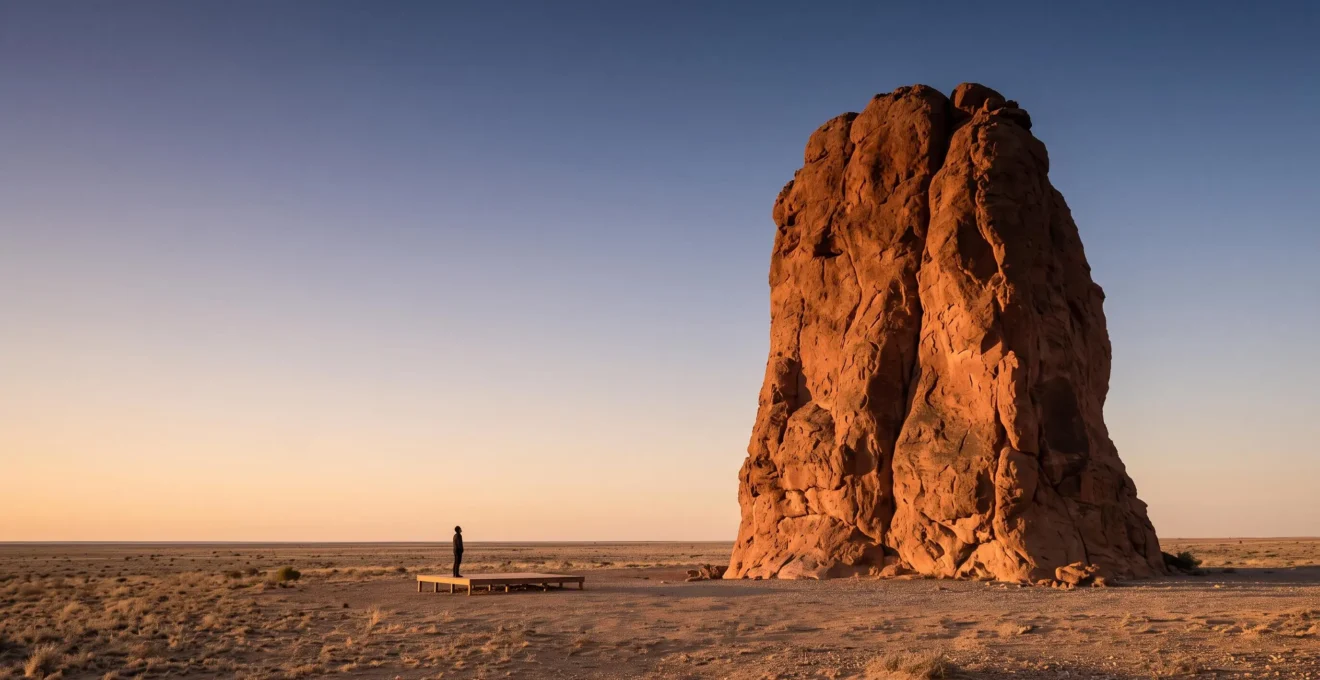
Visiting Uluru isn’t about capturing the perfect photo; it’s about respectfully witnessing a living, sacred legal text written in stone.
- Every rock formation, path, and waterhole is part of the Tjukurpa, the living law of the Aṉangu people that governs all aspects of life.
- Seemingly simple requests—like not climbing or where to take photos—are about visitor safety and respecting sacred legal and spiritual boundaries embedded in the land.
Recommendation: Engage directly with Aṉangu-owned enterprises to learn authentic stories and ensure your visit directly supports the custodians of the land.
The first impulse for many visitors upon seeing Uluru is to raise a camera. The vast, red monolith against a piercing blue sky is an icon, a visual trophy to be captured and taken home. This desire to photograph, to document, and to possess a piece of the experience is understandable. Standard advice often revolves around practicalities: find the best sunrise viewing spot, don’t climb the rock, and listen to the guides. While well-intentioned, this advice barely scratches the surface and can keep you in the mindset of a consumer, ticking items off a checklist.
But what if the most profound experience of Uluru isn’t about what you can take, but what you can receive? What if the key wasn’t in perfecting your camera settings, but in shifting your entire perspective? The true significance of Uluru lies not in its appearance but in its meaning. It is a living cultural landscape, a library of sacred law, and a home. To visit respectfully is to move from the mindset of a tourist ‘capturing’ a scene to that of a guest ‘witnessing’ a place of immense power and importance.
This guide is designed to facilitate that shift. We will explore Uluru not as a static landmark, but as a dynamic entity where geology and spirituality are inseparable. You will learn how the ancient stories, or Tjukurpa, function as living laws and why understanding them is the key to a truly respectful and transformative visit. We will move beyond the ‘what’ and delve into the ‘why’, empowering you to become a more conscious and considerate witness to one of the world’s most sacred sites.
To help you navigate this journey of understanding, this article delves into the core principles of respectful engagement with Uluru’s dual heritage. The following sections will guide you through the cultural, historical, and practical dimensions of experiencing this sacred place as the Aṉangu, its traditional owners, wish for it to be seen.
Summary: How to Experience Uluru Respectfully: A Guide to Its Geological and Cultural Heart
- Why Uluru’s Sacred Significance Should Change How You Photograph and Approach the Rock
- How to Access Authentic Dreamtime Stories That Explain Uluru’s Cultural Meaning
- Uluru Sunrise or Sunset: Which Time Delivers Better Photography and Deeper Connection?
- The Uluru Climbing Ban: Why It Took Decades to Honor Aboriginal Cultural Wishes
- When to Visit Uluru for Comfortable Temperatures and Optimal Photographic Light
- Why Aboriginal Culture Is the World’s Oldest Living Civilization Still Practicing Today
- Why Dreamtime Stories Function as Legal Codes, Not Just Creation Myths
- How to Learn About Aboriginal Culture Respectfully Without Appropriation or Tokenism
Why Uluru’s Sacred Significance Should Change How You Photograph and Approach the Rock
When you stand before Uluru, you are not in a museum or a theme park; you are in a place of worship, a home. For Aṉangu, the traditional custodians, every crevice, stain, and rock face tells a story and holds a law. This is why the common tourist approach—treating the rock as a mere backdrop for selfies—is so jarring. It reduces a deeply sacred site to a prop. The Aṉangu ask visitors to shift from a mindset of ‘capturing’ to one of ‘witnessing’. This means putting the camera down at times and simply being present, observing with your senses rather than through a lens.
Certain areas around the base of Uluru are so sacred that photography is forbidden. These are not arbitrary rules; they protect sites of gender-specific ceremonies or other culturally sensitive knowledge. To photograph them would be equivalent to walking into a church during a private ritual and taking flash photos. The harm caused by a purely extractive mindset is not hypothetical. In one instance, a cave containing ancient rock art was permanently damaged when tourists threw tanning oil against its walls, staining the art forever. This act, born of ignorance and disrespect, highlights the permanent consequences of treating a sacred place like a personal playground.
Case Study: Tourist Damage to Sacred Rock Art
One of the saddest sites visited was a cave that has been blocked off because tourists have stained the art by throwing tanning oil against its walls. This real incident illustrates how a purely extractive, self-focused approach to visiting Uluru — treating the site as a backdrop for personal experience rather than a living sacred place — can cause irreversible cultural harm, reinforcing why visitors are asked to witness rather than simply consume the landscape.
Instead of focusing on what you can’t photograph, consider a different way of recording your experience. Engage in sensory journaling. Note the texture of the air, the sound of the wind, the changing colors of the rock, the feeling of the earth beneath your feet. This practice of deep observation creates a far more profound and lasting memory than a simple digital file. It honors the Aṉangu request to be a witness, not just a consumer of the landscape.
Ultimately, your approach to Uluru should be guided by respect. Before you raise your camera, ask yourself: « Am I capturing an image, or am I witnessing a sacred place? » The answer will profoundly shape your experience and ensure your presence is a positive one.
How to Access Authentic Dreamtime Stories That Explain Uluru’s Cultural Meaning
The term ‘Dreamtime’ is a Western simplification. For Aṉangu, the correct term is Tjukurpa, and it is not a collection of ancient myths but a living, breathing legal and spiritual framework that governs all of reality. Tjukurpa stories are not public domain entertainment; they are complex, layered, and often contain knowledge that is restricted, belonging to specific families or initiated individuals. Demanding access to these stories is culturally inappropriate. The respectful way to learn is to listen to what the Aṉangu are willing to share, in the way they choose to share it.
The most authentic way to engage with Tjukurpa is through Aṉangu-owned and operated enterprises. The Uluṟu-Kata Tjuṯa Cultural Centre is the essential starting point. Here, you can experience art, presentations, and displays curated by the Aṉangu themselves. The art, in particular, is a powerful medium for storytelling. The symbols and patterns in a dot painting are not random; they are a visual language that can map a landscape, recount an ancestral journey, and convey profound cultural law. By purchasing art from a reputable, Aṉangu-owned gallery, you are not just acquiring a souvenir; you are participating in a fair cultural exchange that supports the community and the continuation of their traditions.
Case Study: Maruku Arts and Aṉangu-Controlled Knowledge Sharing
The Maṟuku Arts Gallery at the Uluṟu-Kata Tjuṯa Cultural Centre provides a model for respectful cultural exchange. It gives visitors the chance to experience diverse art from the centre of Australia while gaining an understanding and appreciation of Ngaanyatjarra, Pitjantjatjara and Yankunytjatjara cultural practices. The art is sourced from more than 500 artists across more than twenty remote communities. This model shows how respectful listening happens on Aṉangu terms—through art, workshops, and guided sharing—rather than visitors demanding access to restricted knowledge.
Another powerful way to learn is by taking a guided walk around the base of Uluru with an Aṉangu guide or through a tour operator that works in genuine partnership with the community. On these walks, guides share the public stories of the rock, such as the journey of the ancestral Mala (rufous hare-wallaby) people. They will point to specific geological features and explain their significance within the Tjukurpa narrative. This is how the landscape comes alive. The physical walk becomes a journey through a living story, as reflected in the public stories shared along the base walk. This is the authentic way to access cultural meaning: patiently, respectfully, and on the terms of the knowledge holders themselves.
Uluru Sunrise or Sunset: Which Time Delivers Better Photography and Deeper Connection?
The question of whether to view Uluru at sunrise or sunset is a classic traveler’s dilemma. From a purely photographic standpoint, both offer spectacular, though different, light shows. Sunset is famous for the dramatic moment the rock glows a fiery, incandescent red as it catches the last rays of the setting sun. Sunrise, conversely, bathes the rock in softer, pastel hues, with the landscape slowly awakening and the colors subtly shifting from deep purples to warm oranges. The best photographic choice often depends on the season and the weather.
However, to view this question only through a photographic lens is to miss the deeper opportunity. The choice between sunrise and sunset can also be a choice between two distinct moods of connection. Sunrise is about awakening and potential. To stand in the cool, quiet desert air before dawn, watching as the first light touches the rock, is to witness the birth of a new day. It’s a moment of quiet contemplation, of feeling the vastness of the land and your small place within it. It’s an introspective and personal experience, often with fewer crowds than at sunset, allowing for a more serene connection.
Sunset, on the other hand, is about reflection and climax. It’s a more communal experience, with a shared sense of anticipation as everyone waits for the main event. The vibrant, intense color change is a powerful, shared spectacle. It’s a time to reflect on the day, on the heat and the history held within the rock. This choice is also shaped by the powerful reality of the desert climate. In summer, choosing a sunrise viewing is a far more comfortable and safer experience, given that daytime highs can climb into the 40s°C, making midday and afternoon activities challenging.
Perhaps the best answer is not to choose one over the other. If your itinerary allows, experience both. Witness the awakening at sunrise, feeling the quiet energy of the land coming to life. Then, join the community at sunset to share in the collective awe of its fiery farewell. By experiencing both, you appreciate the full cycle of the day and the rock’s dynamic relationship with the light, moving your experience from a simple photo opportunity to a deeper, more holistic connection with the rhythm of the place.
The Uluru Climbing Ban: Why It Took Decades to Honor Aboriginal Cultural Wishes
The permanent closure of the Uluru climb on October 26, 2019, was a landmark moment for Indigenous rights in Australia, but it was the culmination of a long and patient struggle. For decades, the Aṉangu Traditional Owners had requested that visitors not climb. Signs at the base of the climb politely stated their wishes, explaining that the route crosses a sacred path of the ancestral Mala men. For Aṉangu, there is a profound cultural responsibility to care for the land and for the visitors upon it. The request « please don’t climb » was not just about protecting their culture, but also about protecting visitors from harm, as numerous injuries and deaths have occurred on the climb.
Despite these pleas, climbing continued. When the Uluru-Kata Tjuta National Park was handed back to the Aṉangu in 1985, it was under a lease agreement with the Australian government that required the climb to remain open. This set up a painful conflict between the wishes of the Traditional Owners and the demands of the tourism industry. The turning point came with a shift in visitor consciousness and a strategic addition to the Park Management Plan. Over the years, more and more visitors chose to respect the Aṉangu’s wishes, a trend documented by a drop from 74% of visitors climbing in the 1990s to just 16% by 2015. This decline was crucial.
The 2010 management plan stated that the climb could be closed if climbing rates fell below 20% and other criteria were met. When the 16.5% figure was officially recorded, it triggered the process for closure. In 2017, the park’s Board of Management, with a majority of Aṉangu members, voted unanimously to set a final closure date. The date chosen—the 34th anniversary of the Handback—was deeply symbolic, turning a day that once represented compromise into a day of cultural victory and healing. The decades-long wait demonstrates the incredible patience and resilience of the Aṉangu people in their quiet, determined fight to have their law and culture finally and fully respected in their own home.
The history of this long negotiation is a powerful lesson in cultural respect and persistence.
| Year | Event |
|---|---|
| 1985 | Uluru-Kata Tjuta National Park handed back to the Aṉangu (Handback) |
| 1990s | Please Don’t Climb signs installed at the base; roughly 74% of visitors still climbed |
| 2010 | Park Management Plan sets a threshold: close the climb once fewer than 20% of visitors climb |
| 2015 | Climbing rate falls to approximately 16.5%, meeting the threshold |
| 2017 | Board of Management votes unanimously to close the climb from 2019 |
| 2019 | Climb permanently closes on 26 October, the 34th anniversary of Handback |
When to Visit Uluru for Comfortable Temperatures and Optimal Photographic Light
Choosing when to visit Uluru is often framed by the four Western seasons, but this perspective misses a much richer and more practical way of understanding the land’s rhythms. The Aṉangu people do not recognize four seasons, but five. This traditional calendar is not based on arbitrary dates but on the subtle environmental cues that signal changes in weather, plant life, and animal behavior. Understanding these seasons offers a deeper connection to the landscape and provides a more accurate guide for planning your visit.
The five different seasons recognised by the Aṉangu are:
- Piriyakutu/Piriya Piriya (August-September): A warm, pleasant time when many animals breed and plants flower.
- Mai Wiyaringkupai/Kuli (December-January): The hot season, with soaring temperatures and occasional storms.
- Itjanu/Inyurnga (February-April): A cooler, greener period following the summer rains.
- Wanitjunkupai (May-June): The start of the cold weather, with freezing morning temperatures.
- Tjuntalpa/Wari (June-July): The coldest season, with heavy frosts but clear, sunny days.
As Aṉangu woman Barbara Tjikatu explains, this knowledge is not just folklore; it is a practical guide to life.
Anangu don’t go by Piranpa (white person’s) dates, we only go by our own seasons…. We know which fruits and foods we get during our seasons – that’s what is important to us.
– Barbara Tjikatu, Climate and Seasons, Department of Climate Change, Energy, the Environment and Water
From a visitor’s perspective, the shoulder seasons—April to June and August to September—are generally the most comfortable. During these periods, daytime temperatures are mild, making it ideal for walking the base trails and exploring. The light is often clear and beautiful for photography. The winter months (June-July) offer crisp, clear days but can be bitingly cold in the mornings. The summer (December-January) is best avoided by those sensitive to extreme heat, as temperatures regularly exceed 40°C. Visiting during the right season allows you to engage more deeply with the land, seeing its incredible textures and resilience up close without battling the elements.
By aligning your visit with the Aṉangu seasons, you are not just choosing a date; you are stepping into a more authentic, ancient rhythm and showing another layer of respect for the land and its people.
Why Aboriginal Culture Is the World’s Oldest Living Civilization Still Practicing Today
It is a fact that can be difficult to comprehend: Aboriginal culture is the oldest continuous living culture on Earth. While ancient Rome, Greece, and Egypt have long since fallen, becoming subjects of history and archaeology, Aboriginal societies have maintained an unbroken connection to their laws, traditions, and land. The most recent scientific and archaeological evidence confirms at least 65,000 years of continuous culture in Australia. This is not a story of a civilization that was; it is a story of a civilization that *is*.
This remarkable continuity is a testament to the resilience, adaptability, and bravery of the first Australians. As Professor Eske Willerslev, who led a groundbreaking DNA study, noted, « It was a truly amazing journey that must have demanded exceptional survival skills and bravery. » This journey was not just a physical one across continents, but a cultural one across millennia. The core of this survival has been the efficient and robust system of knowledge transfer: the Tjukurpa. It is a framework designed for cultural perpetuity, ensuring that essential laws for living, spiritual knowledge, and ecological wisdom are passed down intact from one generation to the next.
For a long time, the evidence for this continuity was primarily oral and ethnographic. However, modern archaeology is increasingly providing concrete proof that directly links present-day practices to an ancient past.
Case Study: Unbroken Knowledge Transfer at a 12,000-Year-Old Ritual Site
Recent excavations at a GunaiKurnai ritual site provided rare archaeological proof of continuous tradition. Researchers found fireplace remains dated to roughly 11,000-12,000 years old. These remains perfectly matched the descriptions of the same ritual practice recorded by ethnographers in the 19th century and still known to the GunaiKurnai people today. As the study concluded, « Despite millennia of cultural innovations, the Old Ancestors continued to pass down cultural knowledge and know-how, generation after generation, since the last Ice Age. » This shows that Tjukurpa-style knowledge systems are not reconstructed folklore but a continuously transmitted living tradition, as documented by a study in which shows how the world’s oldest culture transmitted ritual knowledge across generations.
Understanding this immense time scale is crucial to visiting Uluru respectfully. You are not visiting a relic of a dead past. You are a guest within a vibrant, resilient, and profoundly ancient living culture that has successfully navigated tens of thousands of years of change. This realization should inspire a deep sense of awe and humility.
Why Dreamtime Stories Function as Legal Codes, Not Just Creation Myths
One of the most profound paradigm shifts a visitor to Uluru can make is to stop thinking of Tjukurpa (‘The Dreamtime’) as mythology. In the Western tradition, myths are often seen as quaint, pre-scientific stories used to explain the world. Tjukurpa is not that. It is a comprehensive and practical system of law, governance, and ethics that is as relevant today as it was 65,000 years ago. It is a legal code written into the landscape itself.
When an Aṉangu elder tells a story about an ancestral being, they are not just recounting a fable. They are citing a legal precedent. The actions of the ancestral beings during Tjukurpa—their journeys, their battles, their creations—established the laws that govern all aspects of Aṉangu life. These laws dictate social relationships, resource management, spiritual responsibilities, and rules of conduct. The landscape of Uluru is a physical manifestation of this legal code. A particular cave might be where a specific ceremony must be performed, a waterhole might be the site of a key ancestral event, and a pathway might be the sacred route of a Tjukurpa ancestor.
This is why the request not to climb Uluru was never just about safety or scenery. It was a matter of law.
Case Study: The Mala Story as a Lived Legal Charter
The traditional climbing path up Uluru’s western face directly follows the sacred route of the ancestral Mala (rufous hare-wallaby) men. For Aṉangu, the Mala Tjukurpa is an intensely spiritual story that governs ceremonies and rules for living. To walk on this path without the proper authority and ceremony is a serious transgression of Aṉangu law. The Aṉangu feel a deep sense of responsibility to uphold their law and to protect others from inadvertently breaking it. Therefore, asking visitors not to climb was an act of upholding their legal system and fulfilling their duty of care. The story is not abstract folklore; it is an active legal and ceremonial boundary embedded in the landscape itself.
When you see the sign at the base of Uluru that reads, « This is our home; under our law we are responsible for you here; please don’t climb, » you are reading a statement of legal jurisdiction. It asserts that Aṉangu law is the law of this land. By respecting that sign, you are not just being a polite tourist; you are acknowledging and submitting to the oldest legal system on the planet. This understanding transforms every interaction with the landscape from a passive viewing to an active engagement with a living system of governance.
Key Takeaways
- Shift Your Mindset: Approach Uluru as a ‘witness’ to a sacred place, not a ‘capturer’ of images. The most profound experience is often found when the camera is down.
- Tjukurpa is Law: Understand that Tjukurpa (‘The Dreamtime’) is not mythology but a living legal and spiritual system that governs the land and its people today.
- Engage Respectfully: The most authentic way to learn is through Aṉangu-owned enterprises like Maruku Arts. Buy art, take guided tours, and listen to what is willingly shared.
How to Learn About Aboriginal Culture Respectfully Without Appropriation or Tokenism
After a visit to Uluru, many people leave with a newfound appreciation for Aboriginal culture and a desire to learn more. This is a wonderful thing, but it must be navigated with care to avoid the pitfalls of cultural appropriation and tokenism. The key is to continue the practice of respectful engagement you learned at Uluru: prioritize authentic voices, ensure fair compensation, and act as an informed ambassador, not a passive consumer.
The most direct way to support the culture is to ensure your money flows to the right people. When buying art or booking experiences, always ask: « Is this business 100% Aboriginal-owned and operated? » Many third-party tour operators and galleries profit from Aboriginal culture without meaningfully benefiting the communities themselves. In contrast, organizations like Maṟuku Arts at Uluru are entirely owned and governed by Aṉangu people. Supporting them ensures that proceeds go directly to artists and their families, funding community projects and enabling the transfer of knowledge to future generations. This is the difference between extraction and genuine appreciation.
Our purpose is to keep culture strong and alive, for future generations of artists and make culture accessible in an authentic way to those that seek a more in-depth understanding.
– Maruku Arts, About Maruku Arts
Beyond financial support, your role as a respectful learner continues long after you leave. It involves becoming an advocate for authenticity. When you return home, share what you’ve learned. If you encounter misinformation about Aboriginal culture—for example, people referring to it in the past tense or misrepresenting Tjukurpa as simple myths—correct it gently and respectfully. Use your experience to amplify the message that this is the world’s oldest living culture. This moves your engagement from a fleeting tourist moment to a lasting commitment to understanding and respect. The following checklist provides concrete steps to put these principles into action.
Your Action Plan: Engaging Respectfully with Aṉangu Culture
- Direct Engagement: Book tours and workshops directly with 100% Aboriginal-owned operators such as Maruku Arts rather than generic third-party resellers.
- Ethical Purchasing: Purchase art and craft only from verified Aṉangu-owned galleries to ensure proceeds return to the artists and their communities.
- Always Ask Permission: Ask before photographing people, ceremonies, or specific rock features, and graciously accept ‘no’ as an answer.
- Extend Your Support: Continue supporting Aboriginal-owned businesses, creators, and causes after leaving Uluru, extending the relationship beyond the trip.
- Become an Ambassador: Correct misinformation about Aboriginal culture when you encounter it, using what you learned to inform others respectfully.
By carrying these lessons with you, your journey to Uluru becomes more than a holiday; it becomes the beginning of a lifelong journey of learning and an active participation in celebrating and respecting the oldest living culture on Earth. The most respectful souvenir you can take home is a changed perspective.