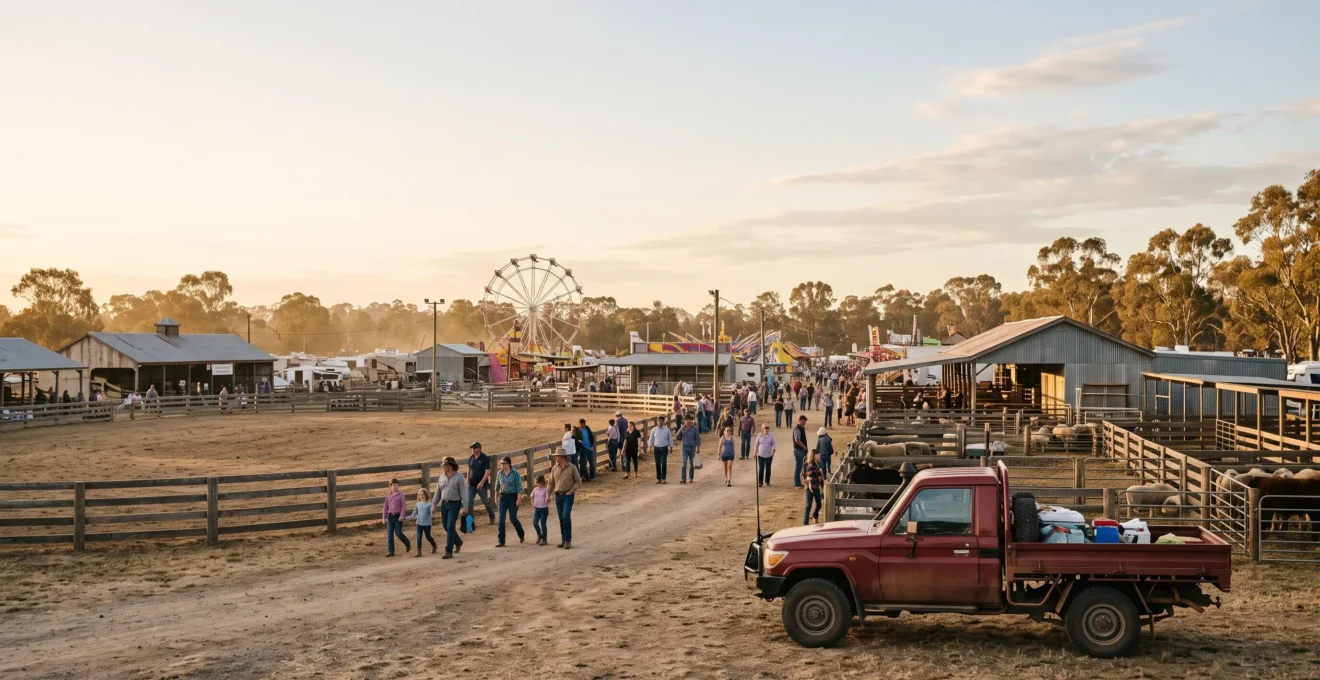
To find authentic Australian experiences, you must ignore the tourism brochures and instead learn to read the « community infrastructure » of a town.
- The most genuine events are not designed for tourists; they are by-products of local life, like agricultural shows, sports carnivals, and neighbourhood gatherings.
- Accessing them requires looking beyond Google to sources like local council websites, regional newspaper listings, and even community notice boards.
Recommendation: Start by searching for the « annual show » or « field days » in a region you plan to visit. This is the fastest way to tap into the true rhythm of local Australian life.
For the traveler seeking genuine connection, Australia presents a paradox. You see vibrant images of massive city-wide festivals and iconic sporting events, meticulously marketed to a global audience. Yet, you have a nagging feeling that the real heart of the country beats elsewhere, in moments that aren’t advertised on a billboard. Many guides will point you to official tourism websites or major event calendars, listing spectacles like Sydney’s Vivid or the Adelaide Fringe. While these are fantastic, they are often professional productions designed for mass consumption.
The common advice to « talk to locals » is well-intentioned but impractical for a visitor planning a trip. How do you find these events before you even arrive? The answer doesn’t lie in finding a better list of festivals. It lies in a fundamental shift in perspective. Instead of searching for events, you need to search for the infrastructure of community life that creates them. This guide is about learning to see the hidden calendar of Australia, which is woven into its regional towns, multicultural suburbs, and the deep-rooted cultural protocols of its First Peoples.
We will move beyond the tourist trail to uncover the frameworks that underpin authentic gatherings. We’ll explore why a small-town agricultural show can be more revealing than a major city festival and provide you with the tools to find events that welcome visitors not as spectators, but as respectful participants. This is your guide to finding the Australia that Australians themselves experience.
Summary: How to Find the Real Australia: A Guide to Local Events Beyond the Tourist Trail
- Why Regional Agricultural Shows Reveal More Real Australia Than City Tourist Events
- How to Access Community Event Calendars Tourism Boards Don’t Advertise
- Surf Carnivals or Music Festivals: Which Local Events Actually Welcome Outsiders?
- The Small-Town Event Assumption That Keeps Tourists Missing Incredible Experiences
- When to Attend Regional Events for Authenticity Before Tourism Changes Them
- When Aboriginal Cultural Events Welcome Visitors and When They’re Community-Only
- When to Visit Multicultural Neighborhoods for Festivals or Everyday Cultural Immersion?
- How to Learn About Aboriginal Culture Respectfully Without Appropriation or Tokenism
Why Regional Agricultural Shows Reveal More Real Australia Than City Tourist Events
The quintessential Australian « Ag Show » is perhaps the single best window into the soul of regional life. Far from a polished tourist attraction, a country show is a living, breathing expression of community. It’s where multi-generational farming families compete in livestock and produce competitions, where the Country Women’s Association (CWA) judges the best scones, and where local kids display their art. This isn’t a performance for outsiders; it’s a reflection of local pride, skill, and tradition. The economic signal is also clear: these events are often volunteer-run, with funds flowing directly back into the community, a stark contrast to large-scale commercial festivals where revenue is the primary goal.
Major city « Royal » shows, like the Royal Adelaide Show, are the big brothers to these country events and still retain a strong community focus, where even a single event can represent $200m+ in annual economic value to its region and support hundreds of community groups. However, it’s in the smaller regional shows and field days where you find the most undiluted authenticity. These are places of participation, not just observation.
The sounds and smells—the mix of livestock, sawdust from the woodchopping, and Dagwood Dogs—are the sensory backdrop of rural Australia. Attending a country show gives you a direct line into the industries, hobbies, and social fabric of the area. You’ll learn more about a region in one afternoon at the showgrounds than from a week of guided tours. To understand the difference in scale and community involvement, it’s helpful to compare them directly.
The following table, based on an analysis from Australian Rural & Regional News, illustrates the different community and economic signals between small country shows and larger events.
| Event | Type | Attendance | Community/Economic Signal |
|---|---|---|---|
| Ganmain Show (NSW) | Small country agricultural show | ~2,500 | Volunteer-run, multi-generational family involvement |
| Riverland Field Days (SA) | Regional field day | 10,000+ over 2 days | 225 booked exhibitor sites |
| Yorke Peninsula Field Days (SA) | Regional field day | Thousands | $5-8 million injected into the local economy |
How to Access Community Event Calendars Tourism Boards Don’t Advertise
Once you know what you’re looking for, the next challenge is finding it. The most authentic community events are rarely promoted on major tourism platforms because their target audience is local. To find them, you need to look where locals look. This means digging deeper into the digital and physical infrastructure of a region. Your primary tool should be the official websites of local governments, known as Shire or Council websites. Search for terms like « [Town Name] Shire Council » and navigate to their « Community » or « Events » section. This is often where you’ll find listings for farmers’ markets, library workshops, and local sports meets.
Another overlooked resource is the local newspaper or regional news website. While the front pages cover major news, the community sections or classifieds in the back often list upcoming events, from RSL bingo nights to fundraising sausage sizzles at the local hardware store. These are the small-scale gatherings that truly define the rhythm of a town. Don’t underestimate physical notice boards either. In many small towns, the most reliable sources of information are the cork boards at the local IGA supermarket, the post office, or the community hall.
Finally, identify the key pieces of community infrastructure and check their individual schedules. This includes the local show society (who run the annual show), the surf lifesaving club (who host Nippers and carnivals), and historical societies. A direct search for the « Ganmain Show Society » or « Cottesloe Surf Life Saving Club » will yield far more authentic results than a generic search for « events in NSW. » This targeted approach requires more effort, but it’s the key to unlocking a calendar of events that exist for the community, not for you.
Action Plan: Vetting a Local Event for Authenticity
- Check the Organizer: Is it run by a local community group (e.g., Lions Club, Show Society, a specific cultural association) or a professional events company? Volunteer-run is a strong positive signal.
- Scan the Sponsors: Are the sponsors local businesses (the town butcher, the regional bank) or large national corporations? Local sponsorship suggests deep community ties.
- Analyze the Language: Does the event description use language aimed at community participation (« all welcome, » « support our club ») or tourist consumption (« unforgettable experience, » « must-see spectacle »)?
- Look at the Location: Is it held at a dedicated community space like a showground, town hall, or public park, or is it in a ticketed, purpose-built venue?
- Review the Ticket Price: Is entry free, by gold coin donation, or modestly priced to cover costs? An unusually high ticket price can be a sign of commercialization over community.
Surf Carnivals or Music Festivals: Which Local Events Actually Welcome Outsiders?
Applying this new lens helps clarify which types of events are more likely to offer an authentic experience. A classic Australian example is the comparison between a local surf lifesaving carnival and a major music festival. While both can be enjoyable, they stem from entirely different places. A surf carnival is pure community infrastructure in action. It’s the culmination of a season of volunteer patrols, training for young « Nippers, » and fierce but friendly inter-club rivalry. These events take place on public beaches, are almost always free to watch, and are deeply embedded in the coastal way of life. The atmosphere is buzzing with genuine community spirit, and visitors are generally very welcome to lay down a towel and cheer on the competitors.
Music festivals, on the other hand, are more complex. While smaller, independent festivals can have a strong community ethos, many of the larger, well-known events are commercial ventures. They are professionally organized, heavily marketed, and designed as a product for a paying audience. The focus is on the lineup and the « experience » being sold, rather than on a pre-existing community gathering. This doesn’t make them bad—they can be incredible fun—but it positions you firmly as a consumer. You’re attending an event staged for you, not stumbling into an authentic expression of local culture.
The key differentiator is purpose. A surf carnival would happen whether tourists came or not; its primary function is for the surf lifesaving community. Many large music festivals would not exist without ticket sales from a broad, often non-local, audience. As a traveler seeking authenticity, the question to ask is: « Who is this event for? » If the answer is « the local community, » you’re on the right track. If the answer is « ticket-holders, » it’s likely a more commercial, less « local » experience.
The Small-Town Event Assumption That Keeps Tourists Missing Incredible Experiences
One of the biggest mistakes travelers make is assuming that a quiet town has nothing going on. Tourists often drive down a sleepy main street, see a few closed shops, and conclude the town is « dead. » This overlooks the hidden rhythm of the town, where the most important social events are often invisible to the casual observer. The pulse of a small town isn’t in a bustling, 24/7 entertainment district; it’s in the weekly farmers’ market, the Saturday morning kids’ sport at the local oval, the monthly CWA meeting, or the sausage sizzle outside the hardware store.
These aren’t « events » in the tourist sense. They are recurring rituals of connection. They lack the marketing and scale of a festival, but they offer something far more valuable: a glimpse into the everyday social fabric of a place. Stopping at a local bakery on a Friday morning might put you in the middle of an informal gathering of farmers discussing the weather. Visiting the local park on a Sunday afternoon could mean witnessing a family cricket game that’s been a tradition for decades.
The assumption that an event must be « big » or « advertised » to be worthwhile is a tourist-centric view. For locals, the most meaningful gatherings are often small and consistent. To access this layer of Australian life, you must slow down and adjust your definition of what constitutes an « activity. » Instead of looking for a headline act, look for signs of routine: the notice for the « Meat Tray Raffle » at the local pub, the chalkboard sign for « Devonshire Tea » at the historical society, or the stream of cars heading to the local sports ground.
This requires a shift in mindset from a consumer of experiences to an observer of life. The reward is not a spectacular show, but a quiet, profound sense of connection to a place and its people. It’s about finding the beauty in the ordinary, which is often the most authentic experience of all.
When to Attend Regional Events for Authenticity Before Tourism Changes Them
Every event exists on a spectrum of authenticity, and many have a lifecycle. They often start as small, grassroots gatherings and, if successful, can grow, attract outside attention, and gradually become more commercial. Finding the « sweet spot » is key for the traveler seeking a genuine experience. This is the point where an event is well-organized and welcoming to visitors, but has not yet been fundamentally altered by tourism. Once an event’s primary focus shifts from serving its community to attracting tourist dollars, its character can change dramatically.
One of the clearest indicators of this shift is ticketing and price. When an event that was once free or donation-based introduces high ticket prices, it often signals a move towards a commercial model. This can price out some local families and change the demographic of the attendees, as was seen when attendance at the Perth Royal Show saw a significant drop to around 300,000 patrons, its lowest in 10 years, a change widely blamed on rising ticket prices that alienated its traditional family audience.
Another sign is the « professionalization » of the event. When handcrafted stalls are replaced by slick corporate sponsors, and volunteer-run food stands are outsourced to commercial food trucks, the grassroots feel can be lost. The ideal time to attend is often in an event’s « growth » phase, not its « mature » phase. This means looking for events that are perhaps in their 5th or 10th year, not their 50th. They have ironed out the initial kinks but haven’t yet become a major fixture on the national tourist calendar.
To find these, look for mentions in local media that describe an event as « growing in popularity » or « a hidden gem. » These are clues that you’ve found an event in its authenticity sweet spot, offering a perfect blend of community spirit and visitor-friendliness, before it becomes just another stop on the tourist circuit.
When Aboriginal Cultural Events Welcome Visitors and When They’re Community-Only
Engaging with the culture of Australia’s First Peoples is a profound opportunity, but it requires a deep level of respect and understanding. Not all cultural business is for public consumption. A critical distinction must be made between events designed to share culture with outsiders and ceremonies that are private, community-only affairs. The guiding principle is always invitation. If an event is publicly advertised with a « welcome to all » message, it is generally appropriate to attend. These events are a generous act of sharing culture. Examples include festivals like the Garma Festival in Arnhem Land (which is a structured, ticketed event for cultural exchange) or open-day events at Aboriginal cultural centres.
Conversely, if you hear about a ceremony through informal channels or see a gathering that is not publicly promoted, the respectful default is to assume it is private. These can include funerals, men’s or women’s business, or other significant community rites. To attend uninvited is a serious breach of cultural protocol. It’s also vital to understand the difference between a Welcome to Country and an Acknowledgement of Country, as explained by Tourism Australia’s official protocols. As their guide states:
A Welcome to Country can only be given by a Traditional Owner of the land where the event is taking place, whereas an Acknowledgement of Country can be delivered by anyone.
– Tourism Australia protocol guide, Welcome to and Acknowledgement of Country – Industry Protocols
Recognizing a formal Welcome to Country at the start of a public event is a strong signal that the gathering has been sanctioned by the Traditional Owners and that visitors are indeed welcome. To aid this process of respectful engagement, structured resources have been developed.
Case Study: The Connecting to Culture Toolkit
To help tourism operators navigate these complexities, a government-backed toolkit was developed in consultation with First Nations representatives. This resource helps non-Indigenous businesses understand the difference between appropriate, community-approved engagement and tokenistic gestures. It provides a framework for guiding businesses on when and how to responsibly connect with First Nations events and partners, ensuring that cultural sharing is done on the community’s own terms.
When to Visit Multicultural Neighborhoods for Festivals or Everyday Cultural Immersion?
The same principles of authenticity apply in Australia’s vibrant urban landscapes. Many city suburbs are rich hubs of multicultural life, from the Vietnamese communities in Melbourne’s Richmond to the Lebanese culture in Sydney’s Lakemba. These neighborhoods often host fantastic festivals, like Lunar New Year or Ramadan Nights, which are explicitly designed to welcome the wider public. These are wonderful, celebratory events that offer a concentrated dose of culture through food, music, and performance. They are the « main event » on the cultural calendar and are an excellent way to experience a community’s hospitality.
However, an equally, if not more, authentic experience can be found by visiting on a normal weekday, far from any festival. This is the « everyday cultural immersion. » It means visiting the local grocery stores to see unfamiliar produce, having lunch at a small, family-run restaurant where English isn’t the first language, and simply observing the daily rhythm of life. This approach shifts you from being an audience member at a festival to a quiet observer of the community’s living infrastructure. You are not consuming a prepared cultural « product »; you are witnessing culture as it is lived.
Choosing between these two approaches depends on your goal. A festival offers a vibrant, high-energy, and curated experience. A visit on a regular Tuesday offers a quieter, more subtle, and arguably deeper insight into the fabric of the community. For the traveler seeking genuine understanding, the ideal approach is to do both. Attend the festival to celebrate with the community, and return on a quiet day to appreciate the culture in its everyday context. Both experiences are valid, but they are fundamentally different, and recognizing that difference is key to a richer cultural journey.
Key Takeaways
- Authentic events are by-products of community life, not productions for tourists. Prioritize events run by local clubs, societies, and cultural groups.
- Look for information where locals do: on Shire council websites, in regional newspapers, and on community notice boards, not on major tourism portals.
- Respect is paramount when engaging with First Nations culture. Only attend events that are explicitly public and always follow cultural protocols.
How to Learn About Aboriginal Culture Respectfully Without Appropriation or Tokenism
Moving beyond simply attending events to genuinely learning about Aboriginal culture requires a conscious and respectful approach. The goal is to engage in a way that supports communities directly and avoids the pitfalls of cultural appropriation or tokenism. The first and most important step is to understand that Aboriginal culture is not monolithic; it is a diverse tapestry of hundreds of distinct nations, each with its own language, stories, and laws. True learning begins with acknowledging this diversity.
A foundational concept to grasp is Indigenous Cultural and Intellectual Property (ICIP). This framework recognizes that stories, art motifs, songs, and ceremonies are not public domain; they are owned by specific clan groups and individuals and are governed by complex protocols. Engaging respectfully means never assuming you have the right to reproduce or reinterpret what you see or hear.
Case Study: The Indigenous Cultural and Intellectual Property (ICIP) Framework
Official resources, such as guides from Tourism Western Australia, draw a clear line between standard Intellectual Property and ICIP. They educate operators and visitors that specific designs, stories, or knowledge can belong to a particular language group or family. The framework sets out protocols for seeking permission and ensuring that cultural knowledge is shared respectfully and with community consent, preventing the unauthorized use of sacred or significant cultural assets.
The most direct way to support communities and learn respectfully is through economic empowerment. This means seeking out Aboriginal-owned tour operators, art centres, and businesses. When you buy art or a tour from a community-owned enterprise, you are ensuring that the financial benefits flow back to the community and that the stories you are being told are authentic and authorized. As the travel guide Responsible Vacation advises, this is a direct and impactful form of respectful tourism:
Buy authentic art and wood carvings from Aboriginal cultural centers and learn more about Dreamtime and the Aborigines’ relationship with the land and wildlife.
– Responsible Vacation
This approach transforms you from a passive consumer into an active partner in the preservation and celebration of the world’s oldest living culture. It is a commitment to learning on the community’s terms, ensuring your journey is one of genuine exchange, not extraction.
By shifting your focus from a consumer of entertainment to a respectful observer of community, you unlock a deeper, more meaningful way to travel through Australia. The most memorable moments are rarely found on a main stage; they are discovered in the shared laughter at a country show, the quiet reverence of a cultural welcome, and the simple rhythm of a town going about its day. Your next step is to start putting this mindset into practice on your next journey.
Frequently Asked Questions About Finding Authentic Australian Events
What’s the best way to find out about events if I’m already in a small town?
Go to the places where community information is exchanged. This includes the local pub, the post office, the bakery, and the local library. These places often have physical notice boards with flyers for everything from local sport matches to town hall meetings. Striking up a friendly conversation with the staff can also yield invaluable insider tips.
Are tourists genuinely welcome at very local events like a school fete or a sports club fundraiser?
In almost all cases, yes. The spirit of these events is community-wide, and a friendly visitor is typically seen as a welcome addition. The key is your demeanor. Attend with humility, show genuine interest, spend a little money to support the cause (buy a raffle ticket or a cake), and be a respectful observer. You’ll often find people are happy and proud to share their community with you.
How can I tell if an Aboriginal art piece is authentic and ethically sourced?
The best practice is to buy directly from Aboriginal-owned art centres. These centres are community-based organizations that ensure artists are paid fairly and that the stories behind the art are shared appropriately. Be wary of mass-produced souvenirs in tourist shops. An authentic piece will often come with a certificate of authenticity detailing the artist’s name, language group, and the story behind the work.