In summary:
- Most snorkeling problems start with an ill-fitting mask; achieving a perfect « seal integrity » is your first priority.
- Mastering a calm, steady « breathing cadence » is the key to overcoming panic and conserving energy in the water.
- Protecting the reef is about protecting yourself; learning buoyancy control prevents dangerous coral scrapes and damage to the ecosystem.
- Australian waters offer ideal learning conditions, but understanding local factors like currents and stinger seasons is non-negotiable for safety.
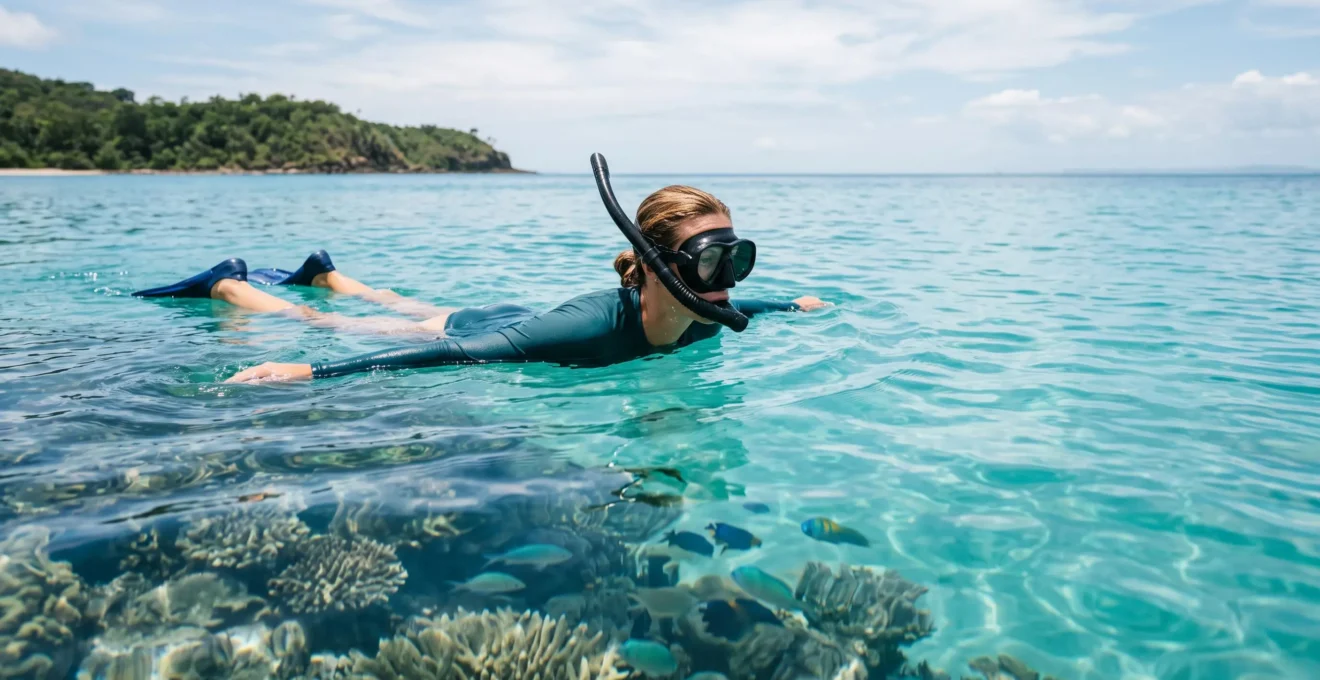
The vision is captivating: you, floating effortlessly over the vibrant tapestry of the Great Barrier Reef, surrounded by a kaleidoscope of marine life. For many, this is the ultimate Australian dream. Yet, for a complete beginner, this dream is often shadowed by a wave of anxiety. Questions about breathing, strange equipment, and the vastness of the ocean can feel overwhelming, turning excitement into apprehension. Many guides will give you a list of rules to follow—don’t touch this, stay near that—but this approach treats you like a child, not an adventurer.
The common advice is to simply rent equipment and listen to your tour guide. While not wrong, this advice misses the fundamental point. True confidence in the water doesn’t come from blindly following instructions; it comes from understanding. What if the secret to a joyful and safe first snorkel wasn’t about memorizing a list of dos and don’ts, but about deeply understanding the simple physics of your gear and the language of the ocean itself?
This is where we shift the perspective. Forget the fear. This guide is built on a simple principle: knowledge dispels anxiety. We will move beyond the basic rules to explore the ‘why’ behind them. We will transform you from a nervous passenger into an informed, confident snorkeler. You’ll learn how to make your gear an extension of your body, how to control your breathing to stay calm, and how to read the water to make smart, safe decisions. This is your journey to mastering the art of snorkeling, not just surviving it.
This comprehensive guide is structured to build your confidence from the ground up. We’ll start with the most critical gear on dry land and progressively move into the water, covering everything you need to know for a safe and unforgettable first experience in Australia’s magnificent marine environments.
Summary: Your Path to Confident Snorkeling
- Why Proper Mask Fitting Stops 80% of Snorkeling Frustrations Before You Enter Water
- How to Control Breathing and Overcome Panic During Your First Snorkel
- Reef Snorkeling or Open Water: Which Environment for Your First Snorkel Experience?
- The Coral-Touching Mistake That Injures You and Destroys Marine Ecosystems
- When to Snorkel as a Beginner and When Conditions Are Too Rough for Safety
- Outer Reef or Inner Reef: Which Coral Sea Zone Delivers Better Marine Encounters?
- Why Australian Waters Offer Better Learning Conditions Than European or American Coasts
- How to Experience the Coral Sea’s Marine Life Without Damaging the Reef
Why Proper Mask Fitting Stops 80% of Snorkeling Frustrations Before You Enter Water
The single greatest source of frustration for new snorkelers isn’t deep water or strange fish; it’s a constantly leaking mask. A slow, incessant trickle of saltwater into your mask causes distraction, ruins visibility, and can lead to panic. This isn’t just an annoyance; it’s a safety issue. The problem is so prevalent that in a review of snorkeling incidents, a study found 90% of those with full-face masks who had trouble attributed it to their equipment. The core of the issue is what we’ll call seal integrity: the perfect, airtight connection between the silicone skirt of the mask and your face.
Achieving this seal is your first and most important mission. Before you even think about the water, test your mask. Hold it to your face without using the strap, and inhale gently through your nose. If the mask suctions to your face and stays there, you have a good fit. The strap is only there to hold the mask in place, not to create the seal. Overtightening a strap is a classic beginner mistake that distorts the silicone skirt and actually creates leaks.
Look for a mask with a soft, high-grade silicone skirt that molds to the contours of your face. Be aware that facial hair, and even smiling, can break the seal. For men with moustaches, a small amount of Vaseline can sometimes help, but a clean-shaven area under the nose is best. By spending five minutes ensuring perfect mask fit on dry land, you eliminate the problem that forces most beginners out of the water prematurely. This is the foundation upon which all other skills are built.
How to Control Breathing and Overcome Panic During Your First Snorkel
Once your mask is sealed, the next challenge is purely psychological: breathing through a tube. It’s an unnatural act that can trigger a primal feeling of anxiety. Your brain, accustomed to unrestricted breathing, can misinterpret the slight resistance of the snorkel as a sign of suffocation, leading to short, shallow breaths. This is the fast track to panic. The key to overcoming this is to establish a deliberate and calm breathing cadence. A crew member on a Great Barrier Reef vessel put it best: « Keep calm, go slowly, control your breathing, don’t panic. » This isn’t just a suggestion; it’s a physiological instruction.
Slow, deep, and regular breaths—much like in meditation or yoga—tell your nervous system that everything is okay. They ensure an efficient exchange of oxygen and prevent the buildup of carbon dioxide, which is a primary trigger for the « air hunger » that leads to panic. Before you even enter the open sea, you should practice this on land and in a controlled environment like a swimming pool. Put your face in the water and just focus on the sound and rhythm of your breath. Inhale slowly, exhale fully. Hear the gentle ‘whoosh’. This simple act builds a powerful mind-body connection, teaching your brain to associate the snorkel with calm, not crisis.
Your Action Plan for Building Breathing Confidence
- Pool Practice: Before your reef trip, practice your snorkeling technique in a controlled environment like a pool or a calm, shallow beach.
- Dry Land Familiarization: Get fully comfortable with your mask, fins, and snorkel on dry land first to build muscle memory without the pressure of being in the water.
- Equipment Check: Ensure your snorkel tube is the right size (an 18-22mm diameter is standard for adults) to minimize breathing resistance and effort.
- Gradual Immersion: Embrace a slow, step-by-step learning approach. Don’t rush from the boat deck straight into deep open water; take your time.
Remember, you are in control. If you ever feel overwhelmed, simply stop, lift your head out of the water, and take a few normal breaths. Reset your breathing cadence, and then continue. This simple power to ‘reset’ is your ultimate safety net against panic.
Reef Snorkeling or Open Water: Which Environment for Your First Snorkel Experience?
With your gear sorted and your breathing calm, the next question is: where should you take your first plunge? Not all water is created equal, especially for a beginner. The choice between a sheltered reef environment and a generic ‘open water’ spot can make or break your initial experience. For a first-timer, a designated, guided reef snorkeling area is almost always the superior choice. These locations are chosen by operators specifically for their favorable conditions: typically calmer waters, better visibility, and protection from strong currents.
Jumping into the ocean from a random beach might seem appealing, but you’ll be contending with unknown variables like shore breaks, hidden currents (rips), and potentially poor visibility. A guided tour on the Great Barrier Reef, for example, will take you to pontoons or mooring sites in sheltered lagoons. This provides a stable base of operations, easy entry and exit points, and designated snorkeling areas that are patrolled by lookouts. It’s the aquatic equivalent of learning to ski on a gentle, groomed beginner slope rather than an untamed mountain face.
Case Study: Tongue Reef as a Beginner’s Paradise
Tongue Reef, a specific section of the Great Barrier Reef, is frequently highlighted as an ideal location for novice snorkelers. This is not by accident. Tour operators specifically use this site because it features accessible, beginner-friendly coral gardens in a protected setting. The organised boat tours provide guided exploration, ensuring first-timers are taken to the safest spots with the calmest conditions, maximizing their chance for a positive and breathtaking first encounter with the reef.
Furthermore, when snorkeling in tropical Australian waters, especially in Queensland between November and May, wearing a protective « stinger suit » is essential. These full-body lycra suits are not for warmth but are your primary defence against marine stingers like the Irukandji and Box Jellyfish. Reputable tour operators will provide these and make their use mandatory during stinger season—another crucial safety layer you won’t get by simply wading in from a random shore.
The Coral-Touching Mistake That Injures You and Destroys Marine Ecosystems
The number one rule you will hear on any reef tour is « Look, but don’t touch. » This is not just an empty environmental slogan; it’s a critical safety instruction for both you and the fragile coral ecosystem. From a distance, coral may look like a collection of colourful rocks, but it is a living colony of tiny, delicate animals. Touching it with your hands or scraping it with your fins can kill polyps that have taken decades or even centuries to grow. But the danger is a two-way street. What many beginners fail to realise is that coral can injure you back.
Coral skeletons are sharp and covered in bacteria to which your body is not accustomed. As the Divers Alert Network (DAN), a leading dive safety organization, warns, a seemingly minor scrape can have serious consequences. They state that « The most frequent complications from non-stinging coral scrapes are inflammation (which leads to poor healing) and less commonly a secondary infection. » These seemingly insignificant cuts can turn into nasty, painful infections that take weeks to heal, putting a serious damper on your holiday.
This is why mastering the Buoyancy Principle is so important. Your goal is to achieve a state of neutral buoyancy, floating horizontally and effortlessly on the surface. Use your fins for gentle, controlled propulsion and your arms for balance, keeping them crossed over your chest if necessary to avoid the temptation to ‘swim’ with them. By maintaining this respectful distance, you are not only acting as a responsible guardian of the reef but also actively protecting yourself from injury. It’s the ultimate win-win.
When to Snorkel as a Beginner and When Conditions Are Too Rough for Safety
Part of building confidence is knowing your limits and learning to recognise when conditions are simply not safe for your skill level. Australian waters are beautiful but can be unforgiving. It’s a sobering reminder from the National Drowning Report that there were 357 drowning deaths in Australian waterways in a recent year, a figure significantly higher than the 10-year average. While not all are related to snorkeling, it underscores the importance of respecting the ocean. Your ability to read the environment, a skill we call environmental literacy, is just as important as your ability to use your gear.
For a beginner, ideal conditions are clear: sunny skies, minimal wind, and calm water with little to no swell. Strong winds create choppy surface conditions that can make breathing through a snorkel difficult and tiring. A significant ocean swell, even on a calm day, can create surges near the reef and reduce visibility, making navigation disorienting. If the waves are breaking forcefully on the reef edge or the water looks murky and churned up, it is not a day for a novice to be in the water.
This is another reason why a guided tour is so valuable for your first time. The captain and crew are professionals who assess these conditions for a living. They will not take you out if it is unsafe. If you do find yourself in a difficult situation, stay calm. As Cairns Discovery Tours advises, signal for help by raising one arm straight into the air—this is the universal signal for assistance. Then, calmly make your way to the boat, platform, or nearest lookout. Never try to fight a strong current; swim parallel to the shore until you are out of its pull.
Outer Reef or Inner Reef: Which Coral Sea Zone Delivers Better Marine Encounters?
As you plan your Australian snorkeling adventure, you’ll often hear terms like « Inner Reef » and « Outer Reef. » Understanding the difference is key to managing your expectations and choosing the right trip. The Inner Reef refers to the reefs closer to the mainland. They are often in more sheltered waters and involve shorter boat trips, which can be a plus for those prone to seasickness. However, their proximity to the coast can mean the water visibility is more affected by rainfall and runoff, and the coral may not be as pristine as sites further out.
The Outer Reef, as the name suggests, is the system of reefs on the edge of the continental shelf, bordering the deep Coral Sea. Reaching these sites requires a longer boat journey, but the rewards are often spectacular. The water here is generally clearer, deeper blue, and less affected by coastal conditions, leading to outstanding visibility. The coral structures are often more massive and complex, and you have a greater chance of encountering larger marine life like sea turtles, reef sharks, and giant pelagic fish. For many, the Outer Reef represents the quintessential Great Barrier Reef experience.
The best time to experience either reef system is during the dry season. For the Great Barrier Reef region, the distinct seasonal pattern means that the dry season runs from May to October. This period typically offers lower humidity, less rain, and calmer seas, all of which contribute to the best possible snorkeling conditions and visibility. The wet season (November to April) can still have beautiful days, but there is a higher chance of rain, wind, and reduced water clarity.
Why Australian Waters Offer Better Learning Conditions Than European or American Coasts
While beautiful coastlines exist all over the world, Australia—and the Great Barrier Reef in particular—offers a uniquely forgiving environment for a beginner snorkeler. A primary factor is the remarkably warm and stable water temperature. Unlike the chilly waters of the US Pacific Northwest or the variable temperatures of the Mediterranean, the Great Barrier Reef boasts incredibly pleasant conditions year-round. This comfort is largely due to average water temperatures ranging from 24°C in winter to a balmy 29°C in summer.
This warmth is more than just a matter of comfort; it’s a significant safety and learning advantage. Cold water can cause an involuntary « gasp reflex » which is dangerous when your face is in the water. It also saps body heat, leading to fatigue much more quickly. In Australia’s warm tropical waters, you can relax, stay in the water longer, and focus entirely on your technique and the marine life without the distraction of being cold. You can spend your energy practicing buoyancy and observing fish, not shivering.
Additionally, the massive, well-developed reef tourism industry means there is an unparalleled infrastructure dedicated to beginners. The sheer number of reputable tour operators, purpose-built pontoons, expert guides, and high-quality rental equipment creates a supportive ecosystem for learning. This level of professional, beginner-focused support is harder to find in many parts of Europe or the Americas, where coastal tourism might be more geared towards beachgoers or experienced divers. The combination of ideal water conditions and a mature tourism infrastructure makes Australia arguably the best classroom in the world for learning to snorkel.
Key takeaways
- Your snorkeling experience hinges on comfort and confidence, which begin with perfectly fitted gear before you even see the water.
- Calm, controlled breathing is not just for relaxation; it’s a physiological tool to prevent panic and manage your energy effectively.
- The « look, don’t touch » rule is a dual-safety mandate: it protects the delicate, living coral and prevents you from getting nasty cuts and infections.
How to Experience the Coral Sea’s Marine Life Without Damaging the Reef
You are now equipped with the skills and knowledge to be a safe and confident snorkeler. The final piece of the puzzle is to synthesize this into a mindset of respectful observation. As a visitor to this incredible underwater world, your goal is to leave no trace of your presence. This philosophy will not only ensure the reef’s health for future generations but will also lead to more profound and authentic marine encounters. Animals are more likely to go about their natural behaviours when they don’t feel threatened.
This means moving slowly and deliberately in the water. Thrashing and splashing will scare away fish and risk accidental contact with the reef. Keep your fins below the water’s surface with gentle kicks to propel yourself smoothly. Remember your buoyancy practice and maintain that horizontal position, giving yourself plenty of clearance above the coral. It is also critical to use only reef-safe sunscreen. Conventional sunscreens contain chemicals like oxybenzone that are incredibly toxic to coral polyps. Look for zinc-based, non-nano formulas and apply them well before entering the water.
Ultimately, your conduct on the reef can be summarized by a simple code:
- Never touch or stand on coral: It is a fragile, living animal.
- Practice good buoyancy: Keep your body and fins well clear of the reef at all times.
- Respect marine life: Look, don’t touch. Never chase, corner, or attempt to feed any animal.
- Choose reef-safe sunscreen: Use zinc-based products and avoid aerosol sprays on the boat deck.
- Move slowly and calmly: You’ll see more and disturb less.
By embracing these principles, you transition from a mere tourist to a true custodian of the reef. Your presence becomes a quiet, respectful one, allowing you to witness the full, undisturbed magic of the Coral Sea.
Your journey into the underwater world of Australia is an incredible opportunity. By building your skills methodically and approaching the ocean with respect and understanding, you ensure your first snorkeling experience is not just safe, but truly transformative. Start today by practicing these principles, and prepare to be amazed.