In summary:
- Brisbane’s mild climate allows for comfortable, year-round morning exercise, unlike other major Australian cities.
- Success lies in strategic sequencing: balancing high-intensity activities with low-energy sightseeing to manage your « energy budget ».
- Mastering timing is crucial to avoid both peak sun exposure and local crowd congestion on popular paths.
- Go beyond the tourist zones by exploring the river’s « urban wild » character and suburban green corridors for an authentic active experience.
For the health-conscious traveller, a city break often presents a frustrating choice: stick to your fitness routine or immerse yourself in sightseeing? Trying to do both can lead to exhaustion, turning a relaxing holiday into a frantic rush. Many guides will offer lists of walking tours or gym passes, but they miss the fundamental challenge—how to integrate meaningful physical activity into a packed itinerary without sacrificing energy for discovery.
The common approach of simply adding a morning run before a full day of tourism often fails. You either burn out by midday or the workout feels like a chore, disconnected from the place you’ve come to explore. What if the solution wasn’t about forcing your home routine into a new city, but about adopting the city’s own active rhythm? The true key isn’t just *what* you do, but *how* and *when* you do it.
This guide reframes the problem. Instead of viewing exercise and sightseeing as separate items on a checklist, we’ll treat them as interconnected parts of a whole. You’ll learn the art of strategic sequencing—a method for blending Brisbane’s unique outdoor lifestyle with its cultural highlights. We will explore how to manage your daily energy budget, leverage the city’s climate and geography, and discover authentic local experiences far from the standard tourist trail, ensuring you return home refreshed, not depleted.
This article provides a complete framework for integrating your fitness goals with your travel curiosity. Below, you will find a detailed table of contents guiding you through each strategic aspect of planning your active Brisbane holiday.
Summary: A Strategic Guide to Brisbane’s Active Lifestyle
- Why Brisbane Lets You Maintain Morning Exercise Routines Year-Round Unlike Southern Cities
- How to Join Brisbane’s Morning Fitness Groups as a Short-Term Visitor
- River Kayaking or Mountain Biking: Which Brisbane Outdoor Activity for City-Based Adventurers?
- The Brisbane Outdoor Activity Timing That Causes Sun Injuries for 60% of Visitors
- When to Experience Brisbane’s Outdoor Scene Without Competing with Local Morning Crowds
- Why Brisbane’s River Shapes Daily Life More Than Any Other Australian City’s Landmark
- How to Sequence Water Sports for Skill Transfer and Injury Prevention
- How to Experience Brisbane’s Outdoor Lifestyle Beyond the Southbank Tourist Zone
Why Brisbane Lets You Maintain Morning Exercise Routines Year-Round Unlike Southern Cities
The primary advantage Brisbane offers the active traveller is consistency. Unlike the sharp, prohibitive winter mornings of Melbourne or Sydney, Brisbane’s subtropical climate provides a year-round runway for outdoor activity. The city’s geography plays a key role; in winter, it is more sheltered from the biting southerly winds and rain that can derail exercise plans elsewhere. This translates into a predictable and welcoming environment for anyone wanting to start their day with movement.
This climatic stability is not just a feeling; it’s backed by data. Even in the coldest month, morning temperatures are remarkably mild. Official climate information shows that Brisbane’s minimums average about 11°C (52°F) in winter, a temperature that is invigorating for a run or outdoor workout, not punishing. This removes the « weather excuse » and allows you to build a reliable routine, even on a short trip. It’s this gentle, predictable start to the day that forms the foundation of a sustainable active holiday.
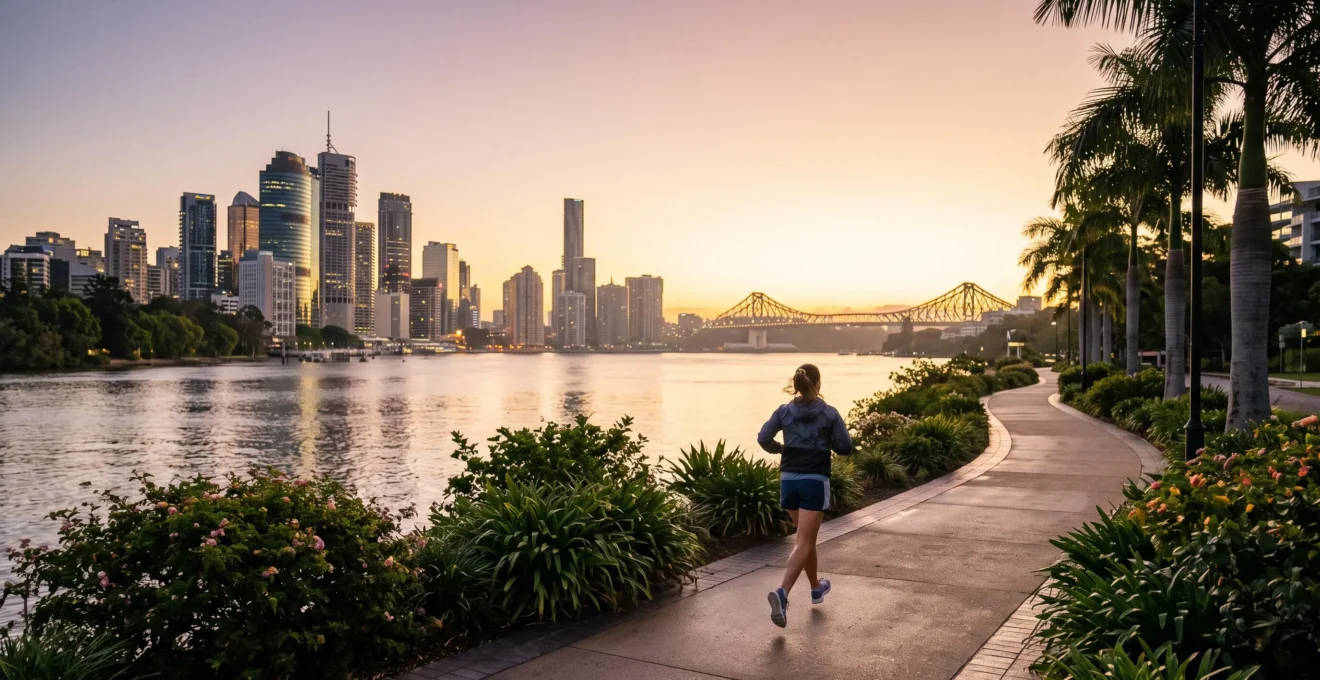
This image captures the essence of a Brisbane morning: calm, open, and inviting. The soft dawn light over the quiet riverside path represents the daily opportunity the city provides for maintaining your wellness rituals. This accessible environment is the first key to successfully blending fitness with travel, allowing you to get your activity in early without a significant barrier to entry, leaving the rest of the day and your energy reserves for exploration.
How to Join Brisbane’s Morning Fitness Groups as a Short-Term Visitor
Maintaining a fitness routine while travelling is often a solitary affair, but it doesn’t have to be. One of the best ways to connect with the city’s active culture is to join a local fitness group. For visitors, the global ‘parkrun’ phenomenon offers a seamless and free way to participate in a timed 5km run or walk. It’s an organised, welcoming event that happens every Saturday morning across the city, providing structure and a sense of community.
For first-time visitors, the South Bank parkrun is an ideal choice. It’s described as the best option for tourists, weaving through the city’s most iconic landmarks. Be prepared for a crowd, as it often attracts over 500 participants, so arriving early is essential. If you prefer a more intimate, local atmosphere, the New Farm parkrun is an excellent alternative. As the city’s original parkrun, it offers a glimpse into a well-established local fitness community. Most Brisbane parkruns see a more typical attendance of 90–220 runners per week, creating a friendly and manageable experience for drop-in visitors.
Integrating into these events is straightforward. You simply pre-register on the official parkrun website to get a personal barcode, which you use to log your time at any event worldwide. This simple step transforms you from a tourist into a temporary local, sharing the path with residents and experiencing the city’s vibrant morning energy firsthand. It’s a perfect example of activity-stacking: you get your workout, a dose of community connection, and a mini-tour of a local park all in one go.
River Kayaking or Mountain Biking: Which Brisbane Outdoor Activity for City-Based Adventurers?
Once you’re ready to move beyond a morning run, the next step is choosing activities that align with your fitness level and sightseeing goals. This is where energy budgeting becomes crucial. Not all activities are created equal; some are short and scenic, while others are full-day commitments that will drain your reserves for other experiences. The choice between a river kayak and a mountain bike adventure is a perfect example of this strategic decision-making process.
River kayaking is often the more accessible option, with a low skill floor and guided tours that last around 90 minutes. It offers high « sightseeing synergy, » allowing you to see the city from a unique water-level perspective without demanding your entire day’s energy. In contrast, mountain biking, especially on trails around the city’s periphery, requires more skill, time, and logistical planning. It’s best treated as the main event of the day rather than an add-on. Deciding between them depends entirely on your daily itinerary and energy budget.
This comparative table helps illustrate how to approach this decision. It’s a tool for strategic planning, allowing you to match an activity to your available time and energy.
| Criteria | River Kayaking | Mountain Biking |
|---|---|---|
| Typical Time Commitment | ~90 minutes (e.g. guided twilight kayak tour) | Half-day or more, including travel to trailheads |
| Skill Floor | Low — beginner-friendly, often guided | Moderate — requires balance and off-road handling |
| Physical Setting | Flat, calm river paddling | Cliffs and trail terrain such as Kangaroo Point |
| Sightseeing Synergy | High — integrates easily with an afternoon of sightseeing | Lower — best reserved as the day’s main activity |
By using this framework, you can consciously choose your adventures. Pair a low-energy paddle with an afternoon at the GoMA (Gallery of Modern Art), or dedicate a full day to conquering a trail, followed by a restful evening. This is the essence of smart active travel: making informed choices that enhance your trip rather than detract from it.
The Brisbane Outdoor Activity Timing That Causes Sun Injuries for 60% of Visitors
A crucial part of your strategic planning, or chrono-planning, must involve managing sun exposure. Many visitors from the Northern Hemisphere or southern Australian states severely underestimate the intensity of Brisbane’s sun. The UV index can reach extreme levels even on days that feel cool or overcast, leading to sunburn and heat-related stress that can derail your plans. This isn’t just an anecdotal warning; public health data shows Queensland has the highest rate of melanoma in the world.
The most common mistake is timing outdoor activities during the peak UV window, typically between 10 a.m. and 3 p.m. Relying on cloud cover for protection is a dangerous fallacy, as UV rays penetrate light clouds easily. Furthermore, Brisbane’s environment, particularly the reflective surfaces of the river and bay, can amplify your exposure. An activity planned for midday might seem like a good idea but can quickly lead to injury and fatigue, compromising the rest of your day.
Therefore, a non-negotiable part of your routine should be checking the daily UV forecast and planning strenuous activities for the early morning or late afternoon. For any activity lasting more than 30 minutes during the day, a multi-layered approach to sun protection is essential. This means not just relying on sunscreen but actively combining it with clothing, a hat, sunglasses, and seeking shade.
Your Sun-Smart Activity Checklist
- Check the UV Index: Before heading out, check the day’s forecast and note the peak hours.
- Assess Reflective Surfaces: Factor in extra protection if you’ll be near water, like the Brisbane River or Moreton Bay.
- Apply a Multi-Layered Defence: Combine sunscreen with a hat, sunglasses, and protective clothing. Never rely on just one.
- Time Your Activity Smartly: Schedule strenuous exercise for early morning or late afternoon, outside the peak UV window.
- Plan for Shade: When active around midday, identify and use shaded areas for rest breaks.
When to Experience Brisbane’s Outdoor Scene Without Competing with Local Morning Crowds
You’ve managed the sun; now you need to manage the crowds. Brisbane’s most popular riverside paths—like the New Farm Riverwalk and the Bicentennial Bikeway—are arteries of city life, bustling with commuters and local fitness enthusiasts during peak hours. Trying to navigate a scenic run or ride during the 7-9 a.m. rush can be a frustrating experience of stop-start traffic, defeating the purpose of a relaxing activity.
The key is to apply your chrono-planning skills to avoid « peak fitness traffic. » One effective strategy is to go earlier than the locals. This is especially viable in summer when seasonal daylight data indicates sunrise can be as early as 4:50 a.m. This pre-dawn window offers a magical, tranquil experience of the city as it wakes, giving you the most popular routes almost to yourself. By the time the main wave of local exercisers arrives, your workout is done.
If you’re not an early riser, the alternative is to go later. After the morning rush disperses (around 9:30 a.m.), the paths become significantly quieter, offering a wide-open window for a mid-morning ride or walk before the lunchtime crowd emerges. On weekends, this pattern shifts. While mornings are busy, afternoons are often surprisingly quiet as locals move on to social events or household chores. By understanding these daily and weekly rhythms, you can time your activities to enjoy the best of Brisbane’s outdoor infrastructure without the congestion.
Why Brisbane’s River Shapes Daily Life More Than Any Other Australian City’s Landmark
To truly understand Brisbane’s outdoor lifestyle, you must understand its river. The Brisbane River, or Maiwar, is not just a scenic backdrop for photos; it is a living, breathing entity that defines the city’s character. Unlike the harbours of Sydney or the placid Yarra in Melbourne, Brisbane’s river is a dynamic system—a true urban wild interface where nature and city life coexist in a raw, unpredictable way. This duality is what makes it so compelling.
On the surface, you see ferries, kayakers, and gleaming skyscrapers. But beneath the calm brown water lies a wild ecosystem. This is most famously embodied by its resident bull shark population. It’s a startling fact for many visitors that wildlife surveys estimate an unexpectedly large population lives within the urban waterway. This presence, while making swimming inadvisable, adds a thrilling edge to any on-water activity and underscores the river’s wild heart.
This duality was perfectly captured in a recent local spectacle that defines the river’s character. The below case study illustrates the river not as a tamed urban canal, but as a stage for surprising natural encounters.
Case Study: The Urban Wild on Display
In the inner-city suburb of Bulimba, residents were astonished to witness a pod of Australian humpback dolphins—a species only recently identified and known to inhabit built-up coastal areas—frolicking in the river. Just days later, a shiver of bull sharks was also spotted in the same area. This juxtaposition of two powerful marine creatures against a backdrop of city ferries and riverside apartments perfectly illustrates the Brisbane River’s unique character as a place where the urban and the wild are in constant, close contact.
How to Sequence Water Sports for Skill Transfer and Injury Prevention
Applying the principle of strategic sequencing is particularly important when it comes to water sports. The Brisbane River and nearby Moreton Bay offer a playground of activities, from stand-up paddleboarding to kayaking and sailing. However, jumping into an advanced activity without preparation can lead to frustration or even injury. A smarter approach is to build a « skill ladder, » starting with a stable, low-intensity activity to build confidence and technique before moving on to more demanding sports.
A guided twilight kayak tour is a perfect example of a « rung one » activity. These experiences are designed for absolute beginners, providing stable craft, expert instruction, and a calm environment. This allows you to master basic paddling strokes and balance without the stress of strong currents or waves. The skills you acquire here are directly transferable to other paddle sports. This initial positive experience can be the gateway to confidently renting a paddleboard or joining a more advanced sea kayaking tour later in your trip.
It’s also crucial to avoid stacking activities that stress the same muscle groups. For instance, pairing a long, intense day of paddling with rock climbing at Kangaroo Point the next day is a recipe for shoulder strain, as both rely heavily on pulling strength. Instead, you should alternate high-drain and low-drain days. Follow an intense paddling session with a gentle riverside walk or a swim at South Bank’s Streets Beach. This ensures you get the most out of each activity while giving your body the recovery time it needs to perform, preventing burnout and injury.
Key takeaways
- Brisbane’s consistent, mild climate is a strategic advantage for maintaining year-round morning fitness routines.
- Successful integration of activity and sightseeing depends on mastering timing to avoid peak sun exposure and crowd congestion.
- Embrace energy budgeting by sequencing activities—mixing low-intensity, high-synergy options with more demanding main events.
How to Experience Brisbane’s Outdoor Lifestyle Beyond the Southbank Tourist Zone
The final layer of a truly integrated active holiday is to venture beyond the obvious. While South Bank and the inner-city river loops are fantastic, they represent only a fraction of what Brisbane offers. The city’s true active lifestyle unfolds in its sprawling network of suburban green corridors, creek-side bikeways, and fringe conservation parks. Tapping into this network is how you move from being a tourist to an explorer.
The key is to change your information sources. Instead of relying on generic city brochures, seek out dedicated regional outdoor guides or local blogs that catalogue adventures beyond the Central Business District. These resources will reveal a hidden Brisbane, full of hundreds of walks, bike rides, and river activities that most visitors never see. Look specifically for listings of bikeway networks and creek corridors, as these are the lifelines of local recreational life.
A car isn’t always necessary for these adventures. Many of these green spaces are accessible via the city’s train network. A short train ride can deposit you near the entrance of a conservation park or a major bikeway, turning a suburban commute line into a car-free route to nature. This approach not only expands your options but also allows you to see the city as its residents do, experiencing the seamless transition from suburban neighbourhood to natural bushland that is so characteristic of Brisbane.
By adopting a mindset of strategic sequencing, energy budgeting, and local exploration, you can transform your Brisbane holiday. It becomes more than a series of sights ticked off a list; it becomes a holistic wellness experience that nourishes both body and mind. Now, put this framework into practice by planning your own active itinerary.