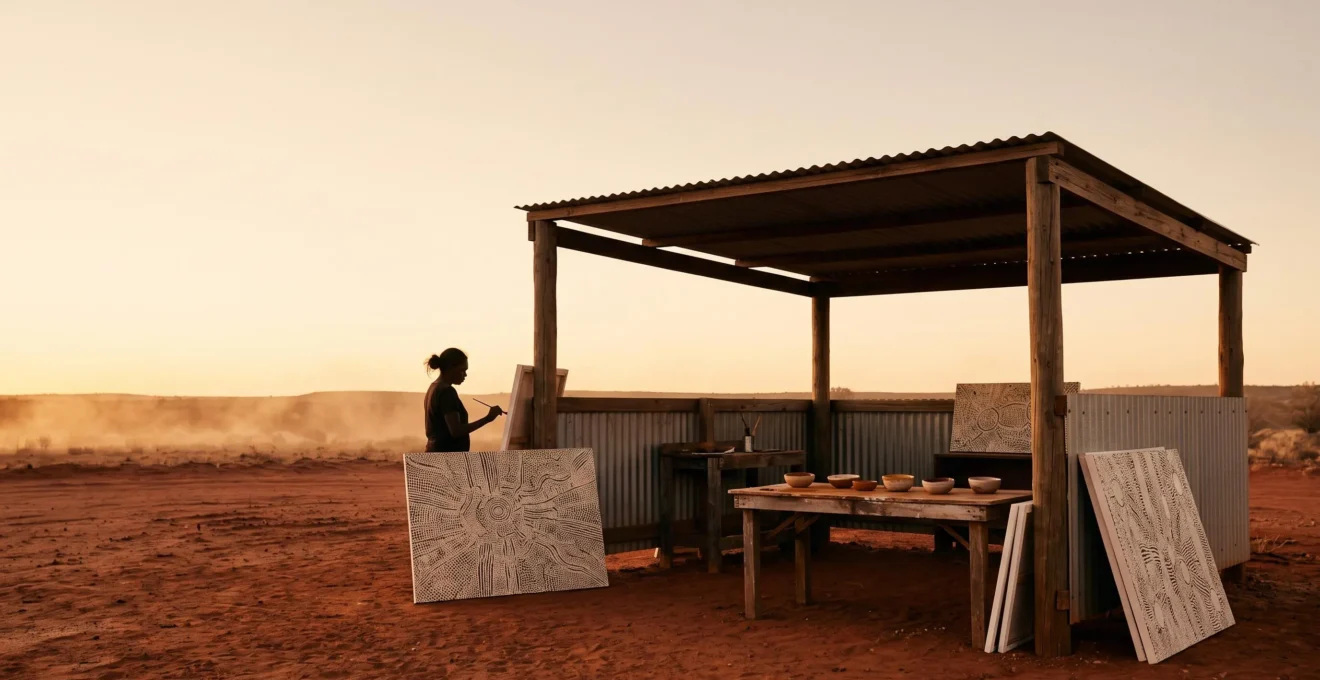
Many approach Aboriginal art seeking a simple dictionary to translate symbols, a method that inevitably leads to misinterpretation. The key to genuine understanding is to abandon this idea. Instead, one must learn the ‘visual grammar’ of the art, recognizing that meaning is constructed through the interplay of an artist’s community, the specific story being told, and the distinct ‘visual dialect’ of their region. True appreciation comes from understanding context, not just decoding isolated icons.
Standing before a masterful piece of Aboriginal art is a powerful experience. The intricate dots, bold lines, and earthy pigments draw you in, creating a mesmerizing visual field. Yet for many art enthusiasts, this initial admiration is quickly followed by a sense of frustration. You can see the beauty, but you feel locked out of the story. The temptation is to search for a simple key, a glossary that translates a circle into a ‘campsite’ or a ‘U’ shape into a ‘person’. While a starting point, this approach fundamentally misses the depth and sophistication of the world’s oldest living art tradition.
The truth is, Aboriginal art is not a collection of pictograms; it is a complex and nuanced visual language. To truly read it requires more than a dictionary of symbols. It requires an understanding of its grammar—the rules, context, and regional variations that give the symbols their specific meaning. It involves grasping the profound difference between a piece of tourist memorabilia and an authentic work that supports an artist and their community. It means knowing the line between appreciation and appropriation.
This guide moves beyond superficial symbol-matching. We will explore the narrative function of dot paintings, learn to distinguish the major regional styles, and provide clear frameworks for ethical purchasing and respectful engagement. By shifting your perspective from decoding to reading, you will unlock a much richer and more meaningful connection with Aboriginal art and its creators.
This article provides a structured path to developing your visual and ethical literacy. Follow along to move from a passive admirer to an informed and respectful participant in the world of Aboriginal art.
Table of Contents: A Guide to Reading Aboriginal Art’s Stories
- Why Aboriginal Dot Paintings Tell Detailed Stories, Not Abstract Decoration
- How to Recognize Central Desert, Arnhem Land, and Kimberley Art Styles
- Artist-Attributed Art or Souvenir Reproductions: Which Purchase Supports Aboriginal Artists?
- The Photography Mistake That Reproduces Restricted Aboriginal Art Without Permission
- When to Visit Aboriginal Art Centers for Artist Interactions, Not Just Sales
- Street Art Tours or Self-Guided Exploration: Which Unlocks Melbourne’s Creative Heart?
- Aboriginal Art Centers or Souvenir Shops: Where to Buy Ethical Authentic Indigenous Art?
- How to Learn About Aboriginal Culture Respectfully Without Appropriation or Tokenism
Why Aboriginal Dot Paintings Tell Detailed Stories, Not Abstract Decoration
The iconic dot paintings of the Central Desert are often the first image that comes to mind when one thinks of Aboriginal art. To the untrained eye, they can appear as beautiful abstract patterns. This is the first and most common misinterpretation. These fields of dots are not primarily decorative; they are a sophisticated narrative technology designed to convey complex knowledge while simultaneously concealing parts of it. This duality is central to understanding their purpose.
Every painting tells a story, often a Tjukurrpa (Dreaming) narrative that connects the land, ancestry, and law. Symbols for campsites, waterholes, animal tracks, and human figures are laid down first. The dots are then applied over and around this foundational layer. This technique has a profound purpose beyond aesthetics. It allows for the co-existence of public and inside stories on a single canvas. Outsiders can appreciate the public, or general, narrative, while the dense dotting veils the restricted, ceremonial iconography meant only for initiated community members.
Case Study: The Strategic Shift at Papunya
The development of dense dotting as a specific technique became prominent in the early 1970s. Following concerns that early Papunya canvases revealed too much sacred knowledge to an uninitiated audience, artists like Clifford Possum Tjapaltjarri and Billy Stockman Tjapaltjarri pioneered the use of dense fields of dots. This innovation allowed them to continue sharing their culture with the world while protecting the sanctity of restricted ceremonial details, a brilliant solution to a complex cultural problem.
This layering of pigment is what gives the paintings their incredible texture and visual vibration. Looking closely at a canvas reveals the artist’s hand in every single dot, a testament to immense patience and skill. The dots are not uniform; they vary in size, colour, and proximity, creating rhythm and depth.
This macro view demonstrates how the layers of dots are built up, obscuring what lies beneath. It is a visual metaphor for the art itself: what is immediately visible is only part of the story. To truly read the work, we must be « brought into the meaning, » understanding that we are only being shown what we are permitted to see. The abstraction is not a lack of content, but a deliberate and masterful act of cultural protection.
How to Recognize Central Desert, Arnhem Land, and Kimberley Art Styles
Thinking of « Aboriginal art » as a single, monolithic style is like thinking of « European art » as one thing. It ignores the vast diversity of a continent. Australia was home to over 600 distinct language groups, and this cultural diversity is mirrored in the art. Each region has its own unique stylistic traditions, stories, and « visual dialects. » Learning to recognize a few key regional styles is the first step in moving beyond generalization and toward genuine visual literacy.
The three most widely recognized regions for collectors and enthusiasts are the Central Desert, Arnhem Land, and the Kimberley. Each has a signature style that is immediately identifiable once you know what to look for.
- Central Desert Style: This is the home of the dot painting style that originated in communities like Papunya. Key features include the use of acrylic paints on canvas, a « top-down » aerial perspective, and the use of well-known symbols to map out Dreaming tracks and significant sites. The meaning of symbols is highly context-dependent and varies between communities.
- Arnhem Land Style: Located in the « Top End » of Australia, this region is famous for its figurative art on bark, poles, and rock surfaces. It is characterized by the iconic « x-ray » style, where artists paint not only the outside of an animal or person but its internal organs and bone structure as well. It also features fine-line cross-hatching known as rarrk, which can signify ancestral power.
- Kimberley Style: In the northwest, the art is dominated by powerful ancestral figures. The most famous are the Wandjina, supreme spirit beings depicted with large, dark eyes but no mouth (they are so powerful that a mouth would be too dangerous), and halo-like headdresses. This region is also home to the ancient and elegant Gwion Gwion (or Bradshaw) figures, a much older and stylistically different form of rock art.
As ART ARK gallery notes, « The meaning of the symbols found in Aboriginal Art can change depending on the context of the story and can vary from region toregion. » A circle in a Central Desert painting might be a waterhole, while in a different context, it could be a star or a fruit. This is why a simple symbol dictionary fails. Understanding the regional origin of a work is the first and most critical piece of contextual information needed for accurate interpretation.
Artist-Attributed Art or Souvenir Reproductions: Which Purchase Supports Aboriginal Artists?
Once you begin to appreciate the stories and styles, the desire to own a piece of this powerful art form often follows. This is where the collector’s journey can take a wrong turn. The market is flooded with mass-produced items labeled « Aboriginal-style » that have no connection to an Indigenous artist or community. Choosing between a genuine, artist-attributed artwork and a souvenir reproduction is the most important ethical decision you will make as a buyer.
An artist-attributed artwork is a unique piece created by a known Indigenous artist, typically working through a community-owned Art Centre. The purchase of such a work directly contributes to the artist’s livelihood and the economic stability of their community. A souvenir reproduction, often made overseas, appropriates cultural motifs for commercial gain with zero benefit flowing back to the culture of origin. They are visually and spiritually empty.
Navigating this requires due diligence. It’s not about being cynical; it’s about being an active and responsible participant in an ethical art ecosystem. Fortunately, buyers are not alone. A robust network of more than 100 Indigenous art centres across Australia operates to ensure artists are treated fairly and buyers can purchase with confidence. Your role is to ask the right questions and look for the right signals.
Your Action Plan: Vetting an Ethical Art Purchase
- Points of Contact: Ask the gallery directly how they source their art. Inquire about their relationship with the artists and the art centres. A reputable dealer will be proud to share this information.
- Collect Documentation: Always request official authentication documentation for the artwork. This should be on art centre or gallery letterhead and include a photo of the work, the artist’s name, their language group, and the story of the piece.
- Verify Pricing Coherence: Check for transparent pricing. Ethical sellers operate on a fixed-percentage model where a clear portion of the sale price goes directly back to the artist and their community-owned art centre.
- Confirm Intellectual Property: Ensure the artwork carries a copyright and an Indigenous Cultural and Intellectual Property (ICIP) acknowledgement. This confirms the artist’s rights are recognized and protected.
- Check for Code Compliance: Before purchasing, ask if the gallery or dealer is a signatory to the Indigenous Art Code. This is a clear indicator that they are committed to fair and ethical trade practices.
Making an ethical purchase transforms the act of buying from a simple transaction into a meaningful act of cultural support. It ensures that the art that hangs on your wall is not just a beautiful object, but a living connection to an artist and their story.
The Photography Mistake That Reproduces Restricted Aboriginal Art Without Permission
In our visually-driven digital age, the impulse to capture and share beauty is almost automatic. When visiting a gallery or an art exhibition, taking a photo seems like a natural way to remember a powerful piece. However, when it comes to Aboriginal art, this simple act can unintentionally become an act of cultural disrespect and copyright violation, particularly concerning the reproduction of restricted knowledge.
The concept of « public » versus « inside » stories is critical here. Many artworks, especially those with ceremonial significance, contain layers of information not meant for general distribution. When an artist creates a work, they make a conscious decision about what to reveal and what to veil. A photograph, especially a high-resolution one shared online, can strip away these protective layers. It captures and flattens all information, making the restricted elements openly accessible in a way the artist never intended. This is not just a breach of etiquette; it is a violation of Indigenous Cultural and Intellectual Property (ICIP).
Reputable galleries and museums have strict « no photography » policies for this reason. These rules are not in place to be difficult, but to protect the artists and the integrity of their cultural knowledge. A sign asking you not to take a photo is a direct request from the community, through the gallery, to respect these cultural boundaries. Ignoring it, even with the best intentions, is to prioritize a personal snapshot over the deeply held cultural protocols of the artist.
This image serves as a powerful metaphor. The draped cloth represents the veil that protects the « inside » story, the sacred knowledge that is not for public view. Photographing an artwork that contains such elements is akin to pulling back that cloth without permission. As a respectful observer, your role is to appreciate the work within the boundaries set by the artist and their community. The best way to « take » a piece of art home is to buy it ethically from the artist, or to purchase a licensed postcard or print from the gallery shop, where the artist receives a royalty for the reproduction.
When to Visit Aboriginal Art Centers for Artist Interactions, Not Just Sales
For the truly committed enthusiast, the ultimate experience is to move beyond the city gallery and visit an Aboriginal Art Centre directly. These centres are the vibrant heart of the Indigenous art world. They are not just galleries; they are community-owned studios, social hubs, and cultural archives, often located in remote areas where the artists live and work. Visiting one offers a unique opportunity for genuine interaction that transcends a simple commercial transaction.
However, it’s crucial to approach a visit with the right mindset. These are working art studios and community spaces first, and tourist destinations second. The primary purpose is to provide a supportive environment for artists to create and earn a fair income. As Stephanie Rajalingam, Manager of the Warmun Art Centre, states:
It’s important to buy ethically because it sustains the livelihoods of Indigenous artists through a system of fair and transparent conduct.
– Stephanie Rajalingam, ABC News
This principle of « fair and transparent conduct » should guide your visit. The goal is not to haggle or to demand an artist’s time, but to observe, learn, and purchase art in a way that directly supports this system. Many art centres are open to the public, but it is essential to check their websites or call ahead. Some may have specific visitor days or require appointments. Respecting these protocols is the first step in a meaningful visit.
If you’re planning a trip, a great starting point is to research the peak body organisations representing hundreds of ethically operated art centres across the country. Bodies like ANKA (Arnhem, Northern and Kimberley Artists), Desart (for Central Australian art centres), and the Indigenous Art Code provide lists of member centres, ensuring any visit you plan is to a reputable, community-governed organization. These visits allow you to see the art being made, sometimes meet the artists (if they are available and willing), and understand the deep connection between the artwork, the artist, and their Country.
Street Art Tours or Self-Guided Exploration: Which Unlocks Melbourne’s Creative Heart?
The narrative of Aboriginal art is not confined to galleries or remote communities; it is a living, breathing, and evolving tradition that explodes onto the urban landscape. In cities like Melbourne, a new generation of Indigenous artists are using the language of street art and graffiti to tell contemporary stories, challenge stereotypes, and assert their presence in the city.
This urban expression is a vital part of the modern Aboriginal art story, directly challenging the platitude that Indigenous art is something ancient and exclusively rural. Artists like Reko Rennie, a Kamilaroi man, explicitly connect their work to these urban subcultures. As Rennie states, « As an urban Indigenous Australian, my work often references the hip-hop and graffiti subcultures that were influential on my artistic practice. » This fusion creates a powerful new visual language that speaks to a contemporary, urban Aboriginal identity.
Case Study: Reko Rennie’s Urban Interventions
A powerful example is ‘Initiation’, a mural-scale work by Reko Rennie. This piece brings together traditional Kamilaroi diamond-shaped designs, language, and bold, neon-coloured protest symbols. Displayed prominently in an urban setting, the work directly confronts common misconceptions about what Aboriginal art and identity look like in the 21st century. It’s a declaration that Indigenous culture is not static but dynamic, adapting and thriving in the heart of the modern city.
So how does one engage with this vibrant scene? Melbourne’s famous laneways, such as Hosier Lane, are public galleries open 24/7. A self-guided tour allows you to discover works at your own pace, experiencing the thrill of finding a hidden masterpiece. However, a guided street art tour, especially one led by an Indigenous guide, can provide invaluable context. Guides can point out works by First Nations artists, explain the political and social commentary embedded in the art, and share stories about the artists themselves, transforming a walk through the city into a deep cultural lesson.
Ultimately, the choice depends on your goal. For pure visual discovery, go it alone. But to truly unlock the meaning and stories behind the art, a guided tour offers a level of insight that is hard to achieve on your own. It’s an opportunity to understand the city’s creative heart from the perspective of its First Peoples.
Aboriginal Art Centers or Souvenir Shops: Where to Buy Ethical Authentic Indigenous Art?
The distinction between an authentic piece of art from a community Art Centre and a mass-produced item from a tourist souvenir shop is the most critical line for a buyer to understand. One supports a culture; the other often exploits it. Recognizing the difference is a core skill of ‘ethical literacy’ and is easier than you might think once you know the red and green flags.
Souvenir shops often sell items with generic « Aboriginal-style » designs. These are frequently made offshore, with no benefit returning to Indigenous communities. They trade on the visual appeal of the culture without participating in its social or economic fabric. In contrast, Aboriginal Art Centres are legally-constituted, non-profit cooperatives owned and run by the artists and their communities. Buying directly from them, or from a reputable gallery that sources from them, ensures your money sustains the artists and their culture. To combat exploitation, the Indigenous Art Code was set up in 2009 to establish a clear standard for fair and ethical trade.
The following table provides a clear comparison to help you make an informed choice. Think of it as your quick-reference guide for ethical purchasing.
| Signal | Souvenir Shop (Red Flag) | Art Centre (Green Flag) |
|---|---|---|
| Attribution | Generic ‘Aboriginal-style’ label, no named artist | Named artist with community and language group listed |
| Documentation | No paperwork or certificate provided | Official art centre authentication certificate on letterhead |
| Ownership structure | Often mass-produced overseas for tourist resale | Legally-constituted, non-profit cooperative owned by artists |
| Price | Suspiciously low, no transparency on distribution | Clear pricing with a fixed percentage returned to the artist |
As Better World Arts explains, « Buying direct from art centres adds certainty, as art centres are legally-constituted, non-profit cooperatives, owned and run by the artists and their communities. » This structure is the ultimate guarantee of authenticity and ethical practice. When you buy from an Art Centre, you are not just acquiring an artwork; you are investing in a system designed by and for Indigenous people to maintain their culture and thrive economically.
Key Takeaways
- Aboriginal art is a visual language, not a simple code; context, region, and artist intent are essential for interpretation.
- Artistic styles are diverse regional « dialects, » with Central Desert dot painting, Arnhem Land x-ray art, and Kimberley Wandjina figures being distinct traditions.
- Ethical purchasing is non-negotiable; buying from community-owned Art Centres or Indigenous Art Code signatories directly supports artists and their culture.
How to Learn About Aboriginal Culture Respectfully Without Appropriation or Tokenism
Your journey into the world of Aboriginal art is now equipped with the tools for visual and ethical literacy. You understand that paintings are stories, that styles are regional, and that your purchasing power has a direct impact on artists’ livelihoods. The final step is to integrate these principles into a holistic approach of respectful engagement, ensuring your appreciation never tips into appropriation or tokenism.
Appropriation happens when cultural elements are taken from a minority culture by a dominant culture and used outside of their original context, often for profit or status, without giving credit or benefit to the source community. Tokenism is the superficial effort to be inclusive, such as displaying a single piece of « Aboriginal-style » art without understanding its origin or meaning, simply to appear culturally aware.
Avoiding these pitfalls comes down to a commitment to continuous learning and prioritizing the voices and systems of First Nations people. It means privileging depth over breadth. It’s better to deeply understand the story of one artwork you purchased ethically, knowing the artist’s name, community, and the meaning of the work, than it is to have a superficial knowledge of a hundred symbols. It means following the lead of Indigenous-owned and governed organizations like the Indigenous Art Code and community Art Centres.
True respect is demonstrated through action. It’s in the questions you ask before buying, in the « no photography » signs you obey, in the choice to take an Indigenous-led tour, and in the effort you make to learn the artist’s name, not just the title of the work. It is an ongoing process of listening, learning, and acknowledging that you are a guest in a rich and ancient cultural world. This approach transforms you from a mere consumer into a genuine ally and a custodian of the story that you have been privileged to acquire.
By embracing this framework of visual grammar and ethical literacy, you can confidently engage with Aboriginal art, ensuring your journey is one of true appreciation that honours the artists and the profound culture they represent.