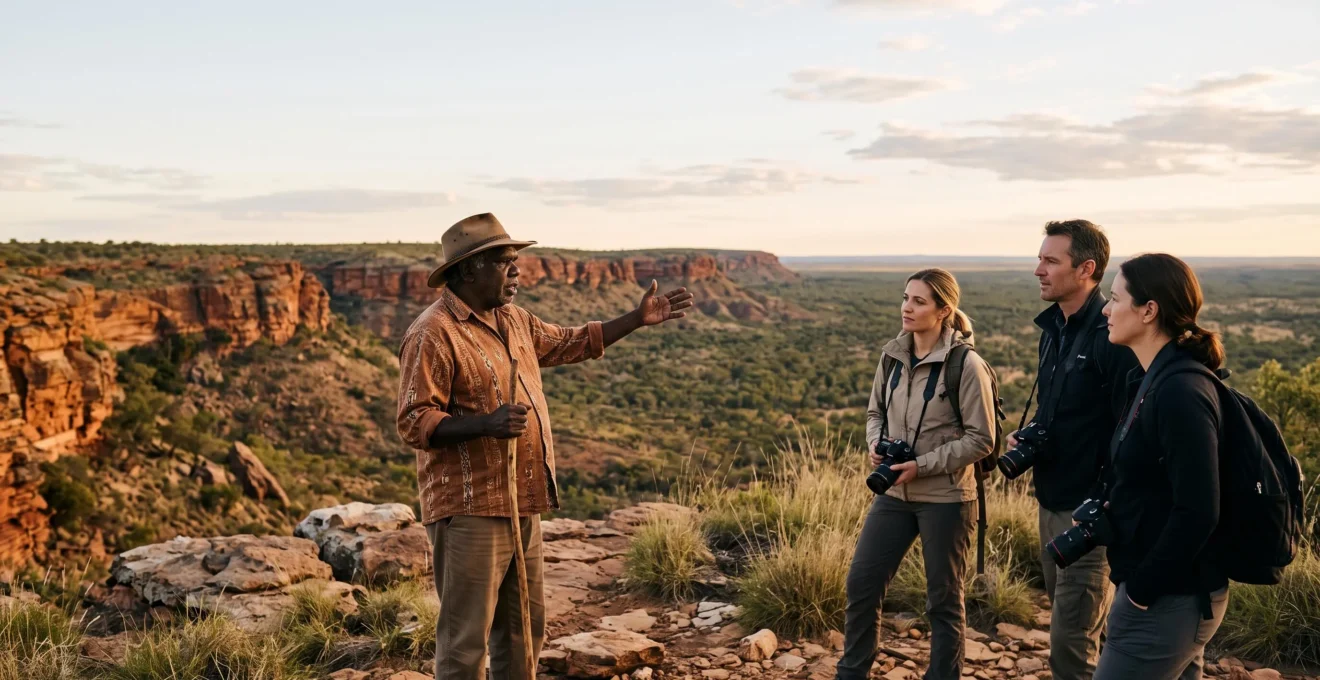
The true value of an Aboriginal cultural tour lies not in the spectacle, but in the verifiable flow of knowledge, authority, and economic benefit back to the community.
- Authentic experiences are led by community-endorsed Knowledge Holders, not just guides performing a script.
- Vetting requires checking for specific credentials like ROC certification, Land Council agreements, and named Traditional Owner involvement.
Recommendation: Shift your mindset from a consumer of entertainment to a respectful student, and use the criteria in this guide to assess and choose tours that support genuine cultural sovereignty.
The desire for a genuine connection with the world’s oldest living cultures is a powerful motivation for traveling to Australia. Yet, many travelers return from so-called « Aboriginal experiences » with a sense of unease—a feeling they’ve witnessed a performance rather than participated in a meaningful exchange. They followed the common advice to « find an Aboriginal-owned tour, » but the experience felt hollow, a polished product designed for mass consumption.
This feeling often arises because the tourism industry can dilute culture into entertainment. The usual guidance, while well-intentioned, fails to equip travelers with the tools to discern the difference between a third-party operator using Indigenous themes and a community-led enterprise sharing its own story, on its own terms. The focus is often on what you see, not on who has the authority to show it, who is telling the story, and who truly benefits from you being there.
But what if the key wasn’t a simple checklist, but a fundamental shift in perspective? What if the goal was not to « see » Aboriginal culture, but to learn how to respectfully engage with its custodians? This guide moves beyond surface-level advice. It provides an ethical framework for you, the culturally serious learner, to become a quality assessor. We will explore how to verify cultural authority, understand the crucial role of economic sovereignty, and adopt a mindset that transforms you from a spectator into a welcome student.
This article will provide a clear framework for making informed and ethical choices. We will delve into the critical differences between operator types, provide concrete steps for verification, and explore the mindset required for a truly reciprocal learning experience.
Contents: A Framework for Choosing Community-Led Aboriginal Tours
- Why Aboriginal-Owned Tours Teach Culture Third-Party Operators Cannot Access
- How to Verify Cultural Tour Operators’ Real Aboriginal Credentials and Endorsements
- On-Country Tours or Urban Cultural Centers: Which Delivers Deeper Aboriginal Learning?
- The Tour Mindset That Treats Aboriginal Guides as Performers, Not Knowledge Holders
- When to Book Small-Group Cultural Tours and Avoid Large Tour Buses
- How to Identify Authentic Aboriginal Experiences and Avoid Cultural Appropriation Tourism
- Bush Tucker Cultural Tours or Survival Courses: Which Learning Path Suits Your Goals?
- How to Learn About Aboriginal Culture Respectfully Without Appropriation or Tokenism
Why Aboriginal-Owned Tours Teach Culture Third-Party Operators Cannot Access
The distinction between an Aboriginal-owned tour and one run by a non-Indigenous third party is not merely a matter of ownership; it’s a matter of cultural authority. Aboriginal-owned and community-led operations are not just businesses; they are acts of cultural maintenance and economic self-determination. When you choose them, you are directly supporting what experts call the growth of Aboriginal tourism, an industry with deep community roots. These enterprises are founded on a responsibility to care for Country and ensure knowledge is passed down correctly.
Third-party operators, even those with Indigenous employees, often lack this foundational connection. They may license a « cultural product, » but they cannot possess the inherited rights and responsibilities that give the stories and ceremonies their true meaning. The person guiding your tour on an Aboriginal-owned experience is frequently a Knowledge Holder, someone with a designated role within their community. As the national training standards for tourism highlight, this is a formal status.
Individuals may have a very specific role, as an Australian Indigenous person or other individual approved of by local elders, to share aspects of their culture with visitors.
– SIT10112 Training Package, Certificate I in Tourism (Australian Indigenous Culture)
This means the information shared is not second-hand interpretation. It is a direct transmission from an authorized source. The stories, the significance of a place, and the use of a plant are all contextualized within a living cultural framework that a third-party company cannot replicate. Collectives like the Discover Aboriginal Experiences portfolio, which brings together dozens of community-vetted leaders, exist specifically to connect travelers with these primary sources, ensuring the economic benefits and the narrative control remain with the rightful custodians.
How to Verify Cultural Tour Operators’ Real Aboriginal Credentials and Endorsements
Moving beyond a generic « Aboriginal-owned » claim on a brochure requires a proactive, investigative approach. True community-led operators are transparent about their connections and credentials because this is the source of their authority. Your role as a responsible traveler is to look for this evidence. Don’t be afraid to ask direct questions before you book; a legitimate operator will welcome your diligence as a sign of respect. This vetting process is your most crucial step in ensuring your tourism dollar supports genuine economic sovereignty and not a corporate imitation.
Start by looking for formal certifications and agreements. These are industry-recognized indicators that an operator has undergone a rigorous process of consultation and meets ethical standards. Then, dig deeper into the operator’s public-facing information to find evidence of specific, named community connections. A lack of transparency is a significant red flag. For instance, the case of Nyanda Cultural Tours in Queensland demonstrates best practice: the business is publicly presented as being run by named individuals, Madonna Thomson and Shoshana William, who are identified as Jagera and Mununjali traditional owners for that specific Country. This is the level of verifiable lineage to look for.
Your Vetting Checklist: 5 Points to Verify a Tour’s Credentials
- Check for ROC Certification: Does the operator hold Ecotourism Australia’s « Respecting Our Culture » (ROC) certification? This is a key national standard developed with Aboriginal tourism bodies.
- Verify Land Council Agreements: If operating on Aboriginal land, look for evidence that the operator has engaged with the relevant Land Council under a formal land-access agreement.
- Assess Cultural Specificity: Is the product focused on the specific cultural values of the area visited, or does it present a generic, « pan-Aboriginal » package?
- Evaluate the Itinerary: Does the tour dedicate the majority of its time to genuine cultural experience, or is significant time allocated to gift shops and merchandise sales?
- Look for Named Endorsements: Can you find named Elders or Traditional Owners from that specific community who publicly endorse or are involved with the tour on their website or social media?
Using this framework transforms you from a passive consumer into an active participant in ethical tourism. It ensures your choice is based on proven commitment, not just marketing language.
On-Country Tours or Urban Cultural Centers: Which Delivers Deeper Aboriginal Learning?
A common misconception among travelers is that a « real » Aboriginal experience can only happen in the remote outback, far from cities. This creates a false dichotomy that devalues the rich, living cultures present in urban and regional centers. While on-Country tours in remote areas offer profound immersion, the depth of learning is determined by the quality of the Knowledge Holder, not the location. Indeed, recent tourism data shows that 1.9 million domestic trips included First Nations activities, spanning a vast range of environments.
Urban cultural tours are not a « lesser » experience; they are a different and equally valid one. They often tell powerful stories of survival, adaptation, and cultural continuity in the very places where colonization had its most immediate impact. These tours connect you to the history layered beneath the modern city, revealing a perspective you would otherwise miss entirely.
A prime example is the collection of Aboriginal-led heritage tours at Barangaroo Reserve in the heart of Sydney. Here, on a 22-acre reclaimed headland, cultural guides share the stories of the Gadigal people, their connection to the harbour, and the use of local plants. The experience is deeply rooted in place and community authority, proving that a profound connection to Country can be powerfully conveyed within a major metropolis. The choice is not about « remote vs. urban, » but about which story you want to learn. Do you want to understand deep-time connection in a largely unchanged landscape, or the story of resilience in a transformed one?
The Tour Mindset That Treats Aboriginal Guides as Performers, Not Knowledge Holders
The single most significant shift a traveler can make is one of mindset: from a spectator demanding a performance to a student ready for reciprocal learning. When you view your guide as a performer, your focus is on entertainment value. You might judge the experience by the quality of a dance, the spectacle of a fire-making demonstration, or the exoticism of the stories. This consumer mindset subtly pressures guides to deliver a polished, repeatable, and often simplified version of their culture, stripping it of its complexity and depth.
Adopting the mindset of a student changes everything. Your focus shifts to listening, observing, and understanding. You recognize the person guiding you as a Knowledge Holder, an expert sharing insights from a sophisticated, ancient system of knowledge. Your goal becomes comprehension, not consumption. This perspective allows for the moments of quiet observation, the unscripted detours, and the complex, sometimes challenging, truths that are the hallmarks of a genuine cultural exchange. It means putting the camera down to truly listen.
A Knowledge Holder offers insights that disrupt your own worldview, which is a key sign of authentic learning. For example, a guide might share a detail that fundamentally challenges Western assumptions, as one guide did when explaining a core societal structure:
[Aboriginal] society is matriarchal not patriarchal.
– Timothy Gray, Aboriginal cultural guide, Afar Magazine
This simple statement is not a performance; it is a profound piece of cultural education that invites you to reconsider your own ingrained perspectives. It is a gift of knowledge, not an act of entertainment. Approaching your tour with humility and a genuine desire to learn creates the space for these powerful moments to occur.
When to Book Small-Group Cultural Tours and Avoid Large Tour Buses
The structure of a tour has a profound impact on the quality of the cultural exchange. Large tour buses, by their very nature, enforce a performer-spectator dynamic. With dozens of people to manage, the experience must be standardized, sticking to a strict schedule and a pre-approved script. The guide becomes a lecturer with a microphone, and the participants become a passive audience. There is little to no room for spontaneous questions, personal stories, or the quiet, shared moments where true learning happens.
Small-group tours, in contrast, create an environment conducive to reciprocal learning. The intimate scale transforms the dynamic from a lecture into a conversation. It allows the Knowledge Holder to adapt the experience to the group’s interests, to pause and point out a detail on a plant, or to share a personal story that isn’t part of the standard itinerary. This flexibility is where the most memorable and impactful learning occurs. It’s the difference between being told about a medicinal plant and having someone show you the leaf, crush it in their hands, and share its scent and story with you directly.
In a small group, you are not an anonymous face in a crowd. You are an individual participant, and this encourages a greater sense of responsibility and respect in your interactions. The guide can learn from you—your questions, your background—and tailor their sharing accordingly. This two-way exchange is the heart of a respectful encounter. Choosing a small-group tour is a practical decision that directly supports a deeper, more personal, and more authentic form of cultural education, moving beyond the superficiality that large-scale tourism often necessitates.
How to Identify Authentic Aboriginal Experiences and Avoid Cultural Appropriation Tourism
Authenticity in tourism extends beyond the tour itself to the items you might purchase along the way. Many tours include a stop at a gallery or gift shop, and this moment represents another critical opportunity to make an ethical choice. The market is unfortunately flooded with inauthentic art and souvenirs that appropriate Aboriginal designs without benefit to the artists or their communities. Buying these items, even with good intentions, contributes to a system that devalues cultural intellectual property. A truly authentic experience, led by a community-conscious operator, will guide you toward ethical purchasing options.
The principle is the same as vetting a tour: follow the money and the authority. Ethical art and product sales are transparent. They are about ensuring the original artist is paid fairly and credited for their work. The market for legitimate Aboriginal art is significant, contributing substantially to the Australian economy, and your purchase should support the artists who are the foundation of this industry. Before you buy, you have the right and the responsibility to ask questions about the product’s origin and the payment structure.
Be wary of anything described as « Aboriginal-style » or products with no information about the artist. Legitimate sellers are proud of the artists they represent and are happy to share their stories. Your diligence supports an ethical ecosystem where artists can thrive. Key questions to ask include:
- Can you tell me about the artist who made this and the story behind the work?
- How is the artist paid for this specific item? Does the majority of the sale price go to them?
- If this is a reproduction (like a tea towel or mug), does the artist receive a royalty or licensing fee for every item sold?
- Are you a member of the Indigenous Art Code or a similar ethical trade body?
A vendor’s hesitation or refusal to answer these questions is a clear sign to walk away. Choosing to buy directly from an Aboriginal-owned art centre or a gallery with proven ethical practices ensures your souvenir is a genuine story, not an empty symbol.
Bush Tucker Cultural Tours or Survival Courses: Which Learning Path Suits Your Goals?
Once you’ve learned how to identify community-led operators, the next step is to choose the type of experience that best aligns with your personal learning goals. The world of First Nations tourism is not monolithic; a state tourism paper outlines that experiences span everything from rock art visits to wildlife tracking. Two common themes are « bush tucker » tours and « survival » courses, and while they may seem similar, their educational focus is often quite different. Understanding this difference is key to finding a satisfying experience.
A bush tucker tour is primarily about cultural education through the lens of food. The focus is on the « what » and the « why »: what plants and animals are traditional food sources, how are they prepared, and what are the cultural stories and protocols associated with them? It’s a deep dive into the sophisticated knowledge systems related to botany, seasonality, and culinary traditions. This path is ideal for those interested in culture, storytelling, and the intricate relationship between people and their environment.
A survival course, while it may include some bush tucker elements, is typically focused on practical application—the « how. » The objective is to teach you skills: how to find water, how to build a shelter, how to make a tool. While culturally rooted, the emphasis is on technique and self-sufficiency. This path is better suited for those who are hands-on learners, interested in bushcraft, and want to test their practical abilities. Both are valid, but they serve different purposes. Clarifying your own motivation—are you there to understand a worldview, or to learn a skill set?—will guide you to the right choice.
Traditional owners see tourism as a way to strengthen their connections to and care for country, but also to share their knowledge of it with their young people as well as visitors.
– Central Land Council, Tourism
This insight reveals that regardless of the tour’s focus, the underlying purpose for many communities is the same: to maintain and strengthen culture. By choosing the tour that genuinely interests you, you become a more engaged and respectful student, contributing positively to that goal.
Key takeaways
- Prioritise verifiable Aboriginal ownership and community endorsement by checking for ROC certification and named Traditional Owner involvement.
- Shift your mindset from a spectator seeking entertainment to a respectful student of a Knowledge Holder, ready for a two-way exchange.
- Assess a tour’s structure: small groups and dedicated time on Country (whether urban or remote) create the conditions for deeper, more genuine connection.
How to Learn About Aboriginal Culture Respectfully Without Appropriation or Tokenism
Ultimately, choosing a community-led tour is the first step in a larger journey of learning to engage respectfully. The principles you use to vet a tour—verifying authority, ensuring fair economic benefit, and adopting a student mindset—form a complete ethical framework that can guide all your interactions. It’s about moving from tokenism, which is a superficial gesture of inclusion, to genuine support, which involves a conscious effort to engage with a culture on its own terms. This means continuing to apply your critical assessment skills throughout your travels.
This respectful approach is perfectly encapsulated in the practice of ethical sourcing. A gallery that builds long-term, direct partnerships with Aboriginal-owned art centres is doing more than just selling art; it is participating in a system of economic sovereignty and cultural respect. Your purchase becomes a traceable story, not just a transaction.
Case Study: The Ethical Sourcing Model
A gallery specializing in ethical Aboriginal art demonstrates a model built on over a decade of direct partnerships with more than 15 remote, Aboriginal-owned art centres. This long-term commitment ensures that sales not only pay the artist fairly but also reinvest income into the art centre’s operational costs and community programs. This transforms a simple purchase into a sustainable investment in cultural infrastructure, offering a practical example of how consumer choice can directly support community-driven goals and create a traceable, supported story for both the artist and the buyer.
This model of long-term partnership and transparent benefit is the gold standard. It shows a commitment that goes beyond a single transaction. By applying this logic to every aspect of your engagement—from the tours you take to the souvenirs you buy and the stories you share—you actively avoid appropriation. You become an ally, using your presence and your purchasing power to support systems that empower Aboriginal communities to control their own narratives and their own economic futures. This is the true meaning of a genuine cultural experience.
Your journey as a culturally serious traveler begins not when you arrive, but when you choose how you will engage. By applying this rigorous, respectful framework to your planning, you can ensure your travels are a force for positive exchange, supporting the custodians of the cultures you have come to learn from.