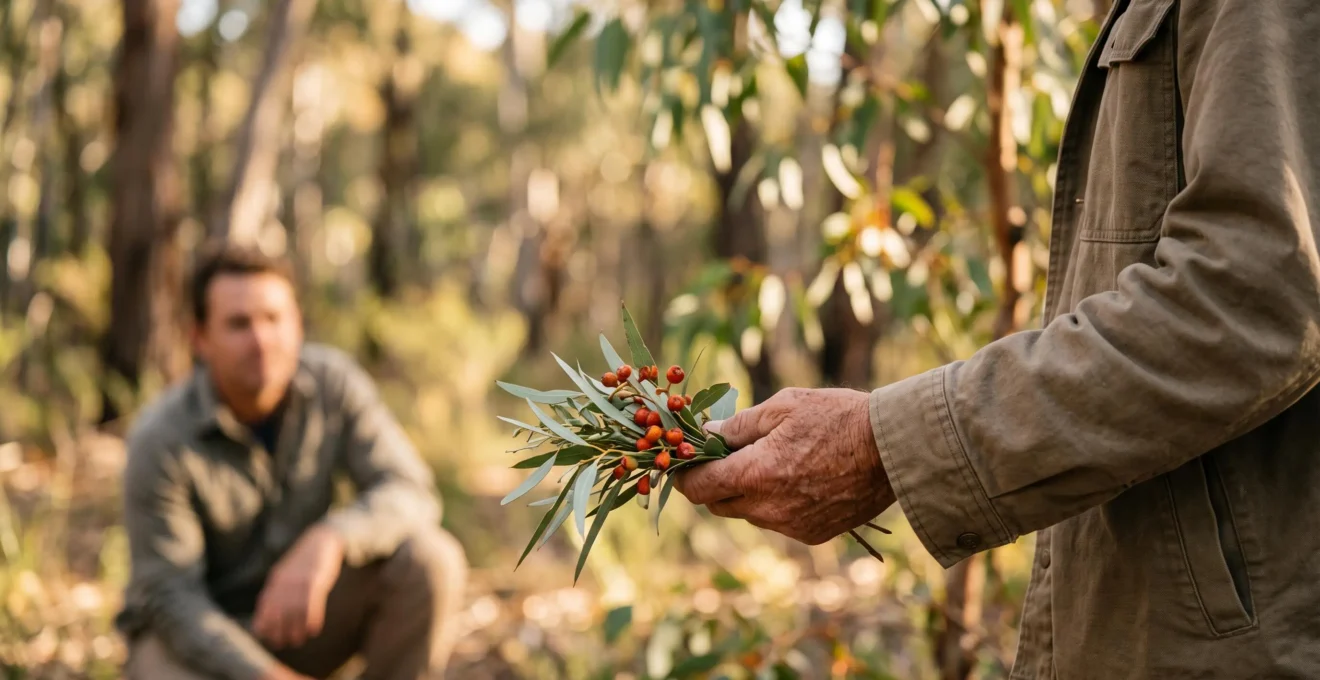
Learning Aboriginal bush tucker is not about acquiring a survival skill; it’s about understanding a complex ecological relationship through a cultural lens.
- True Aboriginal knowledge is advanced ecology, a system of managing landscapes for biodiversity and long-term sustainability.
- The only safe and ethical learning path is through guided experiences with community Knowledge-Holders; apps and DIY foraging are dangerous and disrespectful.
Recommendation: Choose community-owned cultural tours over generic survival courses to ensure your learning is authentic, respectful, and directly supports cultural preservation.
For many foraging enthusiasts, the idea of learning Aboriginal bush tucker is magnetic. It evokes images of a deeper connection to the land and the allure of self-sufficiency. The common path seems clear: buy a field guide, download a plant-ID app, and venture into the bush to identify a few edible plants. This approach frames bush tucker as a simple list of wild foods to be collected, a basic survival skill to be mastered.
But what if this entire premise is flawed? What if the real value isn’t in what you can take from the land, but in what you can learn from its oldest living culture? The fundamental shift required is moving from an extractive mindset— »what can I get? »—to a relational one: « how do I understand? » True Aboriginal knowledge is not a static list of edible species; it’s a dynamic, living system of ecology, philosophy, and custodial responsibility that has sustained people and place for over 60,000 years.
This guide reframes the journey. It’s not a field guide to edible plants. Instead, it offers a respectful pathway to understanding *why* this knowledge is so profound, the dangers of a superficial approach, and how to engage with it ethically and safely. We will explore why Aboriginal knowledge is a sophisticated science, how to choose the right learning path, and how to ensure your journey contributes to, rather than detracts from, the communities who are the rightful custodians of this heritage.
To help you navigate this complex and rewarding topic, this article is structured to build your understanding step by step. The following summary outlines the key areas we will cover, from foundational concepts to practical advice for choosing an authentic experience.
Summary: A Respectful Guide to Learning Aboriginal Bush Tucker Knowledge
- Why Aboriginal Bush Tucker Knowledge Is Advanced Ecology, Not Basic Foraging
- How to Learn Bush Tucker Plant Identification Without Poisoning Yourself
- Bush Tucker Cultural Tours or Survival Courses: Which Learning Path Suits Your Goals?
- The Bush Foraging Mistake That Damages Native Ecosystems Aboriginal People Manage
- When to Experience Bush Tucker Tours for Seasonal Plant Diversity and Harvest
- How to Identify the 15 Key Australian Native Plants on Any Bushwalking Trail
- Why Aboriginal-Owned Tours Teach Culture Third-Party Operators Cannot Access
- How to Choose Aboriginal Cultural Tours Led by Community Members, Not Tour Companies
Why Aboriginal Bush Tucker Knowledge Is Advanced Ecology, Not Basic Foraging
The term « foraging » barely scratches the surface of what Aboriginal bush tucker knowledge represents. It’s a common misconception to view these practices through the narrow lens of survival. In reality, it is one of the world’s oldest and most sophisticated sciences of applied ecology. For millennia, Aboriginal people have not just survived in the Australian landscape; they have actively shaped and managed it to increase its biodiversity and productivity. This is not passive gathering; it is custodial management.
A prime example of this is cultural burning, often called « fire-stick farming. » This is not simply about preventing large wildfires. It is a precise ecological tool used to create a mosaic of habitats at different stages of regeneration. An ethnographic and satellite study found that this deliberate practice of creating small-scale habitat mosaics directly increases small-animal hunting productivity and vegetational diversity. It’s a form of landscape architecture that nurtures the land to ensure it provides for generations to come.
As this fire-managed landscape shows, the outcome is a healthier, more resilient ecosystem. Understanding bush tucker, therefore, is not just learning which berry to eat. It is about understanding the intricate web of relationships between plants, animals, fire, seasons, and people. It’s a holistic worldview that sees humanity as a caretaker of Country, not its master. This deep, relational knowledge is the true essence of bush tucker.
How to Learn Bush Tucker Plant Identification Without Poisoning Yourself
In the age of instant information, it’s tempting to think you can learn plant identification from an app or a book. This is arguably the most dangerous mistake a budding forager can make, especially in Australia, where many edible plants have toxic look-alikes. Relying on technology for this task is a gamble with your health. The belief that an app can replace a Knowledge-Holder is a critical misunderstanding of the expertise required.
The data on this is clear and concerning. For instance, a study from the University of Leeds and University of Galway found that even the best-performing plant identification app was only 80-88% accurate. This means at least one in every five identifications could be wrong. When dealing with potentially toxic flora, those odds are unacceptable. Furthermore, clinical toxicology research highlights that misidentifications occurred with some significantly toxic plants like Hemlock (Conium maculatum) even with high-quality photos.
True identification goes beyond a simple visual match. A trained Aboriginal guide or Elder teaches a multi-sensory process. They teach you to look at a plant’s entire context: where it grows, what grows with it, the texture of its leaves, the smell when crushed, and the subtle differences in its form throughout the seasons. This deep, contextual identification is a skill honed over a lifetime and passed down through generations. It cannot be replicated by an algorithm. The only safe way to learn is in person, from a qualified human being who holds that generational knowledge.
Bush Tucker Cultural Tours or Survival Courses: Which Learning Path Suits Your Goals?
Once you accept the need for expert guidance, you face a crucial choice: do you join an Aboriginal cultural tour or a generic survival course? While both may involve being in the bush, their philosophies and outcomes are worlds apart. The decision reveals your core intention: are you seeking to extract a skill for personal use, or are you seeking to build a relationship with a culture and its Country? Understanding this distinction is key to a respectful journey.
A generic survival course typically focuses on an individualistic, extractive model. The goal is self-reliance and mastering techniques to conquer nature. Knowledge is presented as a universal toolkit, often divorced from its cultural origins. In contrast, an Aboriginal cultural tour is built on a relational and reciprocal framework. The objective is not to conquer the land, but to understand your place within it. Learning is a gift shared by a Knowledge-Holder, and it comes with an implicit responsibility to respect the culture and the environment.
The following table, based on the fundamental differences in approach, can help clarify which path aligns with your goals.
| Criterion | Aboriginal Cultural Tour | Generic Survival Course |
|---|---|---|
| Learning Objective | Understanding worldview and relationship with Country | Acquiring individual practical skills |
| Knowledge Source | Elder or Traditional Owner with custodial authority | Instructor trained in generic survival techniques |
| Ethical Framework | Reciprocity and custodial responsibility | Self-reliance and personal endurance |
| Outcome | Allyship and cultural respect | Independence and self-sufficiency |
Ultimately, if your goal is simply to learn how to survive in the wild, a generic course may suffice. But if your interest in bush tucker is rooted in a desire for deeper cultural appreciation and a genuine connection to Australia’s ancient heritage, then an Aboriginal-led cultural experience is the only authentic path.
The Bush Foraging Mistake That Damages Native Ecosystems Aboriginal People Manage
The most common and damaging mistake that well-intentioned foragers make is assuming that identifying an edible plant gives them the right to harvest it. This stems from a fundamental misunderstanding of sustainability as it is practiced within Aboriginal knowledge systems. The critical error is harvesting without a deep understanding of timing, technique, and quantity, which can severely damage the very ecosystems that Aboriginal people have carefully managed for millennia.
Knowing that a plant is edible is only the first of many steps. The real expertise lies in knowing *when* it should be harvested for peak potency and minimal impact, *how* much can be taken without harming the plant’s ability to reproduce, and *which part* of the plant to use. This knowledge ensures the resource will be available for future generations, animals, and other community members. Taking too much, harvesting at the wrong time of year, or using an incorrect technique can disrupt a plant’s life cycle and deplete the resource.
This specialized skill is not something that can be learned from a book. As the official Northern Territory tourism guide explains, this knowledge is a protected and carefully transmitted heritage:
Sacred traditional knowledge of the various uses of the leaves, fruit, berries, bark, herbs and spices of each region is preserved and passed from generation to generation. It’s not as easy to find and prepare bush tucker as you might think. It takes specialised knowledge, experience and skill to understand which plants are edible or curative, when they should be harvested and used, as well as the preparation involved to unlock the nutritional or medicinal benefits they contain.
– Northern Territory Tourism, Australian Bush Tucker Food Guide
The biggest mistake, therefore, is one of mindset: seeing the bush as a supermarket where you can take what you want. The correct approach is to see it as a carefully managed garden, and to learn from the custodial gardeners themselves before ever considering a harvest.
When to Experience Bush Tucker Tours for Seasonal Plant Diversity and Harvest
Timing is everything. Just as you wouldn’t plant a summer garden in the middle of winter, you can’t expect to experience the full diversity of bush tucker by visiting at just any time of year. Australia’s climates are incredibly varied, and the availability of different plants, fruits, and roots is intrinsically linked to complex seasonal cycles. These cycles are understood by Aboriginal people with a nuance that far exceeds the four European seasons.
Many Aboriginal cultures recognize six or more seasons, each defined by subtle environmental cues: the flowering of a particular plant, the movement of animals, or shifts in wind and rain patterns. Planning your visit to align with a specific local season can dramatically enrich your experience, allowing you to see and learn about the unique resources available during that time. For example, a trip in the early dry season might focus on starchy yams, while a late wet season tour could showcase a bounty of berries and fruits.
Learning about these seasons is a journey into the ecological heart of a region. It connects you to a place-based rhythm of life that has been observed for thousands of years. Before booking a tour, researching the specific seasonal calendar of the Nation whose Country you plan to visit is a profound act of respect.
Your Action Plan: Understanding the Noongar Six Seasons for a WA Tour
- Birak (Dec–Jan): Plan for this « fire season » to learn about land management. This is the time for controlled burns that aid seed germination and rejuvenate pastures.
- Bunuru (Feb–Mar): During this hot, dry « season of adolescence, » expect tours to be focused on coastal, river, and estuary resources, where Noongar people traditionally gathered for seafood.
- Djeran (Apr–May): As the « adulthood » season, this is a time of transition. It’s an excellent period to learn about preparing and storing food for the colder months ahead.
- Makuru (Jun–Jul): The coldest, wettest season, « Makuru » is a time to learn about hunting and the use of animals for food and cloaks, as plant resources become scarcer.
- Djilba (Aug–Sep): Known as the « season of conception, » this is when to visit for a spectacular display of wildflowers and to learn about the interconnectedness of insects, birds, and flowering plants.
How to Identify the 15 Key Australian Native Plants on Any Bushwalking Trail
While a title like this might suggest a simple checklist, the true journey of learning plant identification with a Knowledge-Holder is far richer and more complex. A list of « key plants » can be a starting point, but it misses the essence of the skill. The Aboriginal approach to identification is not a simple visual matching game; it is a deep, multi-sensory engagement with the plant in its environment. It’s about learning a process, not just memorizing a list.
When you walk with a cultural guide, you’ll find the lesson goes far beyond « this is what X looks like. » They will teach you to use all your senses. You’ll learn the specific scent of a leaf when crushed between your fingers, distinguishing it from a similar-looking but unscented toxic cousin. You’ll learn the feel of the bark—is it smooth, papery, or rough and fibrous? You’ll learn to listen for the sound its leaves make in the wind and observe which birds or insects are drawn to its flowers.
This macro-level detail is at the heart of genuine identification. It’s about recognizing the plant’s entire « signature »—its texture, smell, location, and relationships—not just its shape. A Knowledge-Holder will show you a plant and then point out five other things growing nearby that always accompany it, teaching you to read the landscape as a whole. They will explain how the plant’s appearance changes from the wet season to the dry, or from youth to maturity. This holistic identification method provides a certainty and safety that a static photo in a book can never offer.
Key Takeaways
- Learning bush tucker is an engagement with a sophisticated ecological science, not a basic survival skill.
- The only safe and respectful method is through guided learning with Aboriginal Knowledge-Holders; DIY approaches are dangerous and unethical.
- Choosing community-owned tours provides an authentic cultural connection and directly supports the preservation of this ancient heritage.
Why Aboriginal-Owned Tours Teach Culture Third-Party Operators Cannot Access
When choosing a tour, the single most important factor is ownership. An Aboriginal-owned and operated tour is not just an alternative; it is a fundamentally different experience. The reason is simple: culture is not a script that can be taught to an outside guide. It is a lived, breathed reality, and the depth of connection and understanding offered by a person sharing their own heritage is something a third-party operator can never replicate.
On a community-led tour, you are not just learning facts about plants. You are being invited, however briefly, into a worldview. The stories, the language, the kinship connections to the land—these elements are the heart of the experience. A Knowledge-Holder shares information that is their birthright, passed down through countless generations. This unbroken chain of cultural transmission carries an authority and authenticity that is palpable. They can answer not just « what is this plant? » but « what does this plant mean to my family, my language, and my Dreaming? »
Furthermore, choosing an Aboriginal-owned business is a powerful act of economic reconciliation. Your investment directly benefits the community, creating local jobs and empowering people to maintain their culture on their own terms. As the World Travel & Tourism Council (WTTC) notes, this is a global movement with profound local impact.
Indigenous tourism is rapidly emerging as a key economic driver. It creates jobs and economic value in remote areas. It promotes and protects Indigenous people’s cultures, languages and lands.
– World Travel & Tourism Council (WTTC), Indigenous Tourism to Inject $67BN USD into Global Economy
The tangible results are clear. For example, a recent report showed that Aboriginal tourism businesses added $63.8 million to the Gross State Product in Western Australia alone in 2021-22. By choosing wisely, you are not just a tourist; you become an ally, contributing to the vitality and continuity of the world’s oldest living culture.
How to Choose Aboriginal Cultural Tours Led by Community Members, Not Tour Companies
Knowing you should choose an Aboriginal-led tour is the first step; finding one and verifying its authenticity is the next. In a growing market, some non-Indigenous companies use generic branding and marketing to appear authentic, making it crucial for travellers to be discerning. Thankfully, there is a strong and growing desire for genuine experiences, with data confirming that visiting an Aboriginal site or community was part of 881,000 domestic trips in 2023-24.
The key is to look for specificity and transparency. Vague, pan-Aboriginal language is a red flag. A genuine operator will be proud to state their specific Nation or language group (e.g., « a tour led by a Noongar guide, » not « an Aboriginal guide »). They will have clear protocols about photography and information sharing, demonstrating respect for their own cultural and intellectual property. Your role as a responsible traveller is to do your research and look for these « green flags. »
To help you make an informed and ethical choice, here are some key indicators of a genuine, community-led tour:
- Specificity of Nation: The operator’s website and materials should clearly name the guide’s specific Nation or language group (e.g., Arrernte, Yolngu, Wiradjuri). Avoid vague, generic « Aboriginal experience » branding.
- Community Ownership: Look for explicit statements about community ownership or that the business is a registered Aboriginal Corporation.
- Recognized Collectives: Check if the tour is part of a reputable collective like Discover Aboriginal Experiences, a Tourism Australia initiative that vets its members to ensure they are led by Aboriginal guides.
- Focus on Culture, Not Cliches: Be wary of tours that heavily promote « adventure, » « survival, » or « ancient secrets. » Authentic tours focus on genuine cultural transmission, storytelling, and connection.
By taking the time to verify these details, you ensure your experience is not only more meaningful and authentic but that your money is directly supporting Aboriginal entrepreneurs and communities. This small amount of research is the final, crucial part of your journey.
Your journey into the world of bush tucker begins not with a step into the bush, but with respectful research from home. By choosing a community-led tour, you are not just signing up for a holiday activity; you are accepting an invitation to learn, and in doing so, becoming an ally in the preservation and celebration of this invaluable cultural heritage.