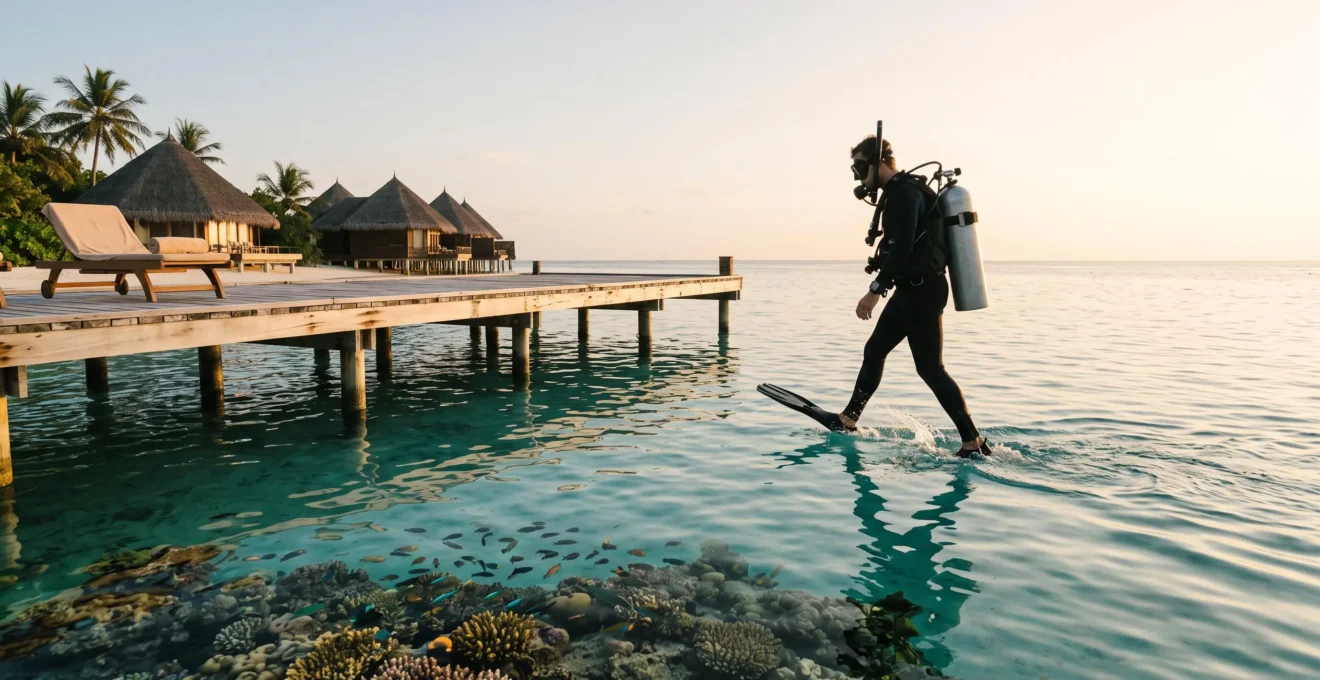
The best Great Barrier Reef resort for a diver is not the one with the best pool, but the one that functions as the most efficient marine access system.
- Island-based resorts offer superior time-on-reef value by eliminating long mainland transit times.
- Evaluating a resort’s programmatic depth—like biologist-led talks and specialty courses—is a better indicator of quality than just a PADI sign.
- Booking should align with an ecological calendar (e.g., coral spawning, whale migrations) rather than generic seasons for truly unique encounters.
Recommendation: Shift your selection criteria from resort amenities to reef logistics. Assess how a resort’s location, dive program, and schedule directly maximize your quality underwater time.
For the serious reef enthusiast, choosing a Great Barrier Reef resort can be a frustrating exercise. You scroll through images of infinity pools, spa menus, and beachfront cocktails, while the real object of your desire—the reef itself—remains an abstract concept, a tour you book at the concierge desk. The standard advice to « pick a resort near the reef » is true but trivial. It ignores the fundamental difference between a holiday resort that happens to be near the ocean and a dedicated hub designed to facilitate deep, meaningful marine immersion.
The common approach is to book a beautiful hotel and then figure out the diving. This often leads to crowded day trips, rushed schedules, and a feeling that you’ve only scratched the surface. The real question isn’t about the thread count of the sheets, but about the quality and quantity of your time underwater. This requires a paradigm shift in how you evaluate potential accommodations.
But what if the key wasn’t finding a resort with a dive shop, but assessing the resort *as* a complete marine access system? This guide rejects the poolside perspective. Instead, we will teach you to think like a dive expedition planner. You will learn to evaluate a resort’s logistical efficiency, the programmatic depth of its marine offerings, and how its location on the reef translates into tangible time-on-reef value. We’ll deconstruct the trade-offs between different reef zones, dive tour types, and even the time of year you book, all through the uncompromising lens of maximizing your underwater experience.
This article provides a strategic framework for selecting a resort that serves your passion for diving and snorkeling, not just your need for a place to sleep. Explore the key factors that separate a generic beach holiday from a world-class reef expedition.
Summary: Choosing Great Barrier Reef Resorts for Maximum Dive Access
- Why Island Reef Resorts Deliver Better Marine Access Than Mainland Reef-Tour Bases?
- How to Assess Reef Resort Dive Programs for Quality Instruction, Not Just Equipment Rental?
- Eco-Certified or Luxury Reef Resorts: Which Supports Marine Conservation Better?
- The Reef Resort Booking That Coincides with Stinger Season or Coral Spawning Disruptions
- When to Book Great Barrier Reef Resorts for Both Availability and Peak Diving Conditions?
- Outer Reef or Inner Reef: Which Coral Sea Zone Delivers Better Marine Encounters?
- Pontoon-Based or Boat-Based Snorkeling: Which Tour Type Suits Your Skill Level?
- How to Experience the Coral Sea’s Marine Life Without Damaging the Reef
Why Island Reef Resorts Deliver Better Marine Access Than Mainland Reef-Tour Bases?
The most fundamental decision in planning a reef trip is your base of operations. While mainland hubs like Cairns or Port Douglas offer variety and nightlife, they impose a significant logistical tax on your diving: transit time. For a diver, time spent on a high-speed catamaran is time not spent underwater. This is where the strategic advantage of an island resort becomes undeniable. They don’t just offer proximity; they offer a fundamentally different, and superior, time-on-reef value.
An island resort transforms the reef from a day-trip destination into your backyard. It means you can undertake an early morning dive before breakfast, explore a house reef at your own pace, or participate in a night dive without a long boat ride home. Weather is also a critical factor; an open-sea crossing from the mainland is far more susceptible to cancellation due to high winds than a short trip from the sheltered leeward side of an island to a nearby dive site. This proximity and flexibility constitute the core of a superior marine access system.
The following table breaks down the core differences. Notice how an island resort’s entire structure is geared towards flexible, repeatable access, while a mainland base is built around a single, fixed daily expedition. This distinction is paramount for anyone whose priority is maximizing their underwater exploration.
| Criteria | Island Reef Resort | Mainland Tour Base |
|---|---|---|
| Access to Outer Reef | Often adjacent or short boat ride | Roughly 60km / up to 90 minutes by high-speed boat |
| Diving Windows | Early morning, night dives, repeat un-timed sessions | Fixed single daily departure window |
| Weather Cancellations | Sheltered leeward side often still diveable | Open-sea crossing more exposed to cancellation |
| Ideal Diver Profile | Repeat explorers, night divers, flexible schedules | Day-trippers, first-time certifiers, those wanting varied dive sites |
Case Study: Heron Island’s House Reef as a Personal Marine Laboratory
Heron Island, a resort on the reef’s southern reaches, perfectly illustrates this principle. It offers divers direct, repeatable access to a « bommie » that serves as a manta ray cleaning station. Guests can encounter jacks, barracuda, sharks, and sea snakes right off the resort. This demonstrates how staying on-island transforms a single dive site from a one-off tour stop into a personal ecosystem to study over multiple dives at different times of day, providing immense value for the dedicated enthusiast.
How to Assess Reef Resort Dive Programs for Quality Instruction, Not Just Equipment Rental?
A PADI sign hanging outside a resort hut is not a guarantee of a high-quality dive program. For the discerning diver, the difference between a simple equipment rental service and a center of instructional excellence is vast. True quality lies in the programmatic depth of the operation—the collection of expertise, educational opportunities, and safety protocols that go far beyond basic certification. Assessing this depth before you book is crucial to ensuring your experience is enriching and safe, not just a logistical transaction.
Look for signals that indicate a deep-seated culture of dive expertise. Does the resort employ resident marine biologists? Are there talks on reef ecology included as a standard part of the experience? The presence of such programs is a powerful indicator that the resort values education and enrichment over simply processing as many divers as possible. As the team at Mike Ball Dive Expeditions, a top-tier liveaboard operator, notes about their own high standards:
During all expeditions our resident Marine Biologists conduct our own inhouse ‘Reef Ecology & Interpretation’ program with tailored Q&A to your specific expedition.
– Mike Ball Dive Expeditions, Minke Whale Cairns program page
This commitment to interpretation is a hallmark of a quality operator. Furthermore, investigate the range of specialty courses available. An operation offering advanced training in buoyancy, underwater photography, or night diving demonstrates a higher level of in-house expertise. A low guide-to-diver ratio is another critical, non-negotiable sign of a safety-conscious and personalized service. Don’t be afraid to ask these specific questions before you commit.
Action Plan: Verifying Dive Program Quality Before Booking
- Check Accreditation: Look for recognized status beyond the basic, such as PADI 5-Star Instructor Development or Eco-Centre accreditation, as a baseline quality marker.
- Inquire About Ratios: Ask directly about the guide-to-diver ratio for certified diver trips. Lower numbers mean more personal attention and better safety oversight.
- Assess Specialty Courses: Confirm what specialty courses are offered beyond a basic certificate. Availability of courses like buoyancy, photography, or night diving indicates deeper expertise.
- Verify Instructor Training: Ask if the operator also trains career-level instructors. This is a strong signal of a serious, professional in-house diving culture.
- Confirm Educational Components: Ask whether marine life briefings or ecology talks are a standard, included part of the dive day, not just a paid, optional extra.
Eco-Certified or Luxury Reef Resorts: Which Supports Marine Conservation Better?
The debate between choosing an eco-certified resort versus a luxury one often presents a false dichotomy. Serious divers invested in the reef’s future rightly want their tourism dollars to support conservation, but it’s a mistake to assume that « eco » and « luxury » are mutually exclusive or that one is inherently better than the other. The reality is more nuanced: effective conservation requires both accountability and funding, and different types of resorts contribute in different ways.
Eco-certification from bodies like Ecotourism Australia provides a crucial framework of accountability. It verifies that a resort is actively managing its waste, conserving water, minimizing its carbon footprint, and contributing to local conservation efforts. This certification is a vital baseline, ensuring an operator is meeting established standards for environmental responsibility. It’s a signal that the resort has subjected its operations to third-party scrutiny, moving beyond mere marketing claims of being « green. »
However, high-end luxury resorts often play an equally important, albeit different, role. They can generate the significant financial resources necessary for large-scale conservation projects, such as funding dedicated marine science research, sponsoring major coral restoration initiatives, or employing a full-time team of marine biologists. In many cases, the most impactful conservation work is happening at resorts that blend both: a high-end product that funds ambitious projects, all guided by the principles of a formal eco-certification. The ideal choice is not one or the other, but a resort that leverages its financial capacity for conservation within a certified, accountable framework.
The Reef Resort Booking That Coincides with Stinger Season or Coral Spawning Disruptions
Generic travel advice often warns divers away from the « stinger season » (roughly November to May). While the risk from Irukandji and Box jellyfish is real and requires precaution (like wearing a full-body « stinger suit »), writing off nearly half the year is a rookie mistake. For the strategic diver, this period hosts one of the planet’s most spectacular and sought-after marine events: the annual mass coral spawning. Planning a trip around this phenomenon requires shifting from a mindset of avoiding disruption to one of ecological calendar booking.
Coral spawning is a magnificent, synchronized event where entire sections of the reef release their eggs and sperm into the water column, creating a vibrant underwater blizzard that seeds the next generation of corals. It is a bucket-list experience for many divers. The key is knowing that it isn’t random. This event happens predictably one to six nights after the full moon in October, November, or December, according to the Great Barrier Reef Marine Park Authority. A savvy diver doesn’t see a « disruption »; they see a precise, bookable window for a once-in-a-lifetime dive.
Case Study: Turning a Natural Event into a Bookable Experience
Top-tier operators don’t leave this to chance. For instance, the liveaboard Reef Encounter has already timed its 2025 departures around the predicted spawning window of November 9-11. They offer guided night dives specifically structured to witness the event. This illustrates how a well-prepared operator transforms an unpredictable natural phenomenon into a structured, bookable experience, creating immense value for guests who do their research.
This approach highlights a core principle for advanced reef travel: your booking date should be determined by a specific marine objective, not by a generic fear of seasonal inconveniences. By understanding the reef’s ecological clock, you can intercept incredible natural dramas that the average tourist will miss entirely. Precautions are necessary, but the rewards are immeasurable.
When to Book Great Barrier Reef Resorts for Both Availability and Peak Diving Conditions?
The « best » time to visit the Great Barrier Reef depends entirely on your definition of « best. » Rather than focusing on generic peak seasons with the most sunshine, the strategic diver plans their trip using an ecological calendar. This means aligning your booking with specific, time-sensitive marine mega-events. This approach not only delivers extraordinary encounters but also helps dictate the ideal booking window, often well in advance.
A prime example is the opportunity to swim with dwarf minke whales. This is one of the most profound marine encounters available on the planet, and the Great Barrier Reef is the only place where it is reliably and permissibly done. However, this experience is confined to an incredibly narrow window. These curious whales congregate in the northern Ribbon Reefs almost exclusively in June and July. In fact, one study notes that 80% of minke whale sightings are recorded in these two months. If this is your goal, your travel dates are non-negotiable, and you must book months, sometimes a year, ahead with one of the few permitted operators.
The Ribbon Reefs’ Exclusive Two-Month Minke Whale Window
The annual migration of dwarf minke whales to the Ribbon Reefs illustrates why booking around a specific marine event is critical. This encounter is limited to a handful of liveaboards and resorts over roughly two months. Missing this window means missing the opportunity entirely for another year. This exemplifies how a trip’s success can be determined by planning around a rare ecological event rather than general seasonal advice.
Other events have their own calendars: turtle nesting season peaks around November to January in the southern reef, while the giant potato cod of the Cod Hole are present year-round but visibility is often best from September to December. Your first step should be to identify your primary underwater objective—be it whales, spawning, or shark encounters—and let that dictate your travel dates and how far in advance you need to secure a spot at the right resort or liveaboard.
Outer Reef or Inner Reef: Which Coral Sea Zone Delivers Better Marine Encounters?
A common platitude among casual visitors is that the « Outer Reef is always better. » While the Outer Reef systems, located far from the mainland, often boast spectacular water clarity and the dramatic coral formations known as « bommies, » this oversimplification ignores the unique and valuable biodiversity of the Inner and Southern Reef zones. The right choice depends not on a generic sense of « better, » but on your specific interests as a diver or snorkeler.
The Outer Reef is prized for its visibility and is the destination for those seeking « the big stuff »: reef sharks, large pelagic fish, and vast walls of hard coral. Its distance from coastal runoff means the water is typically clearer, making it ideal for wide-angle photography and experiencing the sheer scale of the reef. However, this experience almost always requires a significant boat journey, making it the domain of day tours and liveaboards.
In contrast, the Inner and Southern Reefs, particularly those fringing islands, offer a different kind of richness. These areas are often more accessible, with some of the best snorkeling and diving available right from the shore. The marine life focus here can shift to different species. These zones are renowned for their healthy populations of turtles, manta rays (at cleaning stations), and an incredible diversity of reef fish and macro life like nudibranchs and invertebrates. For those who enjoy unguided exploration and studying ecosystems up close, these zones offer immense value.
This table from a comparative analysis highlights the different characteristics and strengths of each zone, helping you align your choice with your personal diving style.
| Feature | Outer Reef | Inner / Southern Reef Zones |
|---|---|---|
| Typical Distance | ~60km from Cairns, ~90 min by boat | Often accessible directly from shore or short boat ride |
| Water Clarity | Generally clearer, prized visibility | More nutrient-rich, sometimes lower visibility |
| Marine Life Focus | Hard coral pinnacles, reef sharks, pelagics | Turtles, manta rays, reef fish, invertebrates |
| Best Suited For | Certification dives, beginners in calm shallow sites, ‘big stuff’ seekers | Snorkelers without guides, macro life, unguided shore exploration |
Unguided Shore Snorkeling in the Capricorn and Bunker Reefs
The Southern Great Barrier Reef’s Capricorn and Bunker Groups are a perfect example of inner reef value. Here, relatively shallow waters teeming with reef fish, turtles, and manta rays allow visitors to snorkel directly from the shore without needing a guide. This demonstrates how inner/southern reef zones can offer rich, easily accessible biodiversity that is distinct from, and in no way inferior to, the classic Outer Reef experience.
Pontoon-Based or Boat-Based Snorkeling: Which Tour Type Suits Your Skill Level?
For snorkelers and introductory divers, the choice between a pontoon-based and a boat-based tour is a significant one that impacts the entire day’s experience. There is no single « best » option; the right choice is a trade-off between stability and amenities versus mobility and site variety. Your decision should be based on your comfort level in the water and your group’s needs.
A pontoon-based tour involves traveling on a large vessel to a permanently moored platform on the reef. These pontoons are incredibly stable and act as a multipurpose activity hub. They are an excellent choice for families, less-confident swimmers, or groups with mixed interests. Advantages include:
- Stability: No rocking or seasickness once you arrive at the platform.
- Amenities: They often feature underwater observatories, semi-submersible tours, sun decks, and dedicated, controlled snorkeling areas.
- Easy Access: Submerged platforms and steps make entering the water much less intimidating than jumping off the side of a boat.
The primary drawback is that you are limited to a single location for the entire day. While the site is chosen for its quality, you do not get to experience the diversity of multiple reef sites.
A boat-based snorkeling tour, by contrast, offers a more nomadic experience. These tours typically use smaller, more agile vessels that visit several different reef sites in one day. This is the preferred option for more confident snorkelers who prioritize seeing a variety of reef environments. Advantages include:
- Site Diversity: You get to experience two or three distinct reef locations, each with its own unique topography and marine life.
- Better Access: Boats can often moor closer to more interesting or pristine sections of the reef that larger pontoon-hosting vessels cannot reach.
- Intimate Experience: Group sizes are generally smaller, leading to a less crowded feel both on the boat and in the water.
The trade-off is less comfort. You are on a boat for the entire day, which can be challenging for those prone to seasickness, and amenities are more basic.
Key Takeaways
- Prioritize island resorts over mainland bases to maximize « time-on-reef » and minimize transit.
- Assess a dive program’s « programmatic depth » (biologists, specialty courses) as a true measure of quality.
- Use an « ecological calendar » to book trips around specific marine events like coral spawning or whale migrations.
- The most critical skill for reef protection is mastering perfect buoyancy to avoid any contact.
How to Experience the Coral Sea’s Marine Life Without Damaging the Reef
Experiencing the Great Barrier Reef is a privilege that comes with a profound responsibility. For any serious diver or snorkeler, the prime directive is to leave the reef in exactly the same, or better, condition than you found it. This goes beyond simply not littering; it involves a conscious practice of minimal-impact techniques. The single most important skill to master is perfect buoyancy control. It is the foundation of all responsible diving.
Poor buoyancy control leads to unintentional contact with the reef. A dangling console, a misplaced fin kick, or an uncontrolled descent can break decades-old coral in an instant. This is not just an aesthetic issue; it’s physical damage to a living animal. Before your trip, consider taking a peak performance buoyancy specialty course. Learning to hover effortlessly, motionless, a few inches from the reef is the mark of a truly skilled and respectful diver. It allows you to get close to marine life without stressing it or its habitat.
Another area of impact is chemical. The debate around « reef-safe » sunscreens is complex, but the core principle is simple: minimize what you introduce into the water. The best approach is to cover up with a rash guard or « stinger suit, » which drastically reduces the amount of sunscreen you need. When you do use it, choose a mineral-based formula with non-nano zinc oxide or titanium dioxide. As scientists point out, the long-term effects of chemical filters are still being studied. As expert Michael Gonsior stated in an analysis for Consumer Reports, even low concentrations might be harmful over time:
That’s not to say that lower concentrations have no effect. There may be harmful effects from chronic exposure at lower levels.
– Michael Gonsior, The Truth About Reef-Safe Sunscreen
Finally, practice passive observation. Never touch, chase, or try to feed any marine life. Let the underwater world’s inhabitants go about their lives undisturbed. Your reward will be witnessing natural behaviors, a far more enriching experience than a forced interaction.