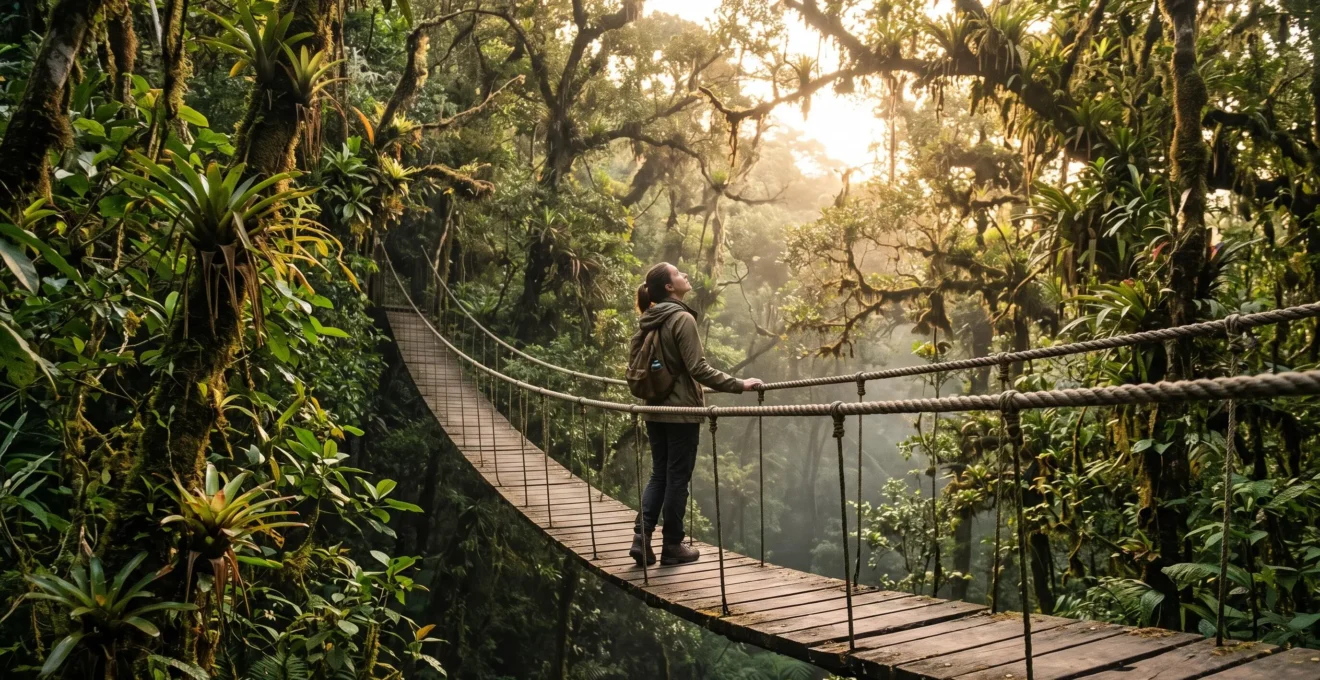
The most profound value of a canopy tour isn’t the adrenaline rush, but the rare ecological insight it provides—if you choose the right one.
- The modern zip-line was not invented for tourism, but for scientific observation, a purpose that should still be central to the experience.
- Assessing an operator’s educational commitment and transparency is as crucial as checking their safety standards.
Recommendation: Shift your mindset from seeking the biggest thrill to finding the best « interpretive lens. » Prioritize tours that use adrenaline as a tool for education, not as the end goal itself.
The promise of a rainforest canopy tour is intoxicating: soaring through a world of green, heart pounding, with a perspective usually reserved for monkeys and birds. For many adventure seekers, the criteria for choosing a tour are simple: the longest zip-line, the highest bridge, the most exhilarating drop. The focus is on the thrill, the speed, the physical sensation of flight. This approach guarantees an adrenaline spike, but often misses the forest for the trees—literally.
While standard advice focuses on safety checks and booking in advance, it often overlooks the most transformative element of a canopy tour: its potential for genuine ecological interpretation. What if the true, lasting thrill isn’t just about conquering a fear of heights, but about gaining a moment of profound understanding? What if the speed of a zip-line could be used not to distract you, but to teach you how to scan the canopy like a hunting eagle? The most memorable tours are not a binary choice between excitement and education; they skillfully weave them together, using the thrill as a gateway to deeper connection.
This guide re-frames that choice. It’s designed for the traveler who wants more than just a ride. We will explore how to manage fear to achieve focus, differentiate between tour types based on their observational potential, and identify the operators who offer true insight versus those who simply sell an adrenaline package. By shifting your evaluation from pure thrill-seeking to seeking a quality « interpretive lens, » you can unlock an experience that is not only exciting but also deeply meaningful.
To help you find this balance, this article will break down the essential components of a high-quality, interpretive canopy tour. From the biological wonders hidden in the treetops to the practical steps for choosing a responsible operator, the following sections provide a complete framework for your next rainforest adventure.
Summary: Balancing Thrills and Interpretation on Your Next Canopy Tour
- Why Rainforest Canopy Tours Reveal Ecosystems You Cannot See from the Ground
- How to Manage Height Fear During Rainforest Canopy Walks and Zip-Lines
- Zip-Line Adventures or Elevated Walkways: Which Canopy Tour for Nature Watching?
- The Canopy Tour Mistake of Chasing Thrills and Missing Rainforest Education
- When to Book Canopy Tours for Wildlife Sightings and Clear Rainforest Views
- Why Trying Every Activity in One Region Delivers Weaker Memories Than Focused Adventures
- Why Daintree Is the Oldest Living Rainforest Ecosystem on Earth
- How to Explore Daintree Rainforest Responsibly While Understanding Its Ancient Ecology
Why Rainforest Canopy Tours Reveal Ecosystems You Cannot See from the Ground
From the forest floor, a rainforest can feel like a dense, impenetrable wall of green. Your view is limited to the understory—a world of shadows, damp earth, and giant tree trunks. But this ground-level perspective captures only a fraction of the story. The vast majority of life in a tropical rainforest, from flowering plants and insects to mammals and birds, is concentrated in the canopy, a vibrant, sun-drenched world hundreds of feet above. This is the forest’s engine room, and the only way to truly witness it is to ascend into it.
A well-designed canopy tour is a vertical journey through distinct ecological layers, or strata. You leave the dark forest floor and rise into the mid-canopy, where light becomes more available and surfaces are draped in a thick blanket of epiphytes—plants like orchids, bromeliads, and ferns that grow on other plants. This is an ecosystem in itself, a complex web of life that is completely invisible from below. A good guide won’t just point out a flower; they will explain how that orchid provides nectar for a specific hummingbird, creating an experience of ecological intimacy.
This concept of vertical stratification is essential to understanding the forest’s complexity. Each layer offers unique resources and shelter, attracting a different community of organisms. The canopy is where the trees produce their flowers and fruit, making it the primary foraging ground for countless species. A canopy tour gives you a front-row seat to this activity, offering a perspective that fundamentally changes your understanding of the ecosystem’s structure and function.
As this visual representation of the forest’s layers shows, the canopy isn’t a monolithic ceiling but a series of distinct habitats stacked vertically. Accessing this realm is not just about getting a better view; it’s about entering the most biodiverse and active part of the entire ecosystem. It’s a shift from being an observer looking in from the outside to being an immersed participant within the forest’s living architecture.
How to Manage Height Fear During Rainforest Canopy Walks and Zip-Lines
A racing heart, sweaty palms, a knot in your stomach—a fear of heights is a primal and common reaction. On a canopy tour, this fear can become an overwhelming obstacle, preventing you from enjoying the view or absorbing any information. However, managing this fear isn’t about ignoring it; it’s about acknowledging it and using rational tools to move past it. The goal is to shift from a state of fear to one of focused awe.
The first step is to address the rational component of your fear. Concerns about safety are valid, especially when you learn that in 2012 alone, more than 3,600 people were treated in U.S. emergency departments for zip-line-related injuries. This statistic isn’t meant to scare you, but to empower you. It underscores why asking direct, technical questions is more effective than relying on marketing slogans. Before you book, and certainly before you clip in, you should ask your operator specific questions about their standards, such as:
- Has the course been built and regularly inspected by an accredited vendor recognized by an industry body like the ACCT (Association for Challenge Course Technology)?
- Does the operation comply with any local or national regulations, like West Virginia’s Zipline Responsibility Act, which mandates adherence to recognized standards?
- What is the guide-to-guest ratio, and what specific training and certifications do the guides hold for rescue and first aid?
Once you’ve satisfied the rational part of your brain, you can work on the psychological aspect. Techniques like focused breathing can calm your nervous system. Another powerful method is attentional shift: instead of looking down at the dizzying drop, focus on a small, tangible detail. Examine the intricate pattern on a leaf, the texture of the rope on the handrail, or the sound of a specific bird call. This simple act grounds you in the present moment and retrains your brain to focus on observation rather than anxiety.
Ultimately, the objective is to reach a state of calm focus where you can truly appreciate your surroundings. By consciously managing your fear, you transform it from a barrier into a stepping stone, allowing you to fully immerse yourself in the canopy’s wonders with a sense of security and presence.
Zip-Line Adventures or Elevated Walkways: Which Canopy Tour for Nature Watching?
The choice between a zip-line tour and a suspended walkway is often presented as a simple trade-off: adrenaline versus contemplation. Zip-lines are fast, exhilarating, and cover great distances quickly. Walkways are slow, stable, and allow for quiet observation. While there’s truth to this, a more nuanced evaluation reveals that the best tour isn’t about the equipment itself, but how it’s used as an interpretive tool. The question isn’t « zip-line or walkway? » but « which format better serves the goal of genuine nature watching on this specific tour? »
Elevated walkways and suspension bridges are the undisputed champions for deep, immersive observation. They provide a stable platform to stand, wait, and watch. You can spend several minutes examining a flowering tree, using binoculars to spot a distant sloth, or listening to your guide explain the complex life of an ant colony on a branch right next to you. This slow pace is ideal for photography and for absorbing detailed information. The quietness of a walkway also minimizes disturbance, increasing the chances of seeing more timid wildlife.
Zip-lines, on the other hand, seem counterintuitive for nature watching. The speed, noise, and focus on safety procedures can easily overshadow any potential for observation. However, dismissing them entirely is a mistake, especially when you consider their origins.
The Scientific Origins of the Modern Zip-Line
The now-popular zip-line canopy tour did not begin as an adrenaline product. The modern-day zipline tour was first popularized by wildlife biologists in the 1970s who needed an efficient way to study Costa Rica’s vast rainforest canopy. This history proves that zip-lines, when used deliberately, can serve a genuine ‘scanning’ function for spotting movement across the canopy—like a toucan in flight or monkeys leaping between trees—that you might miss from a stationary point.
A high-quality, education-focused zip-line tour will be designed with this in mind. It will feature platforms with enough space and time for interpretation between lines. The guides will use the zip-line’s unique perspective to teach you how to scan the canopy from a new angle. The best operations often combine both elements: a series of zip-lines to move efficiently between key areas, connected by shorter canopy walkways that allow for focused, detailed observation. This hybrid approach often provides the most complete experience, balancing the macro view with the micro detail.
The Canopy Tour Mistake of Chasing Thrills and Missing Rainforest Education
The single biggest mistake a traveler can make is assuming that a tour’s quality is proportional to its thrill factor. An operator might boast the « longest, fastest, highest » zip-line in the region, but these superlatives say nothing about the quality of the experience. They are metrics of engineering, not of interpretation. Chasing these thrills often leads to a shallow, forgettable ride that completely misses the opportunity for a deeper connection with the environment you’re passing through at high speed. The real value lies with operators who view the thrill as a tool, not the final product.
This is where the challenge of « greenwashing » comes in. Many operators use vague terms like « eco-friendly » or « sustainable » in their marketing, but their actions don’t support the claims. They sell a high-speed experience dressed up in green branding. Your job as a discerning traveler is to look past the surface-level marketing and assess their genuine commitment to education and conservation. A truly responsible operator provides evidence, not just slogans.
Instead of being swayed by adrenaline-fueled promises, use a critical framework to evaluate a potential tour operator. This audit helps you identify the operators who are genuinely invested in sharing the story of the rainforest.
Action Plan: Auditing a Canopy Tour Operator’s Educational Commitment
- Points of Contact: Review the operator’s website, brochures, and online reviews. What is the core message they are sending? Is it « have a wild ride » or « discover a hidden world »?
- Collect Evidence: Look for specifics, not vague claims. Do they list the scientific names of species? Do they detail their conservation partnerships? Do they showcase guide qualifications beyond basic safety? A lack of detail is a red flag.
- Assess Coherence: Does the « eco » message align with the experience offered? A tour focused exclusively on screaming and speed, but with a logo of a leaf, is incoherent. Favor operators whose activities logically support their stated mission of conservation and education.
- Evaluate Authenticity: Be wary of decor-only sustainability. Natural wood and green uniforms mean nothing without substance. A truly authentic operator will share progress honestly and acknowledge gaps rather than claiming perfection.
- Plan for Verification: Seek third-party validation. Look for recognized certifications. As of 2024, data shows that over 480 tourism organisations were certified under a major eco-destination scheme, giving you a concrete way to verify claims.
Choosing an operator with a strong educational program doesn’t mean sacrificing fun. In fact, it enhances it. Understanding the « why » behind what you’re seeing transforms a simple view into a profound experience. The thrill of spotting a rare bird is far more potent when you know its role in the ecosystem, and that’s a memory that lasts much longer than the 30-second rush of a zip-line.
This focus on detailed observation—seeing the intricate veins of a leaf rather than just a blur of green—is the hallmark of a truly interpretive experience. It’s the difference between being a passenger and being a student of the forest.
When to Book Canopy Tours for Wildlife Sightings and Clear Rainforest Views
The timing of your canopy tour can have a dramatic impact on your experience, influencing everything from visibility to the likelihood of wildlife encounters. While any time in the canopy is a unique experience, strategic booking can significantly enhance the interpretive and observational quality of your tour. The decision involves balancing weather patterns, animal behavior, and crowd levels.
First, consider the broader seasonal patterns. In most tropical rainforests, this means choosing between the wet season and the dry season. The dry season typically offers clearer skies, less rain, and more comfortable conditions. This often translates to better long-distance views from canopy platforms. However, the wet season has its own unique advantages for interpretation. The forest is often more lush, vibrant, and audibly alive. Some animals may be more active, and waterfalls and rivers will be at their most impressive. For photography, the soft, diffused light of an overcast rainy-season day can be superior to the harsh, high-contrast sun of the dry season.
Second, the time of day is arguably even more critical for wildlife sightings. The majority of rainforest animals, especially mammals and birds, are most active during the cooler hours of the early morning and late afternoon. The period just after sunrise is often considered the « golden hour » for birdwatching, as birds are actively feeding and calling to establish their territories. A tour booked for 7:00 AM will almost always yield more wildlife sightings than one at midday when the heat forces most animals to rest in the shade. Similarly, a late afternoon tour can catch the second wave of activity as animals emerge to feed before dusk.
Finally, consider the human factor. The most popular tour slots (mid-morning, around 10:00 AM) are often the most crowded and the least optimal for quiet observation. Opting for the very first tour of the day not only increases your chances of seeing wildlife but also means you’ll have a more peaceful, less rushed experience. You’ll be on the platforms before the largest crowds arrive, allowing for a more intimate and personal connection with the forest canopy. When balancing these factors, prioritizing animal activity (early morning) will almost always deliver the most memorable interpretive experience.
Why Trying Every Activity in One Region Delivers Weaker Memories Than Focused Adventures
In the age of the travel checklist, there’s a pervasive pressure to « do it all. » When visiting a region rich in adventure, the temptation is to tick off as many activities as possible: the canopy tour on Monday, the waterfall rappel on Tuesday, the jungle trek on Wednesday. While this approach fills an itinerary, psychological research on memory suggests it’s a recipe for a diluted, less impactful experience. The human brain doesn’t form strong memories from a rapid-fire succession of shallow events; it thrives on depth, emotion, and novelty. A single, deeply immersive adventure will create a more lasting and meaningful memory than a dozen rushed ones.
This is the principle of focused adventure. Instead of spreading your time and attention thinly across multiple activities, you invest them in one or two that you can experience fully. A high-quality, interpretive canopy tour is a perfect example of a focused adventure. It’s not just a 30-second zip-line; it’s a multi-hour immersion in a completely alien environment. The experience is layered: there is the physical thrill, the intellectual stimulation from the guide’s interpretation, and the emotional resonance of being suspended in a world of ancient beauty.
This depth is what helps to encode strong memories. When you learn to identify a specific bird’s call and then actually spot that bird, your brain creates a rich, multi-sensory memory connected to a story. This is far more potent than the generic memory of simply « going zip-lining. » The « peak-end rule, » a well-known cognitive bias, states that we tend to remember an experience based on its most intense point (the peak) and how it concludes (the end). A shallow, thrill-only tour might provide a brief peak of adrenaline, but an interpretive tour provides a peak of discovery and a satisfying end filled with new knowledge, making the entire experience more memorable.
By resisting the urge to tick boxes and instead choosing to go deep, you trade a collection of fleeting moments for a truly transformative memory. You move from being a tourist who « saw » the rainforest to a traveler who began to understand it. This shift in mindset not only makes your travels more rewarding but also fosters a more respectful and sustainable relationship with the places you visit.
Why Daintree Is the Oldest Living Rainforest Ecosystem on Earth
To visit the Daintree Rainforest in Australia is to step into a world that has defied time. While many travelers are familiar with the Amazon, the Daintree is a living relic of a much older world. Geological dating confirms that the Daintree carries more than 180 million years of history, making it a staggering 125 million years older than the Amazon. This is not just a forest; it is a museum of life, a direct, unbroken link to the supercontinent of Gondwana. A canopy tour here is not just a walk through the trees; it’s a walk through deep geological time.
This incredible age means the Daintree contains a unique and ancient collection of flora and fauna. It’s home to some of the earliest lineages of flowering plants on the planet. As UNESCO describes it, the Daintree is:
« the largest part of Australasia where rainforests have persisted continuously since Gondwanan times »
– UNESCO, Visit Daintree
This continuity has allowed for the survival of species that act as living fossils, providing a window into the evolutionary history of life on Earth. One of the most powerful examples of this unbroken lineage is the relationship between the forest’s ancient plants and its most iconic animal resident.
The Southern Cassowary: A Gondwanan Keystone Species
The endangered Southern Cassowary is a perfect illustration of the Daintree’s ancient ecology. According to wildlife experts at Natural Habitat Adventures, these flightless, fruit-feeding birds can be traced back to the time of Gondwana. They are one of the only animals large enough to consume the fruits of the forest’s most ancient trees and disperse their large seeds. This makes the cassowary a critical « keystone species »; its survival is directly linked to the survival of the forest’s oldest plant lineages. Seeing a cassowary in the Daintree is like seeing a living, breathing link to a supercontinent that broke apart tens of millions of years ago.
Understanding this immense timescale completely reframes the experience of a canopy tour. Every fern, every flower, every bird call is part of a story that began when dinosaurs roamed the Earth. It imbues the forest with a sense of reverence and wonder that goes far beyond simple aesthetic beauty, turning your visit into an encounter with the very origins of our modern world.
Key Takeaways
- Assess canopy tours on their interpretive quality, not just their thrill factor. The best tours use adrenaline as a tool for education.
- Your ability to manage fear and focus your attention directly determines the depth of your experience and the strength of your memories.
- Ancient ecosystems like the Daintree are not just tourist destinations; they are living museums that demand a responsible and educated approach from every visitor.
How to Explore Daintree Rainforest Responsibly While Understanding Its Ancient Ecology
Exploring the Daintree is a privilege, and with that privilege comes a responsibility to understand and respect its ancient ecology and its human history. This is not a theme park; it’s a fragile, living system and a deeply significant cultural landscape. Responsible exploration here means moving with awareness, choosing operators who are true custodians of the land, and seeking to learn, not just to look.
The human story of the Daintree is as ancient as its ecology. The Eastern Kuku Yalanji people have lived in this land for 50,000 years, developing an intricate and sustainable relationship with the forest. Their ecological knowledge is not based on scientific textbooks, but on millennia of direct observation, passed down through generations. A truly responsible visit to the Daintree must acknowledge and honor this living cultural heritage. When choosing a tour, prioritize operators who actively partner with the Kuku Yalanji people, offering genuine cultural tours led by elders who share their knowledge of bush-tucker, medicine, and the Dreamtime stories that are inextricably woven into the landscape.
Beyond the cultural aspect, responsible exploration involves making practical choices that minimize your impact. This includes:
- Choosing Boardwalks: Whenever possible, stick to designated boardwalks and trails. The soil in an ancient rainforest is a delicate web of roots and microorganisms, and straying from the path can cause significant compaction and damage that takes years to recover.
- Supporting Protectors: Favor companies that visibly contribute to the forest’s protection. The Daintree is a World Heritage site, and many local initiatives are dedicated to reforestation and conservation. Ask how your tour operator supports these efforts.
- Driving with Care: The region’s most famous resident, the Southern Cassowary, is highly vulnerable to vehicle strikes. Obey speed limits and be especially vigilant when driving near forest edges, particularly at dawn and dusk. Supporting operators who educate guests on this issue is a sign of their commitment.
By adopting this mindset, you shift from being a passive consumer of scenery to an active participant in the forest’s conservation. Your tourism dollars become a force for good, supporting the communities and initiatives that are dedicated to preserving this irreplaceable corner of the world for the next 180 million years.
Begin your journey by choosing operators who see the forest not as a backdrop for adventure, but as the main character of the story. Your thoughtful choices will not only lead to a more profound and memorable experience but will also contribute to the preservation of these vital ecosystems for generations to come.