In summary:
- Treat Sydney’s icons not as destinations, but as strategic anchors to access local life.
- Master the ferry network from Circular Quay for a scenic and efficient way to explore the harbour.
- Choose your accommodation based on ‘time-cost’ to minimize daily travel and maximize experience.
- Embrace coastal rituals like harbour walks and ocean pools to experience the city’s true rhythm.
- Visit during shoulder seasons (like October-November) for perfect weather and fewer crowds.
Every first-time visitor to Sydney feels the same magnetic pull. You have the postcard images etched in your mind: the soaring sails of the Opera House, the majestic arc of the Harbour Bridge. The pressure is on to « do it all, » to follow the well-trodden path from one landmark to the next. Yet, there’s a quiet anxiety that comes with this checklist approach—the fear that in the rush to see the icons, you’ll miss the *real* Sydney, the city that locals know and love. You worry about getting stuck in tourist corridors, battling crowds, and returning home exhausted rather than enriched.
Most guides offer a simple, linear solution: a day-by-day itinerary that ticks the boxes. But what if the key to a truly memorable trip wasn’t about a rigid schedule, but a shift in perspective? What if the secret to avoiding tourist fatigue was to stop seeing the city as a series of sights to be conquered, and instead learn its unique rhythm? The true art of visiting Sydney lies in using its world-famous icons as strategic anchors—glorious starting points from which you can pivot into the authentic, slower-paced life of its harbour suburbs and coastal communities.
This guide, written from 25 years of local experience, will show you exactly how to do that. We’ll move beyond the platitudes and give you a framework for making smart choices about where you go, how you get there, and when. You’ll learn to see the city not as a tourist, but as a temporary local, finding that perfect balance between the epic and the everyday.
To help you navigate this unique approach to exploring the city, this guide is structured to answer the key strategic questions you should be asking. From mastering the harbour to choosing the right coastline for your style, each section is designed to empower you to build a Sydney experience that feels entirely your own.
Summary: A Strategic Guide to Your 4 Days in Sydney
- Why Circular Quay Deserves Two Hours, Not Two Days of Your Sydney Visit
- How to Explore Sydney’s Harbour Walks That Locals Use Every Morning
- Eastern Beaches or Northern Beaches: Which Sydney Coastline Suits Your Style?
- The Sydney Accommodation Location That Adds 90 Minutes of Daily Travel
- When to Visit Sydney for Perfect Weather and Half the Crowds
- How to Live Like a Coastal Local Beyond the Tourist Beaches
- Why Residential Neighborhood Stays Reveal More Real Australia Than CBD Hotels
- Which Australian Coastal City Matches Your Travel Style: The Personality Guide
Why Circular Quay Deserves Two Hours, Not Two Days of Your Sydney Visit
Circular Quay is undeniably the heart of postcard Sydney. Standing between the Opera House and the Harbour Bridge is a rite of passage, and you should absolutely soak it in. But the most common mistake visitors make is lingering here for too long. The Quay itself is a bustling, often overpriced transit zone. The real magic isn’t in the Quay itself, but in what it enables: it’s the gateway to the entire harbour. The secret is to treat it not as a destination to dwell in, but as a strategic anchor for exploration. See the icons, take your photos, and then immediately board a ferry.
Sydney’s identity is inextricably linked to its harbour, and the green-and-yellow ferries are the city’s lifeblood. This is not just a tourist novelty; it is the most beautiful public transport system in the world. Instead of a pricey harbour cruise, you can use the regular ferry service to experience the same million-dollar views for a fraction of the cost. The key is to pick a route that ventures beyond the main tourist path to Manly. By choosing a quieter loop, you adopt the rhythm of the city and see the harbour as locals do: a stunning backdrop to daily life.
For a true local’s perspective, consider one of the routes that service the lower North Shore. These commuter ferries glide past hidden coves, waterfront mansions, and secluded national parks, offering a glimpse into a side of Sydney most visitors never see. This is the essence of harbour-centric travel.
The following table, based on routes from the official transport authority, outlines a few options for turning a simple ferry ride into an unforgettable, low-key harbour cruise.
| Route | Destination | Character |
|---|---|---|
| F1 | Manly | Iconic tourist crossing, open ocean swell near the Heads |
| F5 | Neutral Bay | Loops past Kirribilli and North Sydney, low-key commuter route with harbour mansion views |
| F6 | Mosman Bay | Passes Cremorne Point, half-hourly on weekdays, a quiet backdoor into the Lower North Shore |
How to Explore Sydney’s Harbour Walks That Locals Use Every Morning
While tourists flock to the Bondi to Coogee walk, Sydneysiders have a network of harbour trails they use for their daily dose of nature and exercise. These paths offer the same stunning water views but with a fraction of the crowds. The experience is less about a strenuous hike and more about participating in a cherished coastal ritual. One of the most accessible and rewarding is the Cremorne Point walk, just a short ferry ride from Circular Quay. Here, the soundtrack isn’t the chatter of a thousand tourists, but the lapping of water against the seawall and the call of native birds.
This easy, paved loop winds around the peninsula, offering constantly shifting perspectives of the Opera House, Harbour Bridge, and city skyline. You’ll pass a historic lighthouse, a stunning harbourside pool, and immaculate public gardens. It’s a perfect example of how the city’s most famous landmarks are woven into the fabric of everyday residential life. Arriving early in the morning allows you to join the locals—dog walkers, joggers, and parents with strollers—and experience the tranquil morning rhythm of the city as it wakes up.
This isn’t just a walk; it’s an insight into the Sydney lifestyle, where world-class scenery is a part of the daily commute. It’s about finding those moments of quiet beauty right next door to the bustling city center, a core principle for avoiding tourist fatigue.
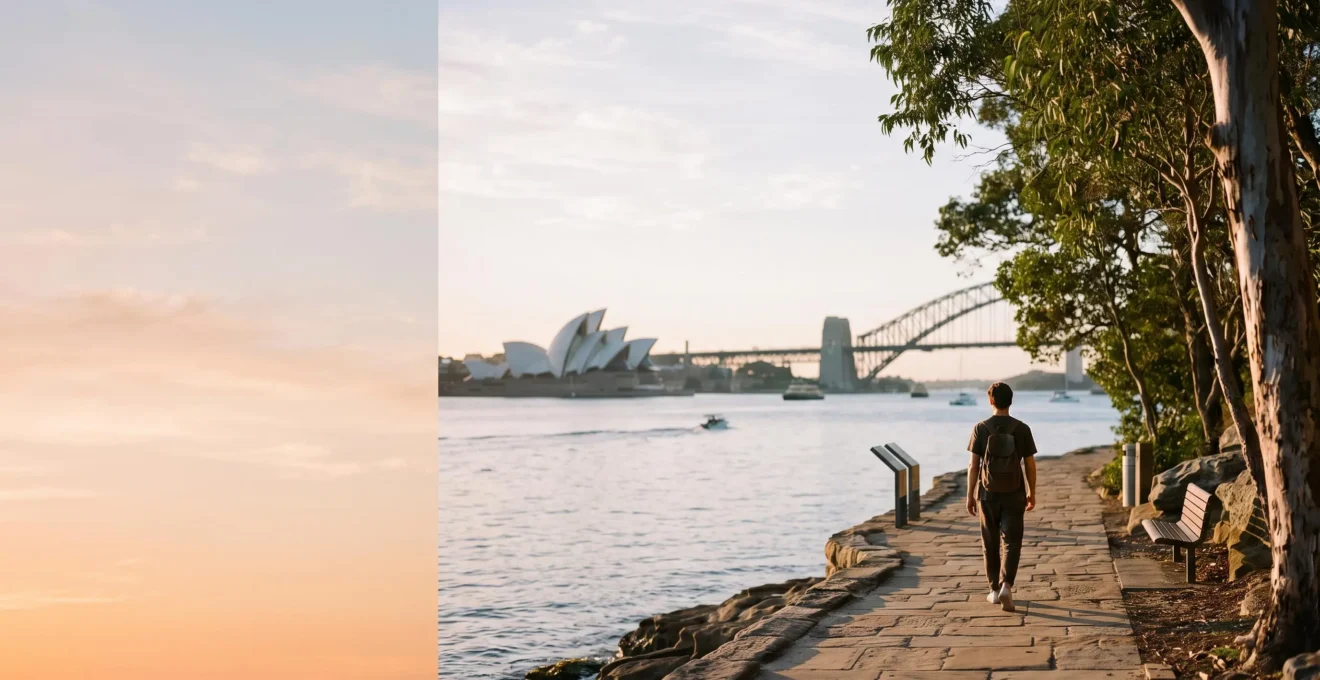
The soft morning light and quiet atmosphere, as seen in the image above, transform the familiar skyline into something more personal and serene. This is the Sydney that locals get to enjoy every day, and by simply hopping on a ferry, you can too. This simple act of starting your day with a harbour walk is a powerful way to connect with the city on a deeper level.
Eastern Beaches or Northern Beaches: Which Sydney Coastline Suits Your Style?
The question of « which beach » in Sydney often gets simplified to Bondi versus Manly. In reality, these two famous spots are merely the entry points to two distinct coastlines, each with its own personality and appeal. Your choice between them will significantly shape your experience. The Eastern Beaches, stretching south from Bondi to Coogee and beyond, are the city’s social heart. They are easily accessible from the CBD, intensely populated, and surrounded by a dense ecosystem of cafes, bars, and boutiques. This is the place to see and be seen, where the energy is high and the people-watching is world-class.
In contrast, the Northern Beaches feel like a different world. The journey itself, a scenic ferry ride across the harbour to Manly, marks a psychological shift. From Manly, a network of buses takes you further up the peninsula to a string of laid-back, surf-focused villages like Curl Curl and Avalon. The vibe here is less about the scene and more about the surf. It’s where you go to escape the city’s intensity, slow down, and adopt a more relaxed, beach-town pace. Choosing the Northern Beaches is a commitment—it’s a longer day trip—but the reward is a genuine sense of getting away from it all.
Ultimately, the « better » coastline depends entirely on your travel style. Do you want the convenience and buzz of the East, or the village-like escape of the North? Understanding this distinction is key to finding your perfect patch of sand.
This table breaks down the essential differences in access and character to help you decide.
| Coastline | Getting There | Character |
|---|---|---|
| Eastern Beaches (Bondi, Coogee) | Short bus or rideshare trip from the CBD, no ferry needed | Social, dense cafe and bar scene, easy day trip |
| Northern Beaches (Manly and beyond) | Scenic ferry crossing from Circular Quay, then bus further north | Laid-back, surf-focused, feels like a village escape from the city |
The Sydney Accommodation Location That Adds 90 Minutes of Daily Travel
When planning a trip, it’s tempting to book accommodation in an outer suburb to save money. On a map, it might look like a savvy move. But in a sprawling city like Sydney, this is a classic false economy. The most crucial factor you must consider is time-cost: the amount of your precious vacation time that will be consumed by commuting. Staying in a seemingly affordable spot that requires multiple train, bus, or ferry transfers can easily add 90 minutes or more to your daily travel, time that could have been spent on the beach, in a gallery, or enjoying a second coffee.
For a short, four-day trip, your time is your most valuable asset. Choosing a base in or near the CBD, or in a well-connected hub like Bondi, centralizes your position. From here, you can easily access the ferry network at Circular Quay, the main train lines, and the bus routes to the Eastern Beaches. This strategic positioning minimizes transit friction and maximizes your opportunities for both planned excursions and spontaneous discovery. You’re not just buying a place to sleep; you’re buying back hours of your day. This is the single biggest decision that will impact your ability to experience the city without fatigue.
Don’t let your trip be defined by long commutes on suburban train lines. Investing a little more to stay in a central or well-connected location pays massive dividends in experience.
The image of a solitary suitcase on an empty platform poignantly captures the feeling of time lost to travel—a stark reminder to prioritize location over a seemingly cheap nightly rate. Think of your accommodation choice as the foundation of your entire itinerary.
Action Plan: Choosing a Sydney Base to Minimize Travel
- Prioritize the CBD (Central Business District) as your primary base for the shortest transit times to Circular Quay and the Opera House.
- Consider a well-connected hub like Bondi or Surry Hills as a strong second option if you accept a short daily commute for a more neighborhood feel.
- Analyze transport maps: Check that your potential stay is near a major train station or a direct bus/ferry route to your key points of interest.
- Calculate the ‘time-cost’: Before booking, use a transit app to simulate the morning journey from your accommodation to Circular Quay. If it’s over 45 minutes, reconsider.
- Avoid outer suburbs that look affordable but require multiple transfers to reach the harbour or beaches, as this is the primary cause of transit fatigue.
When to Visit Sydney for Perfect Weather and Half the Crowds
Sydney’s peak summer season, from December to January, is undeniably electric. The city buzzes with the energy of the Sydney Festival and New Year’s Eve fireworks. However, it also comes with peak prices, peak humidity, and peak crowds. For a first-time visitor wanting to balance icons with local discovery, this can be overwhelming. The secret to a more relaxed and often more pleasant visit lies in the shoulder seasons: Spring (September to November) and Autumn (March to May).
During these months, the weather is arguably at its best—warm, sunny days without the oppressive heat of summer. The ocean is still warm enough for swimming, the tourist crowds have thinned, and prices for flights and accommodation are more reasonable. Late Spring, in particular, is a magical time. The city is blanketed in the vibrant purple of blooming Jacaranda trees, and outdoor events like Sculpture by the Sea along the Bondi coast offer unique cultural experiences. This is the sweet spot for perfect weather and manageable crowds.
Even winter has its unique appeal. While you might need to swap beach time for gallery hopping, June is dominated by Vivid Sydney. This spectacular festival of light, music, and ideas transforms the city’s landmarks into a dazzling outdoor art gallery. It’s a massive event, drawing huge numbers— Vivid Sydney attracted 2.42 million attendees in 2024—but the energy is creative and inspiring, offering a completely different reason to visit.
Choosing when to visit is about aligning the city’s calendar with your travel priorities.
| Season | Signature Event | Why Visit Then |
|---|---|---|
| Winter (June) | Vivid Sydney light festival | Creative energy and light installations, but plan for indoor daytime activities |
| Late Spring (Oct-Nov) | Jacaranda bloom & Sculpture by the Sea | Warm but not hot weather, purple-flowering streets, outdoor art walks before summer crowds |
| Summer (Dec-Jan) | Sydney Festival & NYE fireworks | Peak cultural buzz, but requires booking ahead and avoiding beach crowds |
How to Live Like a Coastal Local Beyond the Tourist Beaches
To truly understand Sydney’s soul, you need to look beyond the sand. The city’s coastline is dotted with a unique feature that is central to local life: the ocean pool. Carved out of the rock shelves at the edge of the sea, these saltwater pools offer a safe and serene way to experience the ocean, protected from waves and sharks. They are far more than just places to swim; they are beloved community institutions and the heart of many coastal rituals. For a visitor, spending an afternoon at an ocean pool is one of the most authentic local experiences you can have.
While Bondi Icebergs is the most famous, nearly every major beach has its own, often more low-key, version. A fantastic example is Wylie’s Baths in Coogee, a stunning heritage-listed pool nestled at the bottom of the cliffs. Here, you’ll swim alongside locals of all ages, from serious lap swimmers to families enjoying the sun. As an entry fee of just a few dollars grants access to one of Sydney’s historic ocean pools, it’s an incredibly affordable way to spend a day feeling like you belong.
The ritual doesn’t end with the swim. It often includes grabbing a coffee from a nearby kiosk, reading a book on the sun-drenched timber decking, and perhaps continuing on the coastal walk. This is the rhythm of coastal life, a slow and simple pleasure that defines the Sydney weekend.
Case Study: The Bondi Icebergs Club
Bondi Icebergs is Sydney’s most famous ocean pool, its winter swimming club dating back to the 1920s. This history illustrates how ocean pools function as genuine community institutions rather than simple tourist photo stops. The commitment of its members to swim through the cold winter months speaks to the deep cultural significance of these pools. For locals, a swim here is often part of a larger ritual that includes completing the magnificent coastal walk to Coogee afterward.
By immersing yourself in these simple, sensory experiences—the feel of the cool saltwater, the texture of the warm sandstone—you connect with the city in a way that rushing between tourist sights never allows.
Why Residential Neighborhood Stays Reveal More Real Australia Than CBD Hotels
While a CBD hotel offers undeniable convenience, it can also insulate you from the real pulse of the city. Staying in a high-rise, you’re surrounded by other travelers, office workers, and international chains. The « real Australia » you came to find can feel distant. By choosing to stay in a residential neighborhood like Surry Hills, Paddington, or Newtown, you trade the sterile hotel lobby for a vibrant, living community. Your morning coffee run isn’t to a generic cafe, but to a local institution where the barista knows the regulars by name.
This is where you discover the true fabric of the city. Sydney’s neighborhood life is powered by small, independent businesses. The sheer scale of Sydney’s deep local cafe culture, with more than 7,000 independent cafes, is a testament to this. A residential stay allows you to stumble upon quirky bookshops, weekend farmers’ markets, and tiny art galleries that will never appear in a mainstream guidebook. You’re not just observing local life; for a few days, you’re a part of it.
This approach transforms your trip from a passive sightseeing tour into an active, immersive experience. It’s in these quiet, unscripted moments—overhearing local gossip at a pub, discovering a hidden laneway garden, finding the best gelato shop—that you’ll find the authentic connections you’re seeking. As one local expert puts it, this is how you unlock experiences a city hotel simply cannot provide.
A Sydney-based travel writer notes that beyond Bondi and Manly there are a few other spots locals usually keep for themselves, highlighting how residential stays can unlock experiences a CBD hotel simply cannot.
– Local perspective, TripAdvisor Itinerary Article
Choosing a neighborhood base requires a bit more research, but the payoff in terms of authentic experience is immense. It’s the difference between seeing Sydney and *feeling* it.
Key Takeaways
- The secret to Sydney is balance: use icons as launching pads for local exploration, not as the entire trip.
- Your two most powerful tools are the ferry network and a strategically located accommodation. Master them.
- Authenticity is found in participation: join the morning harbour walk, take a dip in an ocean pool, and drink coffee in a neighborhood cafe.
Which Australian Coastal City Matches Your Travel Style: The Personality Guide
Every coastal city in Australia has its own distinct personality, a unique blend of culture, geography, and pace. Melbourne has its laneway culture and arts scene, while the Gold Coast offers theme parks and high-rise glamour. But Sydney, when experienced through the lens of this guide, reveals itself to be something unique: it is arguably the world’s greatest harbour city. Its identity is not defined by its beaches alone, but by the vast, glittering waterway that carves through its center, shaping the life and rhythm of everything around it.
The approach we’ve outlined—using icons as anchors, embracing the ferry network, and participating in coastal rituals—isn’t just a travel hack; it’s a way of tuning into this fundamental harbour identity. It’s about understanding that the true Sydney experience is found in the connections between land and water, between iconic grandeur and neighborhood intimacy. It’s a city that asks you to be an active participant, not a passive observer. It rewards those who are willing to walk a little further, catch a different ferry, and look beyond the obvious.
If your travel style is about more than just ticking off sights—if you seek to understand the essence of a place and find your own rhythm within it—then Sydney is a perfect match. It offers a rare combination of breathtaking natural beauty, vibrant urban energy, and a relaxed, outdoor-oriented lifestyle that is deeply infectious. By adopting a local’s mindset, you won’t just see Sydney; you’ll experience it.
Now, with this strategic framework in hand, you are ready to move beyond the brochure and start planning a Sydney journey that is not just a vacation, but a truly immersive and unforgettable experience. Start mapping out your own discoveries.