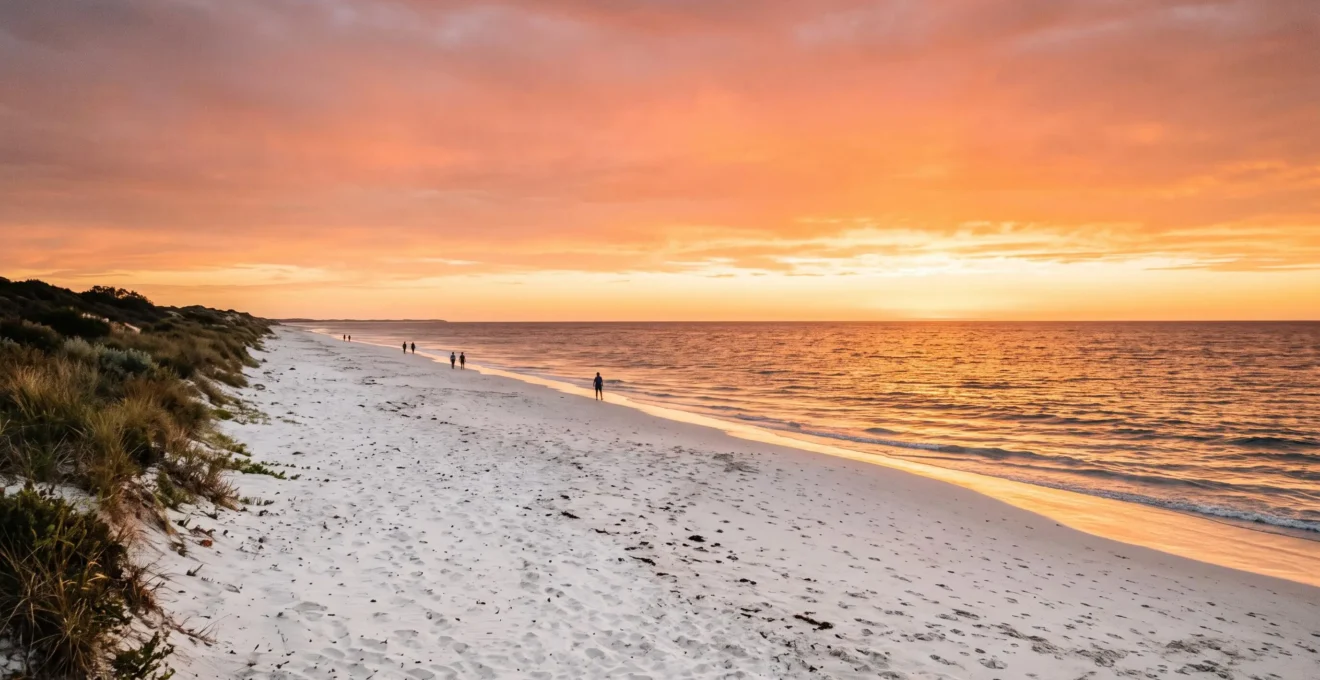
Perth’s infamous isolation isn’t a drawback; it is the very source of the exclusive travel experience you’re looking for.
- It delivers a rare « spatial luxury » with vast, uncrowded beaches that the bustling East Coast lost years ago.
- It offers a unique « temporal luxury, » with a time zone that significantly eases jet lag for European travellers, allowing you to enjoy your holiday from day one.
Recommendation: Stop seeing the journey as a cost and start seeing it as the price of entry for an exclusive, crowd-free Australian experience that prioritises relaxation over rush.
The question looms large for any seasoned traveller planning a trip to Australia: is Perth worth the extra flight? When Sydney and Melbourne dominate the itineraries with their iconic landmarks and bustling energy, the distant western capital can feel like a logistical stretch. Common wisdom suggests the journey is too long, the city too quiet, the attractions too few. You’ve heard about the sunny weather and nice beaches, but is that enough to justify the time and expense of crossing a continent?
This perspective, however, misses the fundamental point. It judges Perth by the standards of other cities instead of on its own unique terms. The very isolation that makes you hesitate is precisely what has preserved an authentic, relaxed coastal lifestyle that is now merely a memory on the East Coast. This isn’t just about fewer people; it’s about a different quality of time and space. It’s about trading the frantic energy of a global tourist hub for the restorative calm of the ‘Western Edge’.
This guide reframes the conversation entirely. We will demonstrate that Perth’s remoteness is not a liability but its greatest asset, creating two forms of unparalleled luxury for the traveller: spatial and temporal. We will explore how its beaches offer a sense of freedom, how its lifestyle allows for genuine decompression, and how its unique position on the globe can even make your adjustment to the holiday smoother. Forget what you think you know; it’s time to discover the exclusive rewards of embracing the distance.
This article breaks down exactly why that long-haul flight is a worthwhile investment. We will cover everything from the quality of the coastline to the surprising practical benefits of Perth’s unique location, providing the justification you need to add this essential destination to your map.
Summary: Why Perth’s Remoteness Rewards the Discerning Traveller
- Why Perth’s Beaches Offer the Space and Clarity Sydney’s Coastline Lost Decades Ago
- How to Experience Perth’s City-to-Beach Lifestyle with Morning Swims Before Sightseeing
- Perth’s Swan Valley or Margaret River: Which Western Wine Region Deserves Your Day Trip?
- The Perth Timezone Advantage That Eases Jet Lag for European Travellers
- When to Visit Perth for Whale Watching and Wildflower Blooms: The September Window
- Why Perth’s Northern Beaches Feel Completely Different from the Southern Coastline
- The Perth Timezone Advantage That Eases Jet Lag for European Travellers
- Which Perth Beach Matches Your Ideal Day: The Activity and Atmosphere Guide
Why Perth’s Beaches Offer the Space and Clarity Sydney’s Coastline Lost Decades Ago
The fundamental difference between a Perth beach and a Sydney beach can be summarised in one word: space. While Sydney’s famous coastlines are undeniably beautiful, they are victims of their own success. They have become global commodities, destinations to be ticked off a list. This popularity comes at the cost of tranquillity and personal space. The experience is often defined by crowds, noise, and a frantic search for a small patch of sand to call your own.
Consider the contrast. On a peak summer weekend, a famous Sydney spot like Bondi can be overwhelmed; an analysis from beach guides shows that on a summer weekend, Bondi packs in around 40,000 visitors per day. This transforms the beach from a natural escape into a bustling outdoor arena. This reality has led many critics to a stark conclusion. As the editors of Beach Verdict bluntly state:
Bondi is not the best beach in Australia. It is not even close.
– Beach Verdict Editorial, Beach Verdict — Bondi Beach Guide
This is the « spatial luxury » that Perth provides by default. Its 19 pristine metropolitan beaches, stretching over kilometres of white sand, have absorbed the city’s growth without sacrificing their core identity. Here, the ocean feels vast and the horizon uncluttered. You can walk for minutes without crossing another person’s towel, find a spot to watch the sunset in peace, and hear the sound of the waves over the chatter of crowds. This isn’t an accident; it’s a direct benefit of the city’s isolation, which has prevented the kind of hyper-tourism that has commercialised the East Coast.
This image is the reality of a standard Perth weekday. It’s not a curated moment from a remote, hard-to-reach location; it’s the accessible, everyday experience. The reward for making the journey west is not just a beautiful beach, but the freedom to actually enjoy it as nature intended: as a wide-open space for reflection and relaxation. You’re not just visiting a beach; you’re reclaiming the very idea of a coastal escape.
How to Experience Perth’s City-to-Beach Lifestyle with Morning Swims Before Sightseeing
In most major cities, a « beach day » is a full-day commitment—a project involving traffic, packed public transport, and significant travel time. In Perth, the beach is not a destination; it’s a seamless part of daily life. This is where the concept of « coastal decompression » becomes a tangible reality for visitors. The city’s urban planning and geography make accessing the coast incredibly efficient, turning a morning swim from a holiday novelty into a daily ritual.
The ease of access is startling for those accustomed to the urban sprawl of Sydney or Melbourne. From the central business district, you can be standing on the sand of a world-class beach in a remarkably short time. For instance, the iconic Cottesloe Beach is exceptionally accessible, with travel guides noting it is located only 15 minutes from downtown Perth. This proximity completely changes the rhythm of your holiday. It means you can start your day with a swim in the turquoise Indian Ocean, enjoy a coffee at a beachfront cafe, and still be back in the city for a 10 a.m. museum visit or a tour departure.
This isn’t just about convenience; it’s about a profound shift in your travel experience. Instead of packing sightseeing into a stressful, back-to-back schedule, you can punctuate your days with moments of genuine relaxation. This city-to-beach lifestyle offers a unique blend of urban culture and natural rejuvenation. You get the best of both worlds without the usual trade-offs. That first coffee after a morning swim, with salt on your skin as you plan the day’s activities, is the moment you understand the true luxury of Perth’s design.
Embracing this lifestyle is simple. Resist the urge to plan your days around a single « beach excursion. » Instead, view the coastline as your backyard. Pick a new beach each morning—the calm, family-friendly waters of Cottesloe, the surf-ready waves of Trigg, or the expansive sands of City Beach. This daily ritual of coastal decompression will redefine your idea of a city break, replacing tourist fatigue with a sense of well-being that lasts your entire trip.
Perth’s Swan Valley or Margaret River: Which Western Wine Region Deserves Your Day Trip?
For any wine lover visiting Western Australia, the name « Margaret River » is legendary. It’s a world-renowned region famed for its powerful Cabernet Sauvignon and elegant Chardonnay. However, its epicurean prestige comes with a significant logistical consideration: it’s a three-hour drive south of Perth. This makes it an ambitious, and frankly rushed, day trip. The true value of Margaret River is in immersion—a multi-day journey combining wine tasting with its spectacular forests and surf coast.
This is where Perth’s other, often-overlooked wine region becomes the savvy traveller’s choice for a day trip: the Swan Valley. Located just 25 minutes from the city, it offers a completely different yet equally rewarding experience. It’s Western Australia’s oldest wine region, a place of rustic charm and incredible diversity. As wine writer Andrew James notes, this proximity is its secret weapon:
It’s overshadowed by the much more famous Margaret River, but it’s well worth the detour.
– Andrew James, Académie du Vin Library — Swan Diversion
Choosing between them is not about which is « better, » but about matching the destination to your itinerary. If you have several days to spare and your trip’s focus is a deep dive into premium wine, Margaret River is an essential pilgrimage. But if you are based in Perth and want a relaxed, spontaneous day of gourmet indulgence without sacrificing a full day to driving, the Swan Valley is the perfect answer. The choice depends entirely on your most valuable resource: time.
To make the right decision, it is crucial to understand the fundamental differences in what each region offers for a short-term visitor. This is not just about wine; it’s about the entire ecosystem of activities, atmosphere, and travel time. A detailed look at the trip-planning criteria, based on official tourism recommendations for the Margaret River region, reveals two very distinct propositions.
| Criteria | Swan Valley | Margaret River |
|---|---|---|
| Distance from Perth | ~25-30 minutes drive | ~3 hours drive |
| Ideal Trip Length | Half-day | Multi-day (5+ days recommended) |
| Number of Cellar Doors | 40+ wineries plus breweries, distilleries, cideries | 100+ cellar doors |
| Vibe | Family-friendly, eclectic food-and-wine trail | Epicurean, high-end, integrated with surf and nature |
| Beyond Wine | Chocolate, cheese, olives, craft beer | World-class surf, caves, towering karri forests |
The Perth Timezone Advantage That Eases Jet Lag for European Travellers
For travellers from Europe, a trip to Australia is synonymous with brutal jet lag. The 10-to-11-hour time difference to Sydney or Melbourne throws your body clock into disarray, often costing you the first few precious days of your holiday in a haze of fatigue. This is where Perth’s geography offers a surprising and significant benefit, a form of « temporal luxury » that is rarely discussed but deeply felt.
Perth operates on Australian Western Standard Time (AWST), which is UTC+8. This places it two to three hours behind the eastern states. While that may seem minor, it has a major biological impact. For a traveller arriving from London (UTC+1) or Paris (UTC+2), the time difference to Perth is only 6 to 7 hours. This is a far more manageable shift for the human body’s circadian rhythm than the 9-to-10-hour jump required to reach the East Coast. It’s the difference between a challenging adjustment and a debilitating one.
This « timezone advantage » means you spend less time fighting your internal clock and more time enjoying your destination. Your sleep patterns can normalise faster, daytime sleepiness is reduced, and you feel more present and energetic from day one. Instead of feeling like you’ve lost a day, you feel poised to embrace it. It’s a subtle but powerful benefit that transforms the entire tone of your arrival experience. It makes the long-haul flight feel less like an ordeal and more like a manageable journey.
Think of it as starting your Australian adventure on an easier difficulty setting. The gentler time shift allows your body to catch up more quickly, meaning the stunning Indian Ocean sunset on your first evening feels like a beautiful spectacle, not a painful reminder that your body thinks it’s the middle of the afternoon. This is the unseen reward of choosing the western gateway: a smoother, faster transition into holiday mode.
When to Visit Perth for Whale Watching and Wildflower Blooms: The September Window
Choosing the right time to visit any destination is crucial, but for Perth, there is a specific month that offers a spectacular convergence of two of Western Australia’s most breathtaking natural phenomena: the peak of the wildflower season and the height of the whale migration. That month is September. While Perth’s climate is pleasant year-round, visiting in early spring elevates the experience from a great trip to an unforgettable one.
Western Australia is home to over 12,000 species of wildflowers, and a significant portion of these are unique to the region. In September, the landscape around Perth erupts in a riot of colour. This isn’t a subtle bloom; it’s a dramatic, widespread event that carpets bushland, parks, and even roadsides in vibrant hues. At the same time, the coastal waters become a highway for one of the planet’s largest mammal migrations. Humpback whales, having journeyed north to warmer waters to breed, return south with their calves, often playing close to shore.
This dual spectacle creates a unique travel opportunity. You can spend the morning marvelling at delicate and rare orchids in a national park and the afternoon watching a 40-tonne humpback whale breach just off the coast. This is nature at its most grand and most intricate, happening simultaneously. According to local travel experts, this timing is no coincidence; as noted by Perth Weekend, « September is also the perfect time to go whale watching in Perth. » It’s this perfect alignment that makes the month so special.
Your Action Plan: Experiencing Perth’s September Convergence
- Start at Kings Park for the curated, accessible Everlasting Festival display of native wildflowers.
- Drive to nearby Walyunga or John Forrest National Park for a wilder, more immersive wildflower experience.
- Book a whale-watching tour departing from Hillarys Boat Harbour or Fremantle to see migrating humpbacks and their calves.
- Consider a day trip to Rottnest Island, where land-based vantage points like West End offer great whale-watching opportunities.
- Bring your camera and binoculars—this is the prime window where the peak of the wildflower blooms and the whale migration overlap.
While other months offer their own charms, September provides the most compelling, multi-faceted natural reward. Planning your trip around this window ensures you see Perth and its surrounding nature at their absolute most vibrant and alive, giving you two powerful reasons to justify the journey.
Why Perth’s Northern Beaches Feel Completely Different from the Southern Coastline
For the first-time visitor, it might be tempting to think a beach is a beach. In Perth, however, the metropolitan coastline is a tale of two distinct characters: the northern and the southern beaches. Understanding their differences is key to crafting your perfect coastal experience. The dividing line is roughly the Swan River estuary, and the change in atmosphere, energy, and even the physical landscape is remarkably clear.
The southern beaches, including the famous Cottesloe, South Beach, and Port Beach, are generally more sheltered. They are often defined by man-made groynes and protected bays, which create calmer swimming conditions. This makes them ideal for families, lap swimmers, and those looking for a relaxed, leisurely day by the water. The vibe is more established, with historic tea houses, sprawling Norfolk pines, and a genteel, community feel. As one guide points out, this infrastructure is a key part of their appeal, as « the beach features purpose-built groynes that are perfect for fishing and safe swimming. »
Head north of the river, and the coastline’s personality shifts. Beaches like Scarborough, Trigg, and Mettams Pool are more exposed to the full force of the Indian Ocean. The energy is higher, the waves are larger, and the atmosphere is younger and more dynamic. This is the heart of Perth’s surf and kitesurfing culture. The coastline here feels wilder and more rugged, with prominent dunes and a more windswept character. The development is more modern, with high-rise apartments, skate parks, and bustling beachside bars that cater to a livelier crowd.
This contrast is not just about atmosphere; it’s physically tangible. The sand itself can feel different, the sound of the ocean is louder in the north, and the angle of the sun seems to hit the water in a new way. Your choice of beach, therefore, becomes a choice of experience. Do you want a tranquil afternoon with a book and calm waters (South), or do you want to watch skilled surfers, feel the ocean’s power, and enjoy a vibrant sunset with a cocktail in hand (North)?
The Perth Timezone Advantage That Eases Jet Lag for European Travellers
We’ve established that the gentler 6-to-7-hour time shift to Perth is a significant biological advantage for European travellers. But how do you leverage this « temporal luxury » in practice? The key is to actively manage your first 48 hours in the city to sync your body clock as quickly and painlessly as possible, turning a potential negative into a strategic positive for your holiday.
Your arrival day is critical. Regardless of what time you land, the golden rule is to stay awake until a reasonable local bedtime (around 9-10 p.m.). This is far easier to achieve with a 7-hour difference than a 10-hour one. The trick is to use Perth’s natural assets. Upon arrival, expose yourself to as much natural daylight as possible. A walk along the Swan River or a visit to Kings Park will send powerful signals to your brain to reset its internal clock. Avoid a heavy meal right away, opting for lighter fare to ease your digestive system into the new schedule.
Day two is about consolidation. Wake up at a normal local time, even if you feel you could sleep longer. The absolute best thing you can do is embrace the city’s lifestyle: head to the coast for an early morning swim. The combination of cool water, bright morning sun, and physical activity is the most effective natural tool for cementing your new circadian rhythm. It tells your body in no uncertain terms that this is the start of the day. Following this with a protein-rich breakfast will further anchor your energy levels.
By following this simple two-day protocol, you are not just passively benefiting from the smaller time difference; you are actively collaborating with it. You are using Perth’s environment—its sun, its ocean, its outdoor culture—as a tool for rapid acclimatisation. This proactive approach means that by day three, you are not just ‘coping’ with jet lag; you are largely free of it, fully energised and ready to explore everything the region has to offer. This is the practical payoff of choosing the western gateway.
Key Takeaways
- Perth’s isolation is its greatest strength, offering unparalleled « spatial luxury » on its beaches compared to crowded eastern cities.
- The city-to-beach lifestyle is a reality, with just a 15-minute commute enabling morning swims before a day of sightseeing.
- The « temporal luxury » of its UTC+8 timezone provides a significant, practical advantage for European travellers by easing jet lag.
Which Perth Beach Matches Your Ideal Day: The Activity and Atmosphere Guide
Now that you understand the sheer quality and variety of Perth’s coastline, the final step is to match a beach to your specific mood and desired activity. The « best » beach is entirely subjective; it depends on whether you’re seeking vibrant social energy, a quiet family spot, or a perfect wave. This guide serves as your practical matchmaking tool, moving beyond simple descriptions to help you plan the perfect day.
For the quintessential Perth experience that balances buzz with beauty, Cottesloe is the undeniable star. It’s the city’s postcard beach, famed for its terraced lawns, the iconic Indiana Teahouse, and its reliably gentle waves. It’s a social hub, a place to see and be seen, but its vast size means it rarely feels overwhelmingly crowded. It’s the perfect all-rounder for a first-time visitor who wants a beautiful, accessible, and lively beach day with excellent nearby cafes.
If your priority is a more active, high-energy day, then Scarborough is your destination. Re-developed into a modern beachfront precinct, it features a surf school, a skate park, and a geothermally heated public pool. The atmosphere is young and dynamic, and the waves are consistently good for surfing and bodyboarding. For those seeking solitude and a more natural setting, City Beach offers a more refined, quiet escape just a short drive from Cottesloe, with wide stretches of pristine sand and upscale restaurants.
Ultimately, making the right choice involves balancing atmosphere with practicality. Factors like parking, public transport access, and the quality of nearby amenities can make or break a beach day. The following scorecard, based on data and reviews from sources like comprehensive online beach guides, provides a quick reference to help you decide.
| Beach | Parking Difficulty (Weekend) | Public Transport Access | Café Quality | Crowd Factor |
|---|---|---|---|---|
| Cottesloe | 4/5 | 4/5 | 5/5 | 4/5 |
| Scarborough | 3/5 | 4/5 | 4/5 | 4/5 |
| City Beach | 2/5 | 3/5 | 4/5 | 2/5 |
| Trigg | 3/5 | 2/5 | 3/5 | 3/5 |
| Port Beach | 2/5 | 3/5 | 3/5 | 2/5 |
The journey to Perth is not just another flight; it’s a filter. It’s a conscious decision to trade the familiar and the frantic for the exclusive and the expansive. You are choosing a destination that rewards you with space to breathe, time to relax, and a genuine connection to a stunning natural environment. So, re-evaluate your map, reconsider your definition of « worth it, » and book the flight. The ultimate luxury is waiting for you on the Western Edge.