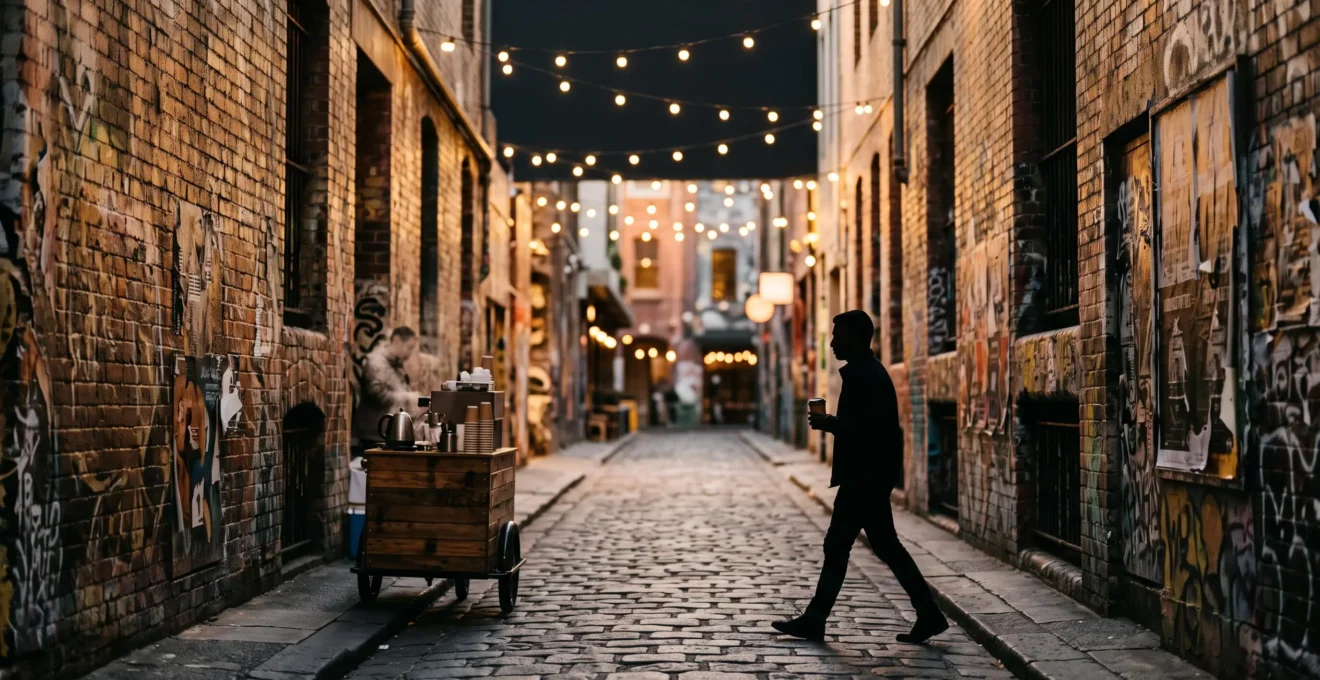
Experiencing Melbourne like a local isn’t about visiting a checklist of famous spots; it’s about learning to decode a city that intentionally hides its best experiences in plain sight.
- The city’s laneways operate as a complex social and economic system, not just a backdrop for photos.
- Coffee ordering is a cultural language with its own strict, unspoken rules that separate insiders from outsiders.
- The most authentic neighbourhoods are often in constant flux, meaning the places you’ve heard of may already be past their prime for locals.
Recommendation: To begin, choose a « vibe » that fits you (e.g., expansive rooftop or intimate laneway) rather than chasing a specific, famous venue.
There’s a feeling many travellers get in Melbourne. You arrive knowing it’s one of the world’s epicentres of « cool, » a city humming with creative energy, but you find yourself on the outside looking in. You walk down the same streets as everyone else, take a photo in front of a famous mural, and grab a coffee that, while good, doesn’t feel like the life-altering experience you were promised. The city’s pulse remains just out of reach, a rhythm you can hear but can’t quite join.
Conventional travel advice offers a familiar checklist: visit Hosier Lane, drink a flat white, explore the laneways. While not wrong, this approach scratches only the surface. It treats the city like a museum of static exhibits. It fails to convey that Melbourne’s culture is not a collection of things to see, but a dynamic system to be understood—a cultural code. The real magic isn’t in finding a specific place, but in learning how to read the map of the city’s social geography.
But what if the key wasn’t about knowing *where* to go, but *how* to see? This guide is designed to hand you the cipher to that cultural code. We’re moving beyond the tourist trail to explore the city as a local insider would: by understanding the narrative of its laneways, the unspoken etiquette of its cafés, and the constant, subtle shift of its creative heart. This is about transforming you from a spectator into a participant in Melbourne’s unique cultural landscape.
Over the next five days, you’ll learn to navigate the city’s layers. This article breaks down the essential codes you need to know, from ordering coffee without looking like a tourist to understanding why the neighbourhood everyone recommends might be the one locals now avoid. Get ready to explore Melbourne from the inside out.
Contents: Your Guide to Melbourne’s Cultural Code
- Why Melbourne’s Laneways Reveal More Than Its Grand Boulevards Ever Will
- How to Order Coffee in Melbourne Without Looking Like a Tourist
- Street Art Tours or Self-Guided Exploration: Which Unlocks Melbourne’s Creative Heart?
- The Melbourne Neighborhood Tourists Love That Locals Abandoned in 2015
- When to Visit Melbourne for Arts Festivals and Bearable Weather: The March Window
- Rooftop Bars or Laneway Venues: Which Australian Nightlife Fits Your Vibe?
- How to Order Coffee in Australian Cafés Using Local Terms, Not Starbucks Language
- How to Navigate Australian Café Culture Without Ordering Like a Tourist
Why Melbourne’s Laneways Reveal More Than Its Grand Boulevards Ever Will
Melbourne’s grand boulevards like Collins Street or St Kilda Road project an image of stately, European-inspired order. They are the city’s public face. But its soul—the messy, creative, and commercial engine—is tucked away in the narrow, cobbled arteries originally designed for rubbish carts and service access. These laneways are not just shortcuts; they are the city’s unofficial circulatory system, where culture, commerce, and community converge in ways impossible on the wide, formal avenues.
This transformation from utilitarian spaces to cultural hubs is a defining feature of modern Melbourne. What were once grimy back-alleys became a canvas for street artists and a low-rent incubator for independent businesses. The intimate scale of a laneway forces a different kind of interaction. You can’t just cruise by; you must immerse yourself. This is where you find the hole-in-the-wall espresso bar, the niche boutique, or the basement bar that becomes your own secret discovery. As the city grew, these spaces were reclaimed, turning grit into a multi-million dollar boon that now defines the city’s identity.
While Hosier Lane is the most famous example, it’s crucial to see it as a starting point, not the destination. Its fame has turned it into an outdoor gallery, but the true laneway culture is about the act of discovery. To experience it like a local, you must venture into less-trodden paths like AC/DC Lane, Degraves Street, or Centre Place, and learn to read their specific character—some are for coffee, others for fashion, and many for the simple, quiet pleasure of being hidden away in the heart of the metropolis.
How to Order Coffee in Melbourne Without Looking Like a Tourist
In Melbourne, coffee is not just a beverage; it’s a cultural ritual with a strict, unspoken etiquette. Ordering coffee is the first and most frequent test of your ability to understand the local code. The reason for this intensity is structural: Melbourne’s café scene is fiercely independent. While many cities are dominated by global chains, a study of the city’s coffee landscape found that 95% of its over 1,600 cafés are independently owned. This independence fosters a culture of expertise, where baristas are respected artisans and customers are expected to have a discerning palate.
This is not an exaggeration. The city’s collective devotion to coffee is so profound that it has even sparked public debate. When a former Lord Mayor, Robert Doyle, once dismissively remarked that « Coffee is coffee; it’s not life or death, » the backlash was swift and severe, cementing his comment as a famous local gaffe. It revealed a core truth: to Melburnians, coffee is a serious matter of identity and quality.
Coffee is coffee; it’s not life or death.
– Robert Doyle, as cited in Museums Victoria’s ‘Café Culture’ article
To order without looking like a tourist, you must first forget the Starbucks lexicon of « grande » or « venti. » Sizes are « small, » « medium, » or « large, » and even these can be vague. The key is to order by the type of coffee. A « latte » is served in a glass, a « flat white » in a ceramic cup. A « long black » is hot water with espresso shots added, while an « Americano » is the reverse. And for a true insider’s drink, ask for a « magic »: a double ristretto (a shorter, more concentrated espresso shot) topped with steamed milk in a smaller 6oz cup, offering the perfect coffee-to-milk ratio.
Street Art Tours or Self-Guided Exploration: Which Unlocks Melbourne’s Creative Heart?
Melbourne’s walls are an ephemeral canvas, a dynamic conversation that changes daily. For a visitor, the sheer volume of street art can be overwhelming. This presents a crucial choice: do you embark on a guided tour or wander the laneways on your own? The common assumption is that self-guided exploration is more « authentic, » but the reality is more nuanced. A self-guided walk allows for serendipity, but you risk only seeing the surface—a collection of pretty pictures without context or meaning.
An artist-led street art tour, on the other hand, is less about being shown art and more about being taught a language. It provides the cultural code to decipher the walls. Guides, who are often artists themselves, can explain the difference between a commissioned mural, a stencil, a paste-up, and a tag. They can point out artist rivalries, collaborations, and the subtle political commentary woven into the works. According to a profile by RACV, one such company, Melbourne Street Art Tours, demonstrates how this initial guidance can empower visitors to later « read » the walls on their own, turning a passive viewing into an active engagement with the city’s creative pulse.
Action Plan: Auditing Your Itinerary for Local Authenticity
- Points of Contact: List all the channels where you’re getting your travel recommendations (e.g., mainstream guidebooks, travel blogs, Instagram influencers, local zines).
- Collection: Inventory your current list of planned activities and venues (e.g., Hosier Lane, Eureka Tower, a specific well-known restaurant).
- Coherence: Confront each item with Melbourne’s « local code » values: is it independent? Is it hidden or mass-market? Is it static or evolving?
- Memorability/Emotion: For each activity, ask if it’s a generic tourist experience or something uniquely Melbourne. Is visiting another chain store memorable?
- Integration Plan: Systematically replace at least two « generic » items on your list with a « local » alternative found through deeper research (e.g., swap a CBD mega-bar for a small neighbourhood venue in Fitzroy).
Ultimately, the best approach is a hybrid one. Start with a reputable artist-led tour on your first day. Use it as a lesson in visual literacy. Then, spend the rest of your trip applying what you’ve learned, exploring laneways with a newfound ability to understand the layers of paint and paper as a living dialogue. This transforms you from a tourist into an urban archaeologist, uncovering the stories hidden on every corner.
The Melbourne Neighborhood Tourists Love That Locals Abandoned in 2015
Every great city has them: neighbourhoods that were once the epicentre of local cool, only to become victims of their own success. In Melbourne, the most potent example of this « tourist vs. local drift » is Chapel Street. For decades, this sprawling road through South Yarra and Prahran was the city’s premier destination for fashion, food, and nightlife. It was a dynamic ecosystem of independent boutiques, edgy designers, and pioneering cafés. But if you ask a discerning Melburnian under 40 where they hang out today, Chapel Street is unlikely to be their answer.
The shift was gradual, then sudden. Around the mid-2010s, the elements that made Chapel Street unique began to erode. Rising rents pushed out the independent businesses that gave the strip its character, replacing them with national chains and generic hospitality groups. The street became a parody of itself, a place to be seen rather than a place to discover something new. This isn’t just anecdotal; it’s a well-documented economic shift.
Case Study: The Economic Hollowing of Chapel Street
The neighbourhood’s decline from a local hub to a commercialized strip is rooted in clear economic pressures. As highlighted in a commercial real estate analysis of its tenant exodus, a perfect storm of major redevelopment disruption and unsustainable rents created a mass departure. Independent tenants could no longer afford leases that soared to between $100,000 and $120,000 a year. This dynamic forced out the unique, small-scale operators, leaving a vacuum that was filled by high-turnover businesses and corporate entities, fundamentally altering the street’s cultural fabric.
So, where did the locals go? They migrated north, to neighbourhoods like Fitzroy, Collingwood, and Brunswick. These areas offered what Chapel Street had lost: a thriving community of independent artists, roasters, brewers, and designers. Understanding this migration is key to experiencing the real, contemporary Melbourne. It teaches a valuable lesson for the urban explorer: the most famous places are often a reflection of the past, while the city’s living culture is found in the places it is moving toward.
When to Visit Melbourne for Arts Festivals and Bearable Weather: The March Window
Melbourne’s weather is famously fickle, often delivering « four seasons in one day. » While the city’s cultural calendar is packed year-round, there is a strategic sweet spot that offers the best convergence of vibrant arts programming and pleasant, stable weather: the month of March. This is when the city is at its most effervescent, hosting a « festival trifecta » that caters to every taste, all under the mild, sunny skies of early autumn.
Visiting in March allows you to experience the city at its peak outdoor-friendly state, before the chill of winter sets in. More importantly, it gives you access to an unparalleled density of world-class events. The centrepiece is the Melbourne International Comedy Festival, one of the largest in the world. Its scale is immense, with a pre-pandemic report noting the festival recorded an attendance of 776,737 people in 2019 alone, taking over hundreds of venues from grand theatres to tiny laneway bars. It’s an event that completely transforms the city’s evening atmosphere.
Alongside the comedy, March hosts two other major events that create a perfect cultural storm. The Melbourne Food and Wine Festival turns the entire state into a playground for gourmands, while the Moomba Festival offers a massive, free community celebration along the Yarra River. Planning your visit during this window means you are guaranteed to stumble upon something extraordinary every day.
| Festival | Typical Timing | Scale |
|---|---|---|
| Melbourne Food and Wine Festival | Early-to-mid March | More than 200 events across Melbourne and regional Victoria, drawing around 75,000 guests |
| Melbourne International Comedy Festival | Late March through April | 600+ shows across 100+ venues, part of an event selling in excess of 600,000 tickets annually |
| Moomba Festival | March Labour Day long weekend | Australia’s largest free community festival, over 250,000 attendees |
While other months have their charms—the buzz of the Australian Open in January or the moody, artistic vibe of winter—no other time offers such a concentrated and accessible blast of everything that makes Melbourne a global cultural capital. If you can only visit once, aim for March.
Rooftop Bars or Laneway Venues: Which Australian Nightlife Fits Your Vibe?
As dusk settles over Melbourne, the city’s social life splits into two distinct realms: the sky and the shadows. Your choice of where to spend your evening—at a sprawling rooftop bar or a hidden laneway venue—is a decision that defines the kind of night you’ll have. This isn’t just about the drink in your hand; it’s about choosing your perspective on the city. One offers panoramic grandeur, the other, intimate discovery. Neither is better, but they cater to completely different vibes.
The rooftop bar experience is about expanse and spectacle. From high above, you watch the city’s lights glitter as you sip a cocktail, feeling part of the grand, cinematic sweep of Melbourne. Venues like Rooftop Bar in Curtin House or Naked for Satan in Fitzroy offer breathtaking views that put the city’s scale on display. It’s a social, often boisterous atmosphere, perfect for warm evenings, group gatherings, and seeing the urban landscape from a god’s-eye view.
In contrast, the laneway venue is an exercise in introversion and secrecy. These bars are often unmarked, hidden down narrow alleys or in unassuming basements. Finding them is part of the appeal. Inside, the atmosphere is typically cozy, dimly lit, and focused on craft. Think expert mixologists, curated wine lists, and quiet corners for conversation. Places like Bar Americano or Eau de Vie are temples to the art of the drink, offering an intense, focused experience. This is the choice for a more personal night, a deep conversation, or the feeling of being an insider who knows the city’s secrets.
So, which fits your vibe? Do you want to survey the kingdom from your castle in the sky, or unearth a hidden gem in the city’s secret passages? Your answer will lead you to a fundamentally different, yet equally essential, Melbourne night.
How to Order Coffee in Australian Cafés Using Local Terms, Not Starbucks Language
For many, experiencing Melbourne’s coffee culture is a primary travel motivator. In fact, one report indicates that for 42% of international visitors, the city’s coffee reputation is a significant reason for their visit. However, to truly partake in this culture, you must learn its specific vernacular. Using generic, international coffee chain terminology is the quickest way to mark yourself as an outsider. The local language is precise, and mastering it is a sign of respect for the craft.
First, it’s essential to understand the philosophy behind the order. Unlike the often diluted, oversized coffees common in other parts of the world, the Melbourne standard is a smaller, more intense, and perfectly balanced cup. The focus is on the quality of the espresso and the texture of the milk, not on volume or sugary syrups. Knowing the difference between a flat white and a latte is a good start: a flat white has a thin, velvety layer of microfoam, while a latte has a deeper layer of foam and is served in a glass.
But to truly speak the language, you need to know the fundamentals that set the local coffee order apart. It’s about adjusting your expectations around size, strength, and flavour profile.
- Expect smaller serving sizes: The standard cup is around 6-8oz (180-240ml), not the oversized buckets you might be used to. Quality over quantity is the rule.
- Embrace a stronger, more concentrated shot: Melbourne coffee is built on a foundation of expertly pulled espresso, which is not meant to be heavily diluted.
- Recognise the preference for lighter roasts: Top-tier cafés favour lighter roast profiles that highlight the bean’s origin and create a smoother, brighter, more acidic cup, unlike the bitter, dark roasts of traditional Italian-style coffee.
- Know that 100% Arabica is standard: Unlike many Italian blends that mix in Robusta beans for crema and caffeine, Melbourne’s specialty cafés almost exclusively use higher-quality, single-origin or blended Arabica beans.
Mastering these terms and expectations will not only get you a better cup of coffee but will also open a door into the heart of the city’s daily life. It’s a small but powerful way to connect with the local rhythm.
Key Takeaways
- Melbourne’s culture is not a checklist of sights but a ‘cultural code’ you can learn to read, turning your visit into an active exploration.
- Coffee is the city’s social syntax; learning the specific, local dialect for ordering is your key to participating, not just observing.
- The most authentic neighbourhoods are in a constant state of flux; the ‘coolest’ places are often the ones you haven’t heard of yet, not the famous ones from old guidebooks.
How to Navigate Australian Café Culture Without Ordering Like a Tourist
Successfully navigating Melbourne’s café culture is the final piece of the puzzle in experiencing the city like a local. It synthesizes your understanding of its independent spirit, its laneway geography, and its specific social codes. This is a city that so thoroughly rejected corporate coffee culture that in 2008, it forced one of the world’s biggest brands into a massive retreat. The fact that, at the time, Starbucks closed seventy per cent of its stores in Australia is the ultimate testament to Melbourne’s fierce loyalty to its own unique coffee identity.
This identity isn’t uniform; it’s learned laneway by laneway, suburb by suburb. Each café has its own unwritten rules about where to order (at the counter or at the table), whether to pay upfront or after, and its own particular social flow. There is no single city-wide rulebook. The best way to learn is by observing for a minute when you first walk in. Watch what others are doing. Is there a queue at the till? Are people waiting to be seated? This small act of observation is the key to blending in seamlessly.
Case Study: Degraves Street as a Microcosm of Café Culture
Degraves Street, a bustling, narrow laneway connecting Flinders Street to Flinders Lane, serves as a perfect archetype of Melbourne’s café culture. Lined with outdoor tables under a canopy of umbrellas, it feels distinctly European yet uniquely Melbourne. It’s a place of constant motion and high-quality, ever-evolving coffee offerings. For a visitor, sitting at a Degraves Street café provides a masterclass in local etiquette. You’ll see how locals interact with baristas, the quick, no-fuss nature of a takeaway order, and the leisurely pace of those sitting in. It illustrates perfectly why the city’s café norms are learned through immersion in specific micro-cultures like this one, not from a generic guide.
Ultimately, navigating this world is about more than just getting caffeinated. It’s about participating in a core part of Melbourne’s social fabric. It’s a daily ritual that brings the city together. By taking the time to learn its language and respect its customs, you are no longer just a tourist buying a drink; you are a temporary resident taking part in the life of the city.
Now that you have the tools to read the city, it’s time to create your own map. Start by exploring one of the neighbourhoods mentioned and see if you can spot the local codes for yourself. This is your invitation to go beyond the surface and truly connect with Melbourne.