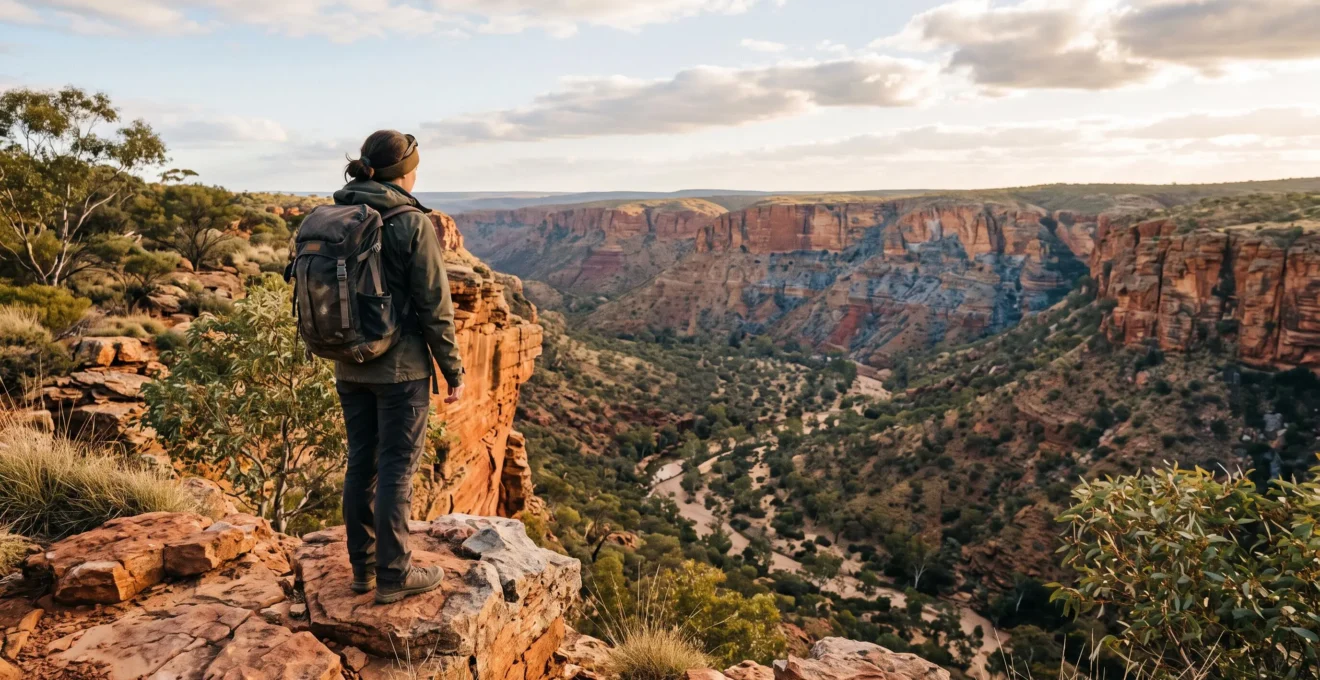
Many visitors mistakenly apply generic ‘eco-tourist’ rules to Australian parks, dangerously underestimating their unique ecological fragility and magnified personal risks.
- The key to responsible travel is adopting a ‘biosecurity mindset,’ viewing yourself as a potential vector between ancient, isolated ecosystems.
- Personal safety and environmental protection are intrinsically linked; the same factors that make the landscape fragile also make it hazardous if unprepared.
Recommendation: Recalibrate your approach from simply ‘leaving no trace’ to actively understanding and protecting an environment that operates by a different, more demanding set of rules.
For many global travelers, the term « national park » conjures images of lush green forests in North America or the well-trodden alpine paths of Europe. We’ve been taught the universal mantras of responsible tourism: pack out what you pack in, stay on the trail, and don’t feed the wildlife. These are good, essential rules. But when you step into an Australian national park, you are stepping onto a different kind of land, one where these rules are merely the starting point for a much deeper level of respect and preparation.
The Australian continent is ancient, its ecosystems shaped by millennia of isolation, nutrient-poor soils, and the pervasive influence of fire. This has created a landscape of incredible endemism and subtle beauty, but also one of extreme fragility. The common advice often fails to capture the magnified risks—to both the visitor and the environment. It’s not just about being « sun smart »; it’s about respecting some of the highest UV radiation levels on the planet. It’s not just about « cleaning your boots »; it’s about preventing the spread of microscopic pathogens that can wipe out entire ecosystems.
But what if the true key to a profound and safe experience wasn’t just following a list of rules, but fundamentally recalibrating your understanding of nature itself? This guide is built on that principle. We will move beyond the generic advice to explore the ‘why’ behind the ‘what’—why Australian parks demand a different mindset, how to navigate their unique challenges, and how to choose experiences that connect you to the deep story of this land. This is about transforming your visit from a simple tour into an act of guardianship.
To help you navigate this unique environment, this guide breaks down the essential knowledge for a responsible and safe adventure. From understanding the profound differences in the landscape to practical steps for trail selection and biosecurity, we will cover the key pillars of conscious exploration in Australia.
Summary: How to Experience Australian National Parks Without Damaging Ecosystems or Risking Safety
- Why Australian National Parks Demand More Preparation Than European or American Parks
- How to Navigate National Park Permits and Access Restrictions Before You Arrive
- Vehicle-Accessible or Remote Wilderness Parks: Which Australian Experience Delivers More?
- The Leave No Trace Mistake 70% of Visitors Make in Australian National Parks
- When to Visit National Parks for Peak Wildlife Activity Without Peak Tourist Crowds
- Why Tasmania’s Wilderness Feels Rawer Than Any Mainland National Park
- Why Australian Bushland Reveals Different Secrets Than European or American Forests
- How to Choose Bushwalking Trails That Teach You Australian Ecology, Not Just Exercise
Why Australian National Parks Demand More Preparation Than European or American Parks
The familiar sense of scale and safety found in many Northern Hemisphere parks can create a dangerous sense of complacency in Australia. The environmental factors here are not just different; they are often magnified to an extreme degree. Personal safety and ecological stewardship are two sides of the same coin. For instance, the sun is a tangible risk; as the Cancer Council Australia points out, Australia has some of the highest levels of UV radiation in the world. This isn’t just a reminder to wear a hat; it’s a non-negotiable aspect of daily survival in the bush, where heat exhaustion and severe sunburn can quickly become medical emergencies miles from help.
This concept of magnified risk extends directly to ecological impact. An action as simple as walking with muddy boots carries a disproportionate threat. Australian flora has evolved in isolation over millions of years, leaving it highly vulnerable to foreign pathogens. A prime example is Phytophthora dieback, a water mould that attacks the roots of plants. According to a national field guide on invasive threats, this single pathogen is already affecting tens to hundreds of thousands of hectares across most of the country. When you move soil from one area to another, you are not just dirtying a path; you are potentially becoming a vector for an ecological disaster.
Furthermore, the sheer scale and isolation of Australia are difficult to comprehend until experienced. A breakdown or a wrong turn that might be an inconvenience in Europe could be a life-threatening event in the outback. This reality demands a higher level of self-reliance, vehicle preparation, and communication planning. Unlike parks that are often nestled between towns, many Australian national parks are the definition of remote, where you are the sole architect of your safety. This combination of intense environmental pressures, ecological fragility, and profound isolation is what fundamentally sets the Australian park experience apart.
How to Navigate National Park Permits and Access Restrictions Before You Arrive
Unlike countries with a single, unified national park pass, Australia’s system reflects its federated structure. Each of its six states and two territories manages its own parks, resulting in a patchwork of different rules, fees, and booking systems. This concept of state-based guardianship means there is no « one-size-fits-all » pass. A pass for New South Wales will not grant you access to a park in Victoria or Western Australia. Therefore, the first step of planning any trip is to identify which state or territory you will be in and research its specific park authority website.
The fee structure can also be confusing. Some states, like New South Wales, primarily charge for vehicle entry at their most popular parks, while day access to many others remains free. Other states may focus fees on specific activities like camping or guided walks. It’s essential to understand what you’re paying for. These fees are not arbitrary taxes; they are a critical source of funding for track maintenance, conservation programs for threatened species, and the protection of Indigenous cultural heritage sites within the park.
Perhaps the most critical habit to develop is checking for alerts right before you depart. Conditions in Australia can change with terrifying speed. A park that was open yesterday could be closed today due to a total fire ban or a sudden flood. Park websites and dedicated state-based apps (like ‘Fires Near Me’ in NSW) provide real-time updates. Ignoring these alerts, or entering a park without a valid pass where required, is not only disrespectful but also carries heavy fines, often many times the cost of the permit itself. This pre-trip check is a non-negotiable part of your safety protocol.
Vehicle-Accessible or Remote Wilderness Parks: Which Australian Experience Delivers More?
The question isn’t which type of park is « better, » but which experience aligns with your goals, preparation, and desire for either curated interpretation or profound self-reliance. Vehicle-accessible parks, often located closer to population centers, are gateways to the Australian bush. They offer paved roads, clear signage, interpretive visitor centres, and well-maintained short walks. For families, first-time visitors, or those with limited time, these parks deliver a safe and highly educational experience. They are designed to showcase the ecological highlights of a region in a digestible format, allowing you to learn about the landscape without the risks of deep wilderness.
Remote wilderness parks, in contrast, offer a different currency: solitude. Reaching them often requires a high-clearance 4WD vehicle, meticulous planning, and the capacity to be entirely self-sufficient with water, fuel, food, and emergency communications. Here, the « visitor facilities » might be a single long-drop toilet and a clearing for your tent. The reward for this effort is an unparalleled sense of immersion. In these places, the rhythms of the day are dictated by the sun and the wildlife, not a park brochure. You are no longer an observer of nature; you are a temporary, and very small, participant within it.
The vehicle itself transforms in these contexts. In an accessible park, it is a convenience. In a remote park, it is your lifeline. It is your shelter, your storage, and your only guaranteed way out. The decision to cross the threshold from a maintained road into a remote track is a commitment. It represents a shift from being guided by the park service to taking full responsibility for your own existence. Ultimately, both experiences are valid and valuable. One delivers knowledge and safety; the other delivers solitude and a powerful lesson in humility.
The Leave No Trace Mistake 70% of Visitors Make in Australian National Parks
While the title is a provocation, it points to a deeper truth. The most common and damaging mistake isn’t a single act like dropping a wrapper, but a failure of mindset: underestimating your passive, invisible impact. This is most evident in two modern phenomena: the spread of pathogens and the digital broadcasting of fragile locations. Many visitors who meticulously pack out their rubbish think their job is done, yet they may be carrying microscopic spores on their boots that could decimate a local plant community. This is why adopting a « biosecurity mindset » is the single most important evolution of the Leave No Trace philosophy for Australia.
The second widespread modern mistake is the careless use of social media. The impulse to share a beautiful, secluded waterfall or a pristine rock pool by geotagging its exact location can have devastating consequences. A Georgia Tech economics study was the first to statistically tie high social media exposure to increased visitor numbers and subsequent ecological damage. A spot that was once visited by a few hikers a week can become inundated with hundreds a day, leading to soil compaction, erosion, and rubbish issues. The mistake is not in taking the photo, but in digitally signposting a fragile location to the entire world, a practice now known as « geo-tagging to death. »
To counter the first, physical threat, building a simple but non-negotiable cleaning routine is essential. This is not just a suggestion; it is a critical conservation action. Moving from one park to another—or even between different vegetation zones in the same park—without decontaminating your gear is playing Russian roulette with the local flora.
Your Biosecurity Self-Audit: A 5-Step Plan
- Points of Contact: Before you leave home, identify every piece of gear that will touch the ground—boots, vehicle tyres, tent pegs, walking poles, and even camp chairs.
- Collecte (Decontamination): Upon leaving a walking trail or campsite, use a stiff brush to physically collect and remove all visible soil, mud, and seed matter from these items.
- Cohérence (Verification): Check your actions against park signage. Obey instructions and use designated boot-cleaning stations where provided, as they indicate a known high-risk area.
- Disinfection Protocol: For high-risk zones (especially in Tasmania and Western Australia), apply a disinfectant solution (e.g., 70% methylated spirits, 30% water) via a small spray bottle after brushing.
- Plan d’intégration: Assemble a dedicated ‘biosecurity kit’ containing a brush, spray bottle, and rubbish bag, and make it a permanent, essential part of your hiking and camping equipment.
When to Visit National Parks for Peak Wildlife Activity Without Peak Tourist Crowds
Timing your visit to an Australian national park is a delicate balance between optimal weather, wildlife activity, and avoiding the crush of peak season crowds. The best windows are often found in the « shoulder seasons »—spring (September to November) and autumn (March to May)—across the southern half of the country. During these periods, the weather is typically mild, and the landscape is often at its most vibrant, with spring wildflowers or autumn colours. Crucially, these months fall just outside the main summer school holidays, meaning fewer people on the trails.
For wildlife viewing, the time of day is far more important than the time of year. Most of Australia’s iconic animals—kangaroos, wallabies, wombats, and many bird species—are crepuscular, meaning they are most active during the low light of dawn and dusk. During the heat of the day, they conserve energy by resting in the shade, making them difficult to spot. An early morning walk or a late afternoon vigil near a water source will almost always be more rewarding than a midday hike. This simple shift in timing can transform your wildlife experience from a fruitless search into a magical encounter.
The equation changes for the tropical north (e.g., Kakadu, the Daintree). Here, the seasons are defined by the « wet » (roughly November to April) and the « dry » (May to October). The dry season is peak tourist season for a reason: roads are accessible, temperatures are manageable, and wildlife congregates around shrinking waterholes, making for spectacular viewing. However, this is also when crowds are at their thickest. For a quieter experience, consider the very beginning or end of the dry season. You may risk some early rains or higher humidity, but you’ll be rewarded with a more personal and peaceful connection to the landscape.
Why Tasmania’s Wilderness Feels Rawer Than Any Mainland National Park
While the Australian mainland has vast and wild parks, Tasmania’s wilderness possesses a different, more primal character. This rawness stems from a unique combination of its ancient geological history, its climatic position, and its sheer scale of protection. Much of the island’s southwest is a time capsule, a living relic of the supercontinent Gondwana. The flora here, with its ancient conifers like the Huon Pine and remnant cool-temperate rainforests, feels fundamentally older and less evolved to the fire-and-drought cycles that define so much of the mainland. It is a wetter, greener, and more moss-covered world.
This is amplified by the weather. Situated in the path of the Roaring Forties, the weather systems that slam into Tasmania are born from an uninterrupted fetch of ocean stretching from South America. The weather is not just an inconvenience; it is a powerful, shaping force of the landscape and the experience. A single day can bring brilliant sunshine, driving rain, and snow, reminding you constantly of nature’s dominance. This, combined with the island’s isolation, creates a palpable sense of being at the edge of the world, a feeling that is harder to find on the vast, connected mainland.
Finally, the scale of conservation is immense. The Tasmanian Wilderness World Heritage Area covers almost 1.6 million hectares, or roughly 20% of the entire state. It’s not just one park but a network of interconnected parks and reserves, creating an unbroken expanse of wilderness that is one of the last of its kind on Earth. Walking here, you are not just in a park; you are in a globally significant wilderness zone. The memory of the extinct Thylacine (Tasmanian Tiger) also haunts the landscape, serving as a poignant reminder of what has been lost and what is left to protect, adding a layer of profound gravity to the experience.
Why Australian Bushland Reveals Different Secrets Than European or American Forests
A visitor accustomed to the dense, verdant undergrowth of a European or North American forest can find the Australian bush initially perplexing. It can seem sparse, dry, and strangely quiet. This is because its secrets are not revealed in obvious abundance but in subtle adaptations to a harsh environment. The dominant aesthetic is shaped by sclerophyllous plants—hard-leaved, tough, and often grey-green species like eucalypts and acacias, designed to conserve water in a land of drought.
The forest floor is not a soft carpet of decaying leaves but often a dry, crackling layer of bark and twigs. The silence during the heat of the day is a collective strategy for survival, as animals and insects shelter from the punishing sun. The secrets are in the details: the intricate patterns of a scribbly gum moth on bark, the brilliant flash of a rosella in a muted green canopy, or the sudden, explosive scent of eucalyptus released by a summer rain. It requires you to slow down, look closer, and adjust your senses to a different frequency of life.
The most profound secret, however, is the bush’s relationship with fire. Where a northern forest is destroyed by fire, much of the Australian bush is renewed by it. Many species require the heat of a blaze to release their seeds. The quintessential example is the eucalypt itself. After a fire has blackened its trunk, appearing dead to an unfamiliar eye, a miracle occurs. Tiny green epicormic shoots burst directly from the seemingly lifeless bark, a testament to an evolutionary strategy that anticipates and embraces fire. To see this is to understand the core principle of resilience that underpins the entire ecosystem. It’s a landscape not of gentle cycles, but of catastrophic destruction and fierce, determined rebirth.
Key Takeaways
- Adopt a Biosecurity Mindset: Your most important role is to prevent the spread of soil and pathogens between ecosystems. Your gear is a potential vector.
- Respect State-Based Guardianship: There is no single park pass. Always research and adhere to the specific permit and access rules of the state or territory you are visiting.
- Practice Interpretive Bushwalking: Shift your focus from physical exercise to ecological learning. Choose trails that help you read the landscape’s story of adaptation, fire, and resilience.
How to Choose Bushwalking Trails That Teach You Australian Ecology, Not Just Exercise
Transforming a walk from simple exercise into an educational journey—what can be called « interpretive bushwalking »—starts with your choice of trail. It’s about selecting paths that are designed to tell a story. The most straightforward way to do this is by seeking out designated « interpretive trails. » These are often shorter walks equipped with signage explaining the local flora, fauna, geology, or Indigenous history. They are curated experiences, designed by ecologists and rangers to reveal the specific secrets of that particular place. They are the perfect starting point for learning to read the landscape.
To deepen your understanding, aim to experience a variety of ecosystems. Instead of doing three similar forest walks, make a conscious effort to choose a coastal heathland trail, a rainforest gully walk, and a dry sclerophyll ridgeline hike. This allows you to see and feel the dramatic shifts in plant communities, soil types, and microclimates firsthand. You will begin to notice not just the trees, but *why* certain trees grow on the cool, damp southern face of a hill while others dominate the hot, dry northern slope. This comparative approach builds a much richer mental map of Australian ecology.
Finally, engage with the resources provided by the park service. Before you even arrive, download the park’s official map and notes from their website. These documents often highlight trails with specific features: « wildflower discovery walks » in spring, « Aboriginal heritage walks » that point out ancient rock art or middens, or trails that traverse unique geological formations. When you arrive, take five minutes to talk to a ranger at the visitor centre. Ask them, « What trail will best show me what makes this park unique? » Their answer will invariably lead you away from the most crowded path and toward a more meaningful experience, turning your feet into tools of discovery.
Your journey into Australia’s national parks is an invitation to become more than just a tourist. It’s an opportunity to become a student of an ancient landscape and an active guardian of its future. By applying this deeper understanding and preparing with diligence, you not only ensure your own safety but also help preserve the very wildness you came to experience for all who will follow.
Frequently Asked Questions About How to Experience Australian National Parks Without Damaging Ecosystems or Risking Safety
Which parks actually charge entry fees?
This varies by state. For example, motor vehicle entry fees are charged at 45 of the 895 national parks and reserves managed by NSW National Parks. These are generally the most popular parks with high visitor numbers, while many quieter parks remain free to enter.
How much does a day pass typically cost?
Day pass costs are generally modest. In a state like NSW, single day vehicle entry is typically between $8 and $12, though iconic or exceptionally large parks like Kosciuszko National Park may have different fee structures. Always check the specific park’s official website for current pricing.
How do these fees actually help the park?
Fees are directly reinvested into the park system. This funding is crucial to maintain and improve visitor facilities like toilets and walking tracks, protect the habitats of threatened species, and conserve vital historic and culturally significant Aboriginal sites for future generations.