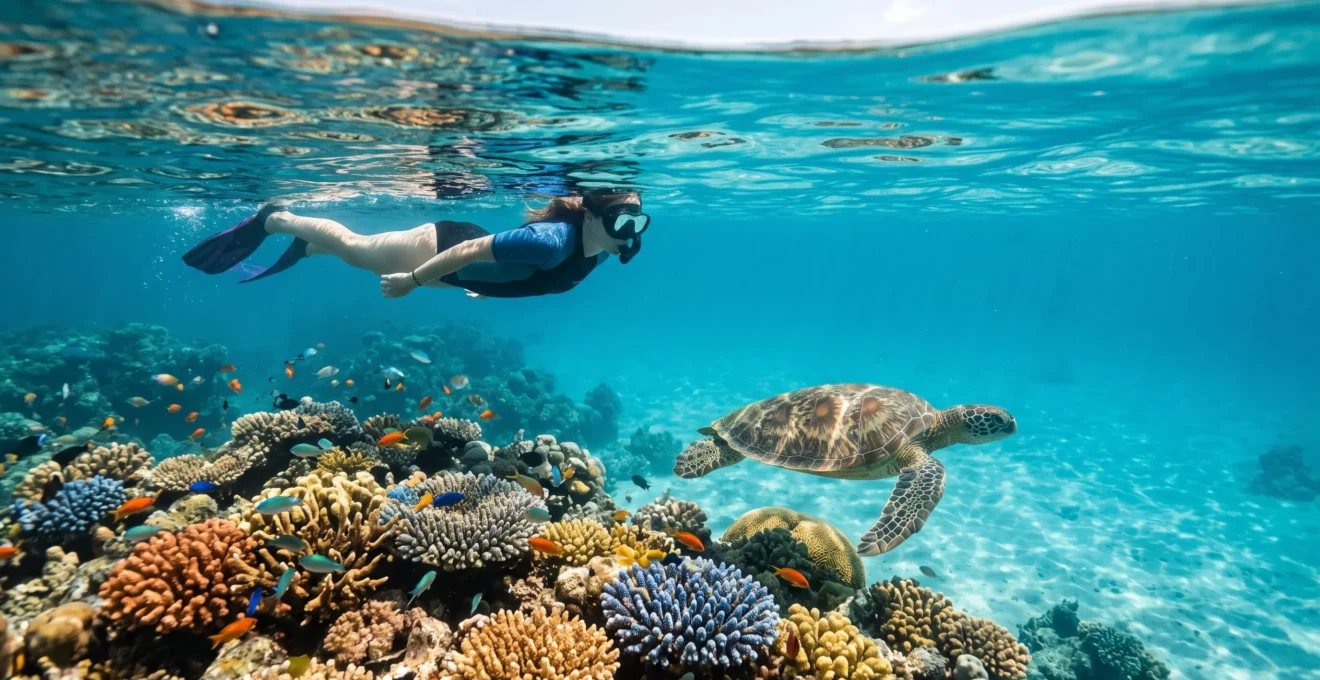
The most profound way to experience the Coral Sea is to transform from a mere tourist into an active, informed custodian of the reef.
- True conservation goes beyond « not touching »; it involves understanding the ecological impact of every choice, from your tour operator to your camera angle.
- Adopting an « observer mindset » enhances your experience, allowing for more meaningful encounters while minimizing disturbance to marine life.
Recommendation: Before booking anything, use the provided checklist to verify an operator’s commitment to marine education and safety, ensuring your visit actively supports the reef’s resilience.
The Coral Sea, particularly the Great Barrier Reef, beckons with a promise of otherworldly beauty. It’s a world painted in impossible colours, a bustling metropolis of marine life that can leave you breathless. For marine enthusiasts, it represents a pilgrimage to one of the planet’s most vital biodiversity hotspots. Yet, there’s a growing awareness among conscientious travellers like you: how do we witness this wonder without contributing to its fragility? The desire to see the vibrant dance of clownfish, the majestic glide of a manta ray, and the intricate architecture of the corals themselves is often shadowed by the fear of causing harm.
The standard advice, while well-intentioned, often feels like a list of prohibitions: don’t touch, don’t stand, use the right sunscreen. These are crucial rules, but they only scratch the surface. They treat the reef as a museum, a collection of delicate objects behind invisible ropes. As a marine biologist who has dedicated my life to these ecosystems, I can tell you the reef is not a museum. It is a living, breathing, and deeply interconnected community. To truly experience it responsibly is to understand your role within that community, however temporary.
This guide is designed to shift your perspective. We will move beyond the simple « don’ts » and into the realm of « why. » My goal is to arm you with an ecologist’s understanding, transforming you from a passive spectator into a skilled and empathetic observer. We’ll explore the science behind the reef’s unparalleled richness, learn how to identify its key inhabitants in a way that helps protect them, and delve into the practical choices that make a genuine difference. By understanding the ecosystem, you not only minimize your impact but also exponentially increase the richness of your own experience.
This article will guide you through the essential knowledge needed to become a true reef custodian. From understanding its unique biodiversity to choosing the right kind of tour, every section is a step towards a more meaningful and genuinely sustainable adventure.
Summary: A Deep Dive into Responsible Coral Sea Exploration
- Why the Coral Sea Delivers Marine Biodiversity the Caribbean Cannot Match
- How to Identify the 10 Key Coral Sea Species During Your Reef Visit
- Outer Reef or Inner Reef: Which Coral Sea Zone Delivers Better Marine Encounters?
- The Underwater Photography Mistake That Disturbs Marine Life and Blurs Your Shots
- When to Visit the Coral Sea for Crystal Visibility and Peak Marine Activity
- The Coral-Touching Mistake That Injures You and Destroys Marine Ecosystems
- Pontoon-Based or Boat-Based Snorkeling: Which Tour Type Suits Your Skill Level?
- How to Choose Snorkeling Tours That Deliver Safety and Marine Education, Not Just Transport
Why the Coral Sea Delivers Marine Biodiversity the Caribbean Cannot Match
When visitors ask me why the Coral Sea feels so overwhelmingly alive, the answer lies in its geographic destiny. It is the heart of a global biodiversity engine. While the Caribbean has its unique charms, the Coral Sea is part of the Coral Triangle, an area scientists have identified as the world’s absolute epicenter of marine life. This region, though covering a tiny fraction of the ocean, is the evolutionary cradle for a staggering variety of species. It’s not just another beautiful reef system; it is the source.
The sheer scale of this diversity is hard to comprehend. The Great Barrier Reef alone is home to over 400 coral species, both hard and soft, creating a complex, three-dimensional habitat that supports thousands of other organisms. This is an order of magnitude greater than what you might find in other regions. This structural complexity creates an almost infinite number of niches for fish, invertebrates, and larger predators. Where the Caribbean might have a handful of dominant coral types, here you find a sprawling, competitive metropolis of different shapes, sizes, and colours, each supporting its own community.
This richness is a product of millions of years of stable sea levels, warm currents, and evolutionary processes. The result is an ecosystem with incredible resilience and a dense web of interdependencies. When you dip your head beneath the surface, you are not just seeing more fish or more coral; you are witnessing a system operating at its peak evolutionary complexity. Understanding this context changes your visit from a simple sightseeing trip to an appreciation of a global natural treasure.
It is this fundamental difference in evolutionary history and scale that makes every encounter in the Coral Sea feel so vibrant and significant.
How to Identify the 10 Key Coral Sea Species During Your Reef Visit
Identifying species on the reef isn’t just about ticking off a list; it’s about learning to read the story of the ecosystem. Recognizing key species—and their health—is the first step toward ecological empathy. When you can distinguish a healthy, grazing parrotfish from a stressed one, or spot an indicator species, you’ve unlocked a deeper level of engagement. Instead of just seeing « a fish, » you start to see a key worker in the reef community. But you don’t have to be a marine biologist to contribute.
A powerful way to enhance your identification skills and actively help the reef is by becoming a citizen scientist. Programs like the Great Barrier Reef Marine Park Authority’s « Eye on the Reef » allow any visitor with a smartphone to become a vital part of the reef’s monitoring and protection network. These initiatives are not trivial; a recent citizen science survey collected over 43,000 reef images collected across 320 reefs in one year, providing data on a scale that would be impossible for scientists alone.
Participating transforms your snorkel from a passive activity into a purposeful survey. Here are the simple steps to get started:
- Download the App: Get the free Eye on the Reef app before your trip and familiarize yourself with its features.
- Learn the Targets: The app helps you focus on key indicator species and conditions, teaching you what to look for—from coral health to sightings of the destructive Crown-of-Thorns Starfish.
- Observe and Record: During your snorkel, make mental or physical notes of what you see. Take photos of anything significant (healthy or otherwise).
- Submit Your Data: Back on the boat or on shore, use the app to upload your sightings. Every entry contributes to a massive dataset that informs management decisions.
By participating, you’re not just learning to identify the top 10 species; you’re learning to see the reef with purpose and contributing to its future.
This simple shift in mindset makes every minute in the water more rewarding and impactful.
Outer Reef or Inner Reef: Which Coral Sea Zone Delivers Better Marine Encounters?
A common question I hear is, « Should I book a tour to the inner reef or the outer reef? » The answer isn’t about which is « better, » but which is better suited to the experience you seek. These two zones offer vastly different ecological encounters, shaped by their proximity to the coast and the influence of the open ocean. Thinking of them as different « neighbourhoods » in the vast city of the reef helps in making an informed choice.
The inner reefs are closer to the mainland, in more sheltered waters. This means the water can have more sediment and nutrients from coastal runoff, sometimes affecting visibility. However, these conditions support incredibly resilient and beautiful ecosystems, often dominated by vibrant soft corals that sway with the current and provide shelter for juvenile fish and unique macro life. They are fantastic nurseries for the reef.
The outer reefs, by contrast, sit at the edge of the continental shelf, battered by the clear, deep blue of the open Pacific. The water clarity here is often breathtaking. This high-energy environment is where you’ll find the massive, architectural structures of hard corals, forming complex walls and bommies. This is the domain of larger pelagic species—reef sharks, manta rays, and turtles—that patrol the reef edge. The following table breaks down the key differences to help you decide.
This ecological variance is a direct result of their location, as this comparative analysis of reef zones shows.
| Feature | Inner Reef | Outer Reef |
|---|---|---|
| Coral spawning timing | Typically October | Typically November or December |
| Water influence | Coastal, more sediment and nutrients | Open oceanic water, clearer conditions |
| Dominant marine life | Resilient soft corals, sheltered fish communities | Hard coral growth, pelagic species such as sharks and rays |
Ultimately, the « best » reef is the one that matches your expectations, whether you’re searching for the intricate beauty of a sheltered garden or the grand drama of the open ocean.
The Underwater Photography Mistake That Disturbs Marine Life and Blurs Your Shots
Underwater photography is a beautiful way to capture reef memories, but it’s also where good intentions can go wrong. The most common mistake isn’t technical; it’s behavioural. It’s the « chase, » the aggressive pursuit of a subject to « get the shot. » This behaviour not only stresses marine life, causing fish to flee and delicate creatures to retract, but it also results in panicked, blurry photos. The secret to great underwater photography is adopting an observer mindset.
A patient photographer who becomes part of the environment will always get better shots and have more meaningful encounters than one who thrashes after a fleeing turtle. Marine animals are acutely aware of energy. Calm, slow, and deliberate movements signal that you are not a threat. Chasing, reaching, and cornering an animal triggers its flight response, stressing the creature and ruining your photo opportunity. The best photographers are masters of buoyancy, able to hover effortlessly, minimizing their fin kicks and their overall presence.
Instead of pursuing a subject, try this: find an interesting spot on the reef, check your position to ensure you are not near any coral, and just wait. Become still. Your calm presence will eventually be accepted by the local inhabitants. Fish will resume their normal behaviour, and curious creatures may even approach you. Holding your camera low and bringing it up slowly is far less intimidating than pointing it directly. This patient approach respects the animal’s space and, paradoxically, brings the wildlife to you, resulting in natural, intimate, and crystal-clear photographs.
Remember, the best wildlife photographers are barely noticed, and that is the principle you should strive for underwater.
When to Visit the Coral Sea for Crystal Visibility and Peak Marine Activity
While the Coral Sea is a year-round destination, timing your visit can dramatically alter your experience. Most guidebooks will point you to the dry season (from May to October) for the best weather and consistently clear water, and this is sound advice. During these months, lower rainfall means less coastal runoff, leading to superior visibility, especially on the inner reefs. The winds are generally calmer, and the water temperature is comfortable.
However, for the truly dedicated marine enthusiast, there is another, more spectacular window to consider: the annual coral spawning. Described by the legendary Sir David Attenborough as « one of the greatest of all natural spectacles, » this is the single most important annual event for the reef’s future. For a few specific nights of the year, triggered by the lunar cycle and water temperature, entire sections of the reef erupt in a synchronized release of eggs and sperm. It’s an underwater snowstorm of potential new life, a foundational moment for resilience contribution.
one of the greatest of all natural spectacles
– Sir David Attenborough, Divernet – Coral Spawning on the Great Barrier Reef
Witnessing this requires careful planning, as the event is brief and occurs at night. Specialized night tours are essential. If you’re planning a trip and want to aim for this incredible phenomenon, here’s what you need to know:
- Know the Trigger: Spawning is timed to water temperature and the lunar cycle.
- Watch the Calendar: Corals usually spawn on nights following the October, November, and December full moons, with timing varying between inner and outer reefs.
- Expect a ‘Snow-storm’ Effect: Entire coral colonies release egg and sperm bundles simultaneously at night.
- Book Night Tours: Plan your trip around the predicted window and book with an operator offering dedicated spawning tours.
- Understand the Stakes: Successful spawning is the most significant annual event for the Reef’s long-term health.
Whether you seek the calm clarity of the dry season or the reproductive chaos of spawning, aligning your visit with the reef’s natural rhythms is key.
The Coral-Touching Mistake That Injures You and Destroys Marine Ecosystems
The rule « do not touch the coral » is the first thing every snorkeler learns, yet the reason behind it is far more complex than simple fragility. Touching coral is a mistake that harms both you and the reef in ways that aren’t immediately obvious. From a biologist’s perspective, a coral is not a rock; it’s a colony of tiny, delicate animals living in a symbiotic relationship with algae. This colony is protected by a thin, vital layer of mucus.
This mucus layer is the coral’s first line of defense. It traps sediment, protects from UV radiation, and contains antimicrobial compounds that ward off infection. When you touch a coral, even gently, you wipe away this protective layer. This leaves the coral polyps exposed and vulnerable to bacterial infections and disease, much like a burn on human skin. Furthermore, the oils and bacteria on your hands are foreign to the reef environment and can be toxic to the coral. A single touch can set off a chain reaction of tissue death that can spread across a colony.
The danger is also personal. Many corals, especially fire coral, have powerful stinging cells called nematocysts. Brushing against them can result in a painful, persistent rash. Other corals have sharp skeletons that can cause cuts that are notoriously slow to heal and prone to infection in the marine environment. The best way to stay safe and protect the reef is to maintain a conscious buffer zone. Master your buoyancy, keep your hands clasped or crossed, and always be aware of where your fins are. This isn’t just a rule; it’s a fundamental principle of ecological empathy.
Your mindful presence is the greatest gift you can give to the reef, ensuring it remains vibrant for generations to come.
Pontoon-Based or Boat-Based Snorkeling: Which Tour Type Suits Your Skill Level?
Once you’ve decided on an inner or outer reef destination, the next practical choice is the type of tour: a floating pontoon or a dedicated snorkel/dive boat. This decision significantly impacts your day and should be based on your comfort level in the water, your group’s needs, and the kind of experience you’re after. Both have distinct advantages and cater to different types of visitors, representing another key informed choice.
Pontoon-based tours are perfect for beginners, families with young children, or mixed-ability groups. These large, stable platforms are moored permanently at a prime reef location. They offer easy access to the water via submerged platforms, designated snorkeling areas protected from currents, and often feature underwater observatories and semi-submersibles for those who don’t want to get wet. You have the freedom to snorkel at your own pace, take breaks on the sun deck, and enjoy a host of amenities. It’s a controlled, safe, and comfortable way to be introduced to the reef.
Boat-based tours, in contrast, are generally geared towards more confident swimmers and dedicated snorkelers or divers. These smaller vessels often visit multiple reef sites in one day, a practice known as « roving. » This provides a greater variety of underwater landscapes and the flexibility to move if conditions at one site are not ideal. The experience is more intimate and adventurous, but it requires you to be comfortable entering and exiting the water from the back of a boat in the open ocean. While one major boat-based operator carries around 30,000 visitors per year, the feeling on any given day is typically less crowded than at a pontoon.
If you are a strong swimmer and want to see as much diversity as possible, a boat-based tour is likely your best bet. If you are less confident, have non-swimmers in your group, or prefer a more relaxed day with more amenities, a pontoon offers an excellent and stress-free alternative.
There is no single « best » option, only the option that is best for you.
Key Takeaways
- Adopt an Observer Mindset: Shift from a passive tourist to a patient, non-intrusive observer to gain more meaningful wildlife encounters and protect the ecosystem.
- Your Choices Are Ecological: Every decision, from the reef zone you visit to the tour operator you hire, has a direct impact on the reef and your experience.
- Contribute to Resilience: Participate in citizen science programs like Eye on the Reef to turn your visit into a net positive for reef conservation and management.
How to Choose Snorkeling Tours That Deliver Safety and Marine Education, Not Just Transport
The single most important decision you will make for your reef trip is choosing your tour operator. A great operator does more than just transport you to a location; they are your gateway to understanding the reef, your safety net in an unfamiliar environment, and your partners in conservation. Distinguishing between a simple « boat taxi » and a high-quality, eco-certified operator is the cornerstone of responsible tourism. Look for operators who weave education and conservation into the very fabric of their tour.
A key indicator of quality is participation in programs like the Master Reef Guide program. These are the world’s leading reef guides, ambassadors who undergo extensive training to share the stories of the reef and inspire visitors. Having a Master Reef Guide on board transforms the day from a fun swim into an immersive educational experience. Since the program began, more than 140 guides have been trained, reaching millions of visitors with their passion and expertise. Seeking out tours that employ these guides is a direct investment in quality and conservation.
High Standard Tourism Operators, certified by the Great Barrier Reef Marine Park Authority, are another benchmark of excellence. These operators are independently assessed on their commitment to protection, presentation, and partnership. They are the leaders in the industry, often contributing to monitoring programs and using the most sustainable practices. Before you book, do your homework. A few pointed questions can reveal an operator’s true commitment.
Your Action Plan: Pre-Booking Checklist for a True Eco-Tour
- Check for Certification: Ask if the operator is recognized as a High Standard Tourism Operator by the Great Barrier Reef Marine Park Authority.
- Inquire About Guides: Ask specifically if accredited Master Reef Guides will be on board during your tour.
- Verify Monitoring Participation: Check if the operator actively participates in stewardship programs like the « Eye on the Reef » monitoring.
- Confirm Mooring Practices: Confirm that the operator uses permanent moorings instead of dropping an anchor, which can destroy coral.
- Assess Education Depth: Look for evidence of ongoing environmental education throughout the day, not just a token safety briefing at the start.
Choosing the right tour is the final, crucial step in ensuring your visit to this global icon is not just unforgettable, but genuinely beneficial for the ecosystem you’ve travelled so far to see.