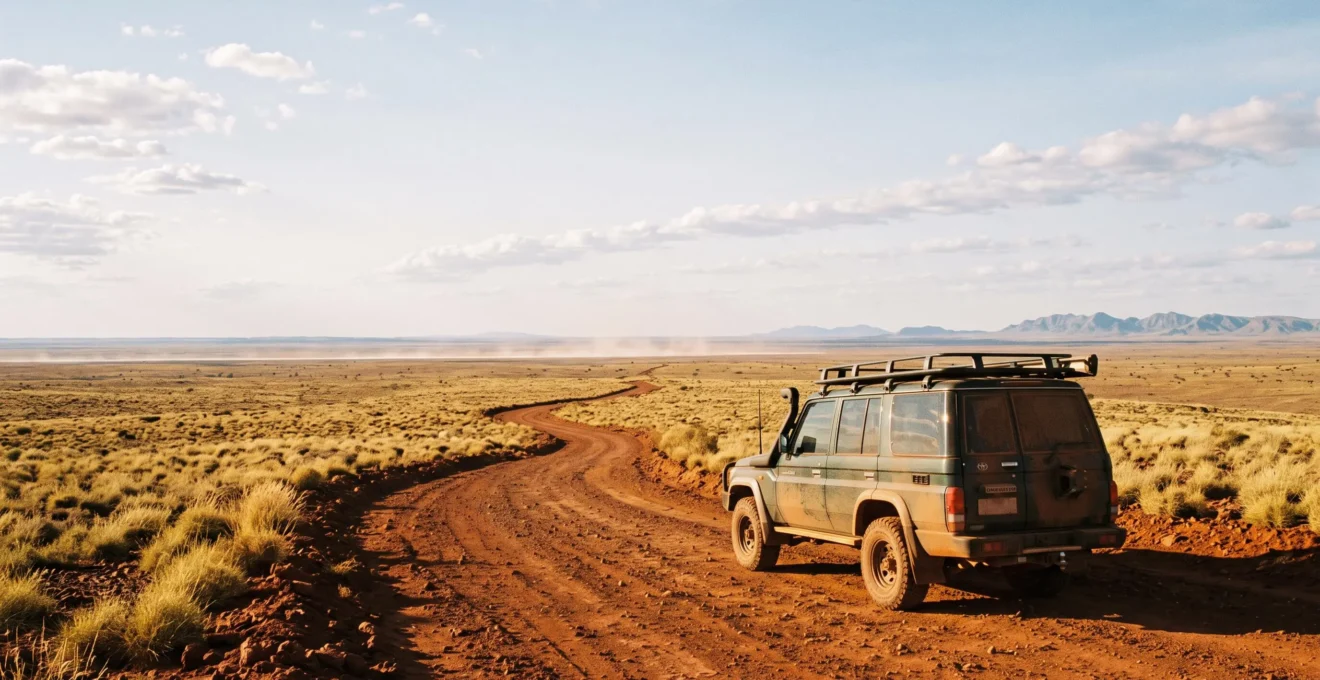
The greatest danger in the Australian Outback isn’t what you think; it’s the ‘Failure Cascade’—the chain reaction where a single, simple problem like a flat tyre becomes a life-threatening emergency due to extreme isolation.
- Standard rescue infrastructure is non-existent; your vehicle is your lifeline and its preparation is a non-negotiable system check, not a simple to-do list.
- Mobile phones are unreliable. Relying on anything less than a satellite device or a registered Personal Locator Beacon (PLB) is a critical planning error.
Recommendation: Treat every trip, no matter how short, as a serious expedition. Your preparation mindset and understanding of system redundancy are far more important than any single item on your packing list.
The allure of the Australian Outback is potent. It promises boundless horizons, ancient landscapes, and a profound sense of freedom. For adventurous travellers, it represents one of the last great terrestrial frontiers. However, this mystique is built on a foundation of extreme remoteness and environmental harshness that is often dangerously underestimated. Many approach it with a standard holiday mindset, armed with generic advice like « pack extra water » or « get a 4WD. » These tips are not wrong, but they are critically incomplete.
As a survival and safety educator with a background in search and rescue, I can tell you the critical distinction between a successful Outback journey and a tragedy is rarely a single event. It’s the ‘Failure Cascade.’ This is the principle where one manageable issue—a flat tyre, a wrong turn, a minor illness—triggers a chain reaction of compounding problems. Immobility leads to exposure, exposure to dehydration, and dehydration to a medical emergency, all amplified by the sheer, unforgiving scale of the continent. Your mobile phone won’t work, and the nearest help might be hundreds of kilometres and several hours away by air.
The key to survival and truly experiencing the Outback is not about avoiding problems altogether; it’s about building robust systems to prevent that first domino from falling and having redundant measures in place for when it does. This guide is designed to shift your perspective from that of a tourist to that of an expedition planner. We will deconstruct the unique risks of the Outback, focusing on vehicle preparation as a life-support system, understanding the reality of communication blackouts, and respecting the life-threatening power of distance and heat.
To navigate this complex environment safely, it’s essential to understand its distinct challenges in a structured way. This article breaks down the core components of Outback preparedness, from the foundational understanding of its unique dangers to the practicalities of transport and life-sustaining resources. The following sections will equip you with the knowledge to build the right systems for a safe and profound adventure.
Summary: A Systematic Approach to Outback Safety
- Why the Outback’s Remoteness and Harshness Exceed Any Other Developed Nation’s Wilderness
- How to Prepare Your Vehicle for Outback Travel: The Essential Safety Equipment Checklist
- Self-Drive Outback or Guided Tours: Which Delivers Real Red Centre Adventure?
- The Mobile Coverage Assumption That Leaves Outback Travellers Without Emergency Help
- When to Visit the Outback for Bearable Heat and When Summer Becomes Life-Threatening
- The Water Miscalculation That Causes Dehydration on 60% of Australian Inland Hikes
- Why Single Australian States Cover Distances Equal to Multiple European Countries
- How to Navigate Australia’s Transport Options Without Wasting Days in Transit
Why the Outback’s Remoteness and Harshness Exceed Any Other Developed Nation’s Wilderness
The term « remote » fails to capture the reality of the Australian interior. It’s not just empty; it’s a void of infrastructure on a continental scale. To put this in perspective, the Royal Flying Doctor Service covers an area of 7.69 million km², a territory larger than Western Europe, staffed by a handful of aircraft. This isn’t a national park with ranger stations. It’s an environment where the concept of a « golden hour » for medical response is a logistical impossibility. As the Journal of Emergency Medical Services notes, there is a « very limited health infrastructure throughout most of the Outback and few resources on the ground. » This means any serious incident immediately becomes a complex aeromedical operation.
This environmental reality is the engine of the ‘Failure Cascade.’ A problem that would be a minor inconvenience elsewhere—a vehicle breakdown, a sprained ankle—becomes the start of a survival situation. You are not waiting for a tow truck; you are waiting for an aircraft, and its ability to reach you depends on weather, daylight, and a suitable landing area. The psychological pressure of this isolation cannot be overstated. When you look to the horizon and see nothing but the curvature of the earth, you understand that self-reliance is not a choice but the only available strategy.
Case Study: The ‘Failure Cascade’ on the Eyre Highway
The Royal Flying Doctor Service documented a stark example of this principle in action. A traveller’s vehicle rolled off the Eyre Highway, one of Australia’s most isolated stretches of sealed road. The occupant was trapped and critically injured. In a suburban setting, this is a routine roadside rescue. In the Outback, it required an RFDS aircraft to land directly on the highway itself to access the patient. The single point of failure (the crash) immediately escalated into a full-scale aeromedical operation, demonstrating how quickly the Outback strips away conventional support systems and amplifies the consequences of any incident.
Understanding this fundamental difference is the first step in proper preparation. You are not planning for a road trip; you are planning for an expedition where you are the first, second, and often third line of response.
How to Prepare Your Vehicle for Outback Travel: The Essential Safety Equipment Checklist
In the Outback, your vehicle is not just transport; it is your life-support system. It provides shelter from extreme temperatures, carries your water and communication gear, and is your only means of self-rescue. Its failure is the most common trigger for a ‘Failure Cascade.’ Considering a nationwide roadside assistance survey found that 80% of Australian drivers have experienced a breakdown, treating vehicle preparation as a casual afterthought is a critical error. The focus must be on systemic resilience, not just a pre-trip oil change.
The primary stressor is not a single dramatic event, but the cumulative effect of thousands of kilometres on corrugated dirt roads. The constant, high-frequency vibration attacks every component of your vehicle, from suspension and tyres to electrical connections and cooling systems. A standard vehicle, even a 4WD, is not inherently prepared for this abuse. Preparation involves a systematic audit of key systems to ensure they are robust enough to withstand the prolonged strain. This is not about a specific brand or model, but about targeted reinforcement and carrying the right recovery tools. Your goal is to make the vehicle mechanically resilient and to carry the equipment to self-recover from common failures like a bogged wheel or a punctured tyre.
Action Plan: Pre-Expedition Vehicle Systems Audit
- Suspension and Load Check: Assess your suspension’s load capacity and current wear. The extra weight of water, fuel, camping, and recovery gear fundamentally changes your vehicle’s braking behaviour and steering response. Ensure it’s rated for the load you will carry.
- Tyre System Integrity: Fit high-quality, off-road-rated tyres (e.g., All-Terrain or Mud-Terrain with light truck construction). Carry two full-size spares, a reliable pressure gauge, a tyre repair kit, and a method for reinflation like a 12V compressor.
- Air Intake and Cooling Audit: Inspect and clean all filtration systems. The fine red dust from corrugated roads is insidious and can choke air filters, affecting engine performance and longevity. Check the entire cooling system for leaks or wear.
- Electrical System and Vibration Proofing: Check battery terminals and all critical electrical connections for tightness. Continuous vibration can loosen wires, leading to system failure. Properly secure any secondary batteries or solar setups.
- Recovery Gear Inventory: Before departure, pack and inspect recovery equipment appropriate for your planned terrain. This includes rated recovery points on the vehicle, a snatch strap, shackles, a long-handled shovel, and traction boards (like Maxtrax).
This audit moves you from a passive driver to an active expedition manager. You are not just hoping for the best; you are systematically hardening your primary asset against the most likely points of failure.
Self-Drive Outback or Guided Tours: Which Delivers Real Red Centre Adventure?
The choice between an independent, self-drive expedition and an organised tour is a fundamental one. It is not merely a question of budget or style, but a critical decision about risk management and responsibility. A guided tour outsources the immense logistical and safety burden to professionals. The guides manage the vehicle, navigation, communication, and emergency plans. For those new to the Outback or without the mechanical skills and recovery experience, a tour provides a safe and accessible way to experience the landscape’s grandeur without bearing the full weight of its risks.
However, for many, the essence of Outback adventure lies in self-reliance. A self-drive journey offers unparalleled freedom to explore at your own pace, to linger where the landscape speaks to you, and to experience a profound sense of accomplishment. This freedom comes with total responsibility. You are the mechanic, the navigator, the communications officer, and the first responder. If a ‘Failure Cascade’ begins, it is your knowledge and preparation that will halt it. This option should only be considered by those who have honestly assessed their capabilities and have systematically prepared their vehicle and safety systems as outlined previously.
Whether you choose a tour or self-drive, one principle remains non-negotiable. As the World Nomads Travel Safety Team emphasizes, you must have a system for being tracked. On a tour, this is inherent. On a self-drive trip, it’s your responsibility.
Always let someone know where you are going to and when you expect to arrive.
– World Nomads Travel Safety Team, How to Road Trip the Rugged Australian Outback Safely
This means leaving a detailed itinerary with a reliable contact, including planned routes, check-in times, and a « panic date » for when to alert authorities if you are overdue. For true self-drive safety, this is the bare minimum, and should be supplemented with a satellite-based communication or tracking device.
The Mobile Coverage Assumption That Leaves Outback Travellers Without Emergency Help
The most dangerous assumption in the Outback is that your mobile phone will work. Outside of the few major towns, it will not. There is no signal. Expecting to call for help is not a plan; it’s a gamble with your life. This communication black hole is a primary accelerator of the ‘Failure Cascade.’ A simple problem becomes a crisis when you have no way to signal for assistance. Experienced travellers understand this, which is why a reader poll found that a significant majority of remote hikers now carry a Personal Locator Beacon (PLB).
A PLB or a satellite phone is not a luxury item; it is an essential piece of your vehicle’s life-support system. A satellite phone allows for two-way communication, which is ideal for complex situations. A PLB is a one-way distress signal, a last-resort button that alerts global rescue authorities. It’s crucial to understand what this means. Activating a beacon is not like calling for roadside assistance. The Australian Maritime Safety Authority (AMSA) is clear on this point.
A distress beacon should be activated in situations of grave and imminent danger.
– Australian Maritime Safety Authority (AMSA), quoted in Technology on the Trail: Personal Locator Beacons
When you press that button, you are stating your life is at risk. The process that follows is a serious, coordinated rescue effort. The beacon transmits a unique signal to the COSPAS-SARSAT satellite network, which is relayed to AMSA in Canberra. They then use your registration details to verify the situation and dispatch the most appropriate resource, which is often a fixed-wing aircraft or helicopter. This system is incredibly effective, but it is for genuine emergencies only—think critical injury, entrapment, or being lost with no water.
Choosing to travel without a registered PLB or a satellite phone is choosing to be invisible in an emergency. It means you are entirely dependent on being found by a chance passerby, who on many remote tracks, may not come for days. System redundancy in communication is non-negotiable.
When to Visit the Outback for Bearable Heat and When Summer Becomes Life-Threatening
The Outback sun is not the same as a pleasant summer day at the beach. It is a relentless, radiating force that can be lethal. The timing of your visit is the single most important decision you will make regarding heat safety. The Australian winter and shoulder seasons (typically April to September) offer clear blue skies and pleasant daytime temperatures, making for ideal travel conditions. Conversely, the summer months (December to February) transform much of the interior into a furnace where temperatures regularly exceed 40°C (104°F) and can approach 50°C (122°F).
Travelling in summer is not just uncomfortable; it is actively dangerous. It dramatically shortens survival timelines if your vehicle fails. The radiant heat from the ground and the intense solar radiation can lead to heatstroke in a matter of hours, a condition that can cause permanent organ damage or death. For this reason, many experienced guides offer a stark warning.
Avoid travelling during the Aussie summer months, that is December, January, February.
– Rita, Outback Guide author, Australian Outback Safety Tips & Facts for Travellers
Even outside of the peak summer, managing heat and fatigue is a constant task. The long, straight roads can be hypnotic, and the heat inside a vehicle can induce drowsiness. Adhering to a strict driving discipline is essential to mitigate these risks. You must treat intense heat, dust storms, and sudden rain not as exceptions, but as standard operating conditions to be planned for. This includes taking regular breaks every two hours, never driving for more than 8-10 hours a day, and an absolute prohibition on driving after dark, when the risk of collision with nocturnal wildlife like kangaroos increases exponentially.
The Water Miscalculation That Causes Dehydration on 60% of Australian Inland Hikes
Water is the most critical consumable in the Outback, and miscalculating your needs is the fastest way to turn a minor problem into a fatal one. The common advice to « drink plenty of water » is dangerously vague. The key failure is underestimating the effect of the environment on your body. The Outback’s air is often incredibly dry. This means your sweat evaporates almost instantly, so you may not feel like you are perspiring heavily. This tricks your brain into thinking you are not losing much fluid, but in reality, you are losing it at an alarming rate.
Thirst is a lagging indicator of your body’s needs. By the time you feel thirsty, you are already entering the early stages of dehydration, which impairs judgment, reduces physical performance, and is the first step towards heat exhaustion and heatstroke. As a baseline rule for survival planning, you must budget for a minimum of 5-7 litres of water per person, per day. This is for drinking alone and assumes mild activity in moderate weather. If you are undertaking physical activity like hiking, this can easily climb to 1 litre per hour.
Your water plan must be built on the principle of redundancy. Your total water supply should be divided into three parts:
- Daily Use Supply: The water you expect to drink each day, stored in an easily accessible container.
- In-Vehicle Reserve: A separate, larger container (e.g., a 20-litre drum) that is kept in the vehicle and is not touched for daily use. This is your reserve if your trip takes longer than planned.
- Emergency Cache: A minimum of 3 litres per person stored in a separate bag with your PLB and a small amount of food. If you must abandon your vehicle, this is the water that goes with you.
Never rely on finding water. Unless a source like a town or a designated station bore is confirmed on a very recent map or report, assume it does not exist. Your life depends on the water you carry with you.
Why Single Australian States Cover Distances Equal to Multiple European Countries
The single greatest conceptual error travellers make is failing to grasp the sheer scale of Australia. Maps flatten this reality into a manageable image, but the « Tyranny of Distance » is a physical and psychological force that governs all Outback travel. Australia’s landmass is larger than all of Western Europe combined, yet its population is a fraction of the UK’s. This creates a landscape of immense voids between points of civilisation. A single Australian state, like Western Australia, is four times the size of Texas or ten times the size of the United Kingdom.
These are not just numbers; they have profound practical consequences. A « short » drive in Australian terms can be an all-day affair covering a distance that would cross several European countries. The drive from Sydney to Perth is a transcontinental journey, longer than a drive from London to Moscow. This reality check is crucial for planning.
| Australian Route | Approx. Distance | Comparable European Journey |
|---|---|---|
| Sydney to Perth | ~3,900 km | Roughly a full west-to-east crossing of Europe |
| Adelaide to Perth | ~2,700 km | Similar to London to Istanbul (~2,800 km) |
| Darwin to Adelaide | ~3,000 km | Crosses the entire continent’s centre, no direct European equivalent of similar emptiness |
| Brisbane to Perth | ~4,300 km | Longer than most transcontinental European rail journeys |
This data, highlighted in a comparative analysis of Australia’s size, forces a shift in mindset. You cannot simply « pop over » to the next town. Each leg of the journey is a commitment of time, fuel, and exposure to risk. Underestimating these distances leads to a cascade of planning failures: running out of fuel, driving while fatigued, and being caught out after dark. Internalising the scale of the country is the foundation of a realistic and safe travel plan.
Key Takeaways
- Outback safety is a mindset focused on preventing the ‘Failure Cascade’—where one small problem becomes a crisis due to isolation.
- Your vehicle is your life support. Its systematic preparation and your ability to perform basic field repairs are non-negotiable.
- Mobile phones are useless. A satellite phone or registered PLB is the only reliable emergency communication.
- The Outback’s scale is continental. Underestimating distances leads to fatigue, fuel shortages, and unacceptable risk.
How to Navigate Australia’s Transport Options Without Wasting Days in Transit
Understanding Australia’s immense scale directly informs your transport strategy. The romantic notion of a cross-country drive often clashes with the harsh reality of the time and risk involved. For long-distance transit between major hubs—for example, from the east coast to Perth, or from Adelaide to Darwin—driving is often a false economy. The days spent in transit are days of exposure to risk: mechanical failure, fatigue, and wildlife collision. Unless the drive itself is the primary purpose of the trip, with multiple stops planned over many days, flying is almost always the more logical, safer, and often cheaper option.
The Indian Pacific train, for instance, offers a spectacular journey but departs only once a week from key cities, making it a wonderful experience but an inflexible mode of transport. Comparing the primary options for a route like Adelaide to Perth reveals the stark trade-offs.
| Mode | Approx. Travel Time | Approx. Cost Range (AUD) |
|---|---|---|
| Flight | ~5h 28m (incl. transfers) | $210 – $800 |
| Indian Pacific Train | ~42h 26m | $600 – $7,000 |
| Driving | ~26h 47m (2,597 km) | Fuel, vehicle wear and extra accommodation nights, often exceeding flight cost |
The data makes a clear case. The nearly 27 hours of driving time doesn’t account for essential rest stops, potential delays, or the significant cost of fuel and vehicle wear. As a result, the expert advice is unequivocal for those whose goal is to reach a destination rather than experience the transit itself: « Fly between these points unless the drive itself is a multi-day itinerary in its own right. » A smart expedition plan uses domestic flights to cover the vast « empty » distances between regions, saving your time, energy, and risk exposure for exploring the destination itself once you arrive. You can then rent a suitable, locally-prepared vehicle for regional exploration.
Your journey into the Australian Outback begins not when you turn the key, but when you commit to a mindset of systematic preparation. By understanding and actively planning to mitigate the ‘Failure Cascade’, you transform yourself from a potential victim of the environment into a respectful and capable explorer. Start today by performing an honest audit of your own skills, your vehicle’s readiness, and your communication systems. This preparation is the true adventure.