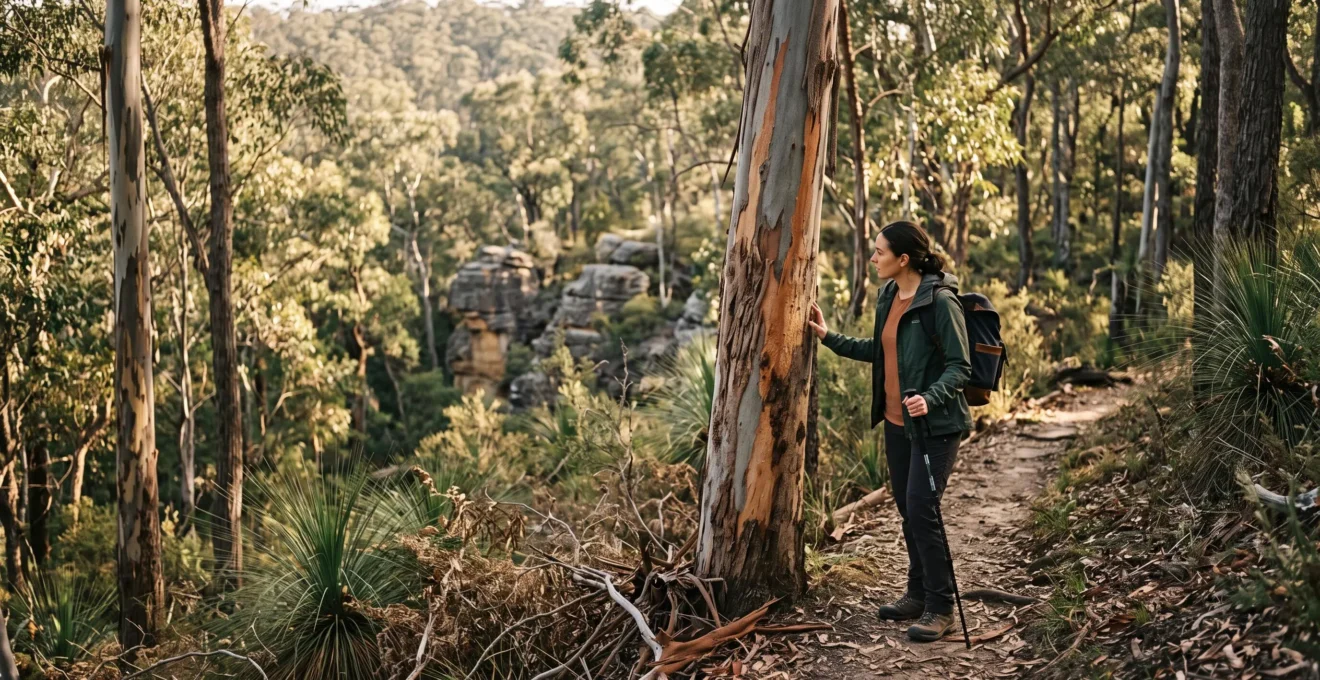
Most people treat a bushwalk as a form of exercise, missing the complex story the landscape is telling. The common focus on just covering distance means we fail to see the bush for what it is: a rich ecological text. This guide shifts your perspective from a walker to a reader, teaching you the skills to interpret the subtle language of Australia’s unique ecosystems, turning any trail into a profound lesson in natural history.
For many, a bushwalk in Australia is about stretching the legs, breathing fresh air, and capturing a scenic photo. We follow the marked trail, count our steps, and feel a sense of accomplishment at the end. We might spot a kangaroo or a colourful parrot, but the deeper narrative of the landscape often remains a closed book. We walk *through* the environment, but we don’t necessarily engage *with* it. The focus is on the physical journey, the exercise, while the intricate, living story woven into the soil, leaves, and shadows goes unnoticed.
This approach misses the fundamental magic of the Australian bush. Unlike the manicured parks or relatively young forests of Europe and North America, our bushland is an ancient library, shaped by millions of years of isolation, fire, and drought. The real key to a transformative bushwalk isn’t choosing the most popular trail or walking the furthest distance. It’s about learning a new skill: ecological literacy. It’s about slowing down and learning to read the clues that are hiding in plain sight.
But what if the true purpose of a bushwalk wasn’t exercise, but interpretation? What if you could learn to decipher the secrets of the ecosystem, to understand why certain plants grow together, to spot the evidence of nocturnal animals, and to read the true seasons of the land? This guide is designed to give you those skills. We will move beyond simple sightseeing and equip you to become an active interpreter of the Australian bush, revealing the complex drama of life that unfolds on every trail.
This article provides a practical framework for turning your walks into educational journeys. We’ll explore the unique characteristics of Australian ecosystems, provide tools for identifying key species, and teach you how to read the subtle signs of wildlife and seasonal change, empowering you to connect with the bush on a much deeper level.
Summary: How to Read the Australian Bush: A Guide to Trails That Teach Ecology, Not Just Exercise
- Why Australian Bushland Reveals Different Secrets Than European or American Forests
- How to Identify the 15 Key Australian Native Plants on Any Bushwalking Trail
- Coastal Bushwalks or Inland Trails: Which Australian Ecosystem Teaches More?
- The Wildlife Spotting Mistake That Misses 80% of Australian Bush Animals
- When to Bushwalk for Wildflower Displays and Active Wildlife in Australian Bush
- The Leave No Trace Mistake 70% of Visitors Make in Australian National Parks
- Why Daintree Is the Oldest Living Rainforest Ecosystem on Earth
- How to Explore Daintree Rainforest Responsibly While Understanding Its Ancient Ecology
Why Australian Bushland Reveals Different Secrets Than European or American Forests
To learn to read the Australian bush, you must first understand that you are reading a completely different language from the forests of the Northern Hemisphere. European and American woodlands are largely shaped by ice ages and relatively rich, young soils. The Australian continent, by contrast, has been isolated for over 45 million years, with ancient, nutrient-poor soils and a climate defined by fire and drought. This has created a unique and profoundly different ecological narrative.
The result is a flora that is both resilient and extraordinarily diverse. Instead of lush, soft-leaved deciduous trees, Australia is dominated by tough, evergreen sclerophyll plants like eucalypts and acacias. Their leaves are typically hard, small, and hang vertically to minimise water loss in the harsh sun. This evolutionary strategy for survival is the first chapter in the story of the Australian bush. It speaks of a land where water is precious and sunlight is relentless.
The scale of this unique evolution is immense. While other continents have their pockets of biodiversity, Australia’s long isolation has turned it into a continental-scale evolutionary laboratory. It is home to a staggering number of endemic species found nowhere else on Earth. For instance, specialists estimate that Australia is home to around 24,000 native plant species, a diversity that presents both a challenge and a thrill for the aspiring naturalist. Understanding this deep-time context of isolation and adaptation is the foundation for reading the secrets hidden in our bushland.
How to Identify the 15 Key Australian Native Plants on Any Bushwalking Trail
With such vast diversity, identifying every plant is impossible. The goal isn’t to be a walking encyclopaedia, but to learn to recognise key ‘characters’ in the ecological story. You can start by focusing on 15-20 of the most common trees and shrubs in your local area. The key is to move beyond simply putting a name to a plant and start asking: « What does this plant’s presence tell me about the environment? » This is the art of using plants as indicator species.
A plant’s form, leaf structure, and location are all clues. Is it a towering Mountain Ash in a damp gully, indicating deep, moist soils? Or is it a hardy, salt-tolerant Coastal Banksia, telling a story of wind and sea spray? Learning to spot these indicators transforms a generic green backdrop into a detailed map of the ecosystem’s health and history. As the experts at Swift Trees Perth note, this skill is central to ecological interpretation:
A healthy Jarrah often signals well-drained, gravelly soils—a natural clue for what other native plants will thrive nearby.
– Swift Trees Perth, A Guide to Identifying Australian Trees
This single observation unlocks a deeper level of understanding. Seeing the Jarrah allows you to predict what other species, like grass trees (Xanthorrhoea) or certain orchids, might be nearby. To develop this skill, you need a systematic approach to observation, not just a casual glance. The following audit provides a framework for turning every unidentified plant into a learning opportunity.
Your 5-Step Plant Identification Audit: From Sighting to Story
- Points of Contact: First, consider the context. Is the plant in a national park, on a disturbed roadside, or in a coastal heath? The location is your first clue to whether it’s likely native, and to what ecosystem it belongs.
- Collecte: Inventory its features without disturbing it. Photograph the entire plant, its leaves (both sides), its flowers or fruit, and its bark. Note the growing conditions: Is it in sandy soil, heavy clay, full sun, or deep shade?
- Cohérence: Confront the evidence with known patterns. Look for distinctive features. Crush a leaf gently—does it have a strong eucalyptus or lemon scent from oil glands? Are the leaves arranged opposite each other or alternately on the stem? These are the key diagnostic criteria.
- Mémorabilité/Émotion: This is the confirmation step. Use a regional field guide or a reliable app (like those from botanic gardens) to cross-reference your collected evidence. The moment of successful identification is when a generic plant becomes a known character.
- Plan d’Intégration: Don’t stop at the name. Ask what this plant tells you. Now that you know it’s a Jarrah, you can infer the soil is gravelly and well-drained. This is how you integrate the identification back into the broader ecological narrative of the trail.
Coastal Bushwalks or Inland Trails: Which Australian Ecosystem Teaches More?
A common question for walkers is where to find the most « interesting » trails. But an ecologist asks a different question: « What language does this landscape speak? » Australia’s ecosystems are incredibly varied, and a coastal heath speaks a different dialect from a dry inland woodland. Neither teaches « more » than the other; they simply teach different lessons. The skill is learning to tune your ear to the local story.
A coastal trail is a masterclass in resilience against wind, salt, and unstable soils. Here, the ecological text is written in the form of stunted, wind-pruned shrubs like Coastal Tea-tree and Cushion Bush. Their low, dense, and often silver-grey foliage is a direct adaptation to reduce water loss and deflect salt spray. The ground is sandy and low in nutrients, favouring plants with deep root systems that can find water and anchor themselves against the constant ocean breeze. Reading a coastal trail means looking for these signs of a battle with the elements.
In contrast, an inland trail in a dry sclerophyll forest tells a story of heat, drought, and fire. The dominant characters are eucalypts with bark that peels, flakes, or remains thick and fibrous—all different strategies for dealing with fire. The understorey is sparse, and the ground is covered in a crunchy litter of leaves and bark that fuels the next fire. Here, reading the landscape means searching for signs of fire’s influence: epicormic growth (new leaves sprouting from the trunk of a burnt gum tree), fire-blackened logs, and the vibrant flush of new growth that follows a burn. It’s a lesson in a cycle of destruction and regeneration that is fundamental to Australian ecology.
The Wildlife Spotting Mistake That Misses 80% of Australian Bush Animals
When we think of Australian wildlife, we imagine kangaroos bounding across a field or a koala in a gum tree. This is the mistake that causes us to miss most of the animal life in the bush. We spend our walks looking up and looking out for large, obvious animals. In reality, the vast majority of Australia’s fauna is small, nocturnal, and secretive. To find them, you must make a fundamental shift in your gaze: look down, not just up.
The ground beneath your feet is a rich tapestry of animal activity, but its signs are subtle. These are the « micro-signs » of the bush: tracks, scat, diggings, scratches on trees, and half-eaten nuts or fruits. This is the evidence left behind by the 80% of animals you will never see during a daytime walk. Learning to spot and interpret these signs is like learning to read the night’s newspaper. A small cluster of cone-shaped diggings points to a bandicoot searching for grubs; a scattering of shredded bark at the base of a tree might be the work of a Yellow-bellied Glider.
Developing this skill requires patience and a change of pace. You must slow down and actively scan the ground, especially in damp soil near creeks or on the soft edges of the trail where tracks are most likely to be preserved. Going out at the right time is also critical. The hours around dawn and dusk are peak activity times for many species as they forage in the cooler temperatures. For nocturnal spotting, a red-light torch is essential, as its light is less disturbing to most animals than a bright white beam. By combining a search for micro-signs with careful timing, you switch from being a passive tourist to an active ecological detective, uncovering a hidden world of animal activity.
When to Bushwalk for Wildflower Displays and Active Wildlife in Australian Bush
The common advice is simple: « Go bushwalking in spring for the best wildflowers. » While not wrong, this is a profoundly limited, Eurocentric view of a continent that doesn’t operate on a neat four-season calendar. To truly time your walks for peak ecological events, you need to discard the calendar and learn to read the real seasons of the bush, as Australia’s First Peoples have done for millennia.
Indigenous seasonal calendars are not based on fixed dates but on a complex and interconnected set of environmental cues. For example, the Yolŋu people of Arnhem Land recognise six distinct seasons, each marked by changes in wind, plants, and animal behaviour. As researcher Katie Degnian notes, « Rembarrnga people identify seven and Dalabon people identify six main seasons that are based on a complex set of ecological indicators. » This is a far more nuanced and accurate way to understand the rhythms of the land.
You can apply this principle by learning the key ecological indicators for your region. The flowering or fruiting of a particular plant is often a reliable signal for a corresponding event in the animal world. This is the ecological narrative in action—a dialogue between flora and fauna. By learning these connections, you can time your walks to witness specific natural phenomena with far greater precision than by simply looking at a calendar.
- Look for Coastal Wattle flowering on the east coast; this is a traditional sign that whales are beginning their northern migration.
- Note when Tea Trees flower in the south; this can signal that fish are becoming more plentiful in estuaries and rivers.
- Watch for Black Bean trees fruiting in the northern rainforests, as this often coincides with heightened activity from certain fruit-eating birds.
This approach transforms timing from a guessing game into a skill. It requires you to be an active observer of the entire ecosystem, understanding that the bloom of a single flower is a signal that the next chapter in the seasonal story is about to begin.
The Leave No Trace Mistake 70% of Visitors Make in Australian National Parks
The « Leave No Trace » principle is familiar to most walkers: pack out what you pack in, don’t feed wildlife, stay on the trail. While crucial, this public-facing message often misses the single most significant and destructive mistake that well-intentioned visitors make: unknowingly spreading invisible killers. The most devastating of these is Phytophthora cinnamomi, or dieback.
Dieback is a microscopic, soil-borne water mould that attacks the root systems of plants, effectively starving them of water and nutrients. It is devastating to Australian flora, particularly in Western Australia, where it infects iconic species like Jarrah, Banksias, and grass trees. As plant pathologist Dr Garkaklis explains, its insidious nature is what makes it so dangerous: « We don’t see it, it’s moving through the soil and that makes it really hard. » The pathogen is spread in infested soil and water, and the most common vectors are the tyres of vehicles and the mud on hikers’ boots.
The damage is not hypothetical; it’s a slow-moving ecological disaster. A single speck of infected mud on your boot can introduce the pathogen to a pristine area, where it can persist for decades. Detailed research shows dieback has spread through Banksia shrubland at a steady rate of up to 1.5 metres per year, silently turning vibrant ecosystems into plant graveyards. This is the real Leave No Trace mistake. Forgetting to scrub your boots at a cleaning station is far more damaging than dropping a food wrapper.
Therefore, the most important act of ecological responsibility is to be meticulous about biosecurity. Always use the boot cleaning stations at trailheads, scrubbing and disinfecting your footwear before and after every walk. If no station is available, carry your own small brush and disinfectant spray. This simple act of hygiene is a critical part of reading and protecting the ecological text of the bush.
Why Daintree Is the Oldest Living Rainforest Ecosystem on Earth
To witness the ultimate ecological text—one written over eons—you must travel to the Daintree Rainforest in North Queensland. While the Amazon is famous for its scale, the Daintree is revered for its age. It is a living museum, a direct window into the world’s deep past. According to scientific consensus, the Daintree is the world’s oldest continually surviving rainforest, estimated to be around 180 million years old—predating the Amazon by tens of millions of years.
What makes it so old? The Daintree is a relic of the ancient supercontinent of Gondwana. When Australia broke away and drifted north, this small corner of the continent retained the warm, wet conditions that allowed its primitive flora to survive while much of the rest of the continent dried out. Walking through the Daintree is like stepping back in time. It holds 13 of the world’s 19 primitive flowering plant families, more than anywhere else on Earth.
These « Gondwanan relics » are the living proof of the forest’s age. They are the sentences in the Daintree’s ancient text, providing a direct link to the age of dinosaurs. Nothing illustrates this better than one of the forest’s most famous inhabitants.
Case Study: The ‘Idiot Fruit’ as a Living Fossil
The story of Idiospermum australiense, or the ‘Idiot Fruit’, is a perfect example of the Daintree’s secrets. This primitive flowering plant was thought to be extinct and was only rediscovered by science in the 1970s. Its flower is one of the simplest of any plant on Earth, and its massive, toxic seed is too large to be dispersed by modern animals. Researchers believe it once co-existed with megafauna that could eat and disperse the seed. Its survival in a tiny pocket of the Daintree is living evidence of the forest’s immense and unbroken evolutionary lineage, a direct link back to the time of Gondwana.
Key Takeaways
- Shift your focus from exercise to interpretation; the Australian bush is a text to be read, not just a path to be walked.
- Learn to identify key ‘indicator species’ to understand the underlying soil, water, and health of an ecosystem.
- Look down for ‘micro-signs’ like tracks and scat; this is where the story of the bush’s hidden 80% of wildlife is written.
- Discard the four-season calendar and learn to read the true ecological seasons through cues from plants and animals.
- Understand that true ‘Leave No Trace’ means preventing the spread of invisible threats like dieback by practicing strict boot hygiene.
How to Explore Daintree Rainforest Responsibly While Understanding Its Ancient Ecology
Understanding the Daintree’s 180-million-year-old story is only half the picture. The other half is a human story, one of profound and continuous connection. The Eastern Kuku Yalanji people are the Traditional Owners of the Daintree, and their presence is not a recent chapter; it is an integral part of the forest’s long history. Evidence confirms that the Eastern Kuku Yalanji people have lived in harmony with the Daintree for tens of thousands of years, a timeline that makes modern history seem like a fleeting moment.
To explore the Daintree responsibly means acknowledging that you are a visitor in their home. It means moving beyond a purely scientific or touristic lens and embracing an understanding of the forest as a cultural landscape. The Kuku Yalanji were not passive inhabitants; as one expert from Fund the Planet notes, « The Kuku Yalanji were active participants in the forest’s ecology across tens of thousands of years. » Their knowledge of the forest’s plants, animals, and seasons is an invaluable library of ecological wisdom, passed down through generations.
Responsible exploration, therefore, is an act of listening and respect. This has several practical implications for any visitor.
- Prioritise Indigenous-led tours: The best way to learn the forest’s story is from those who know it best. A Kuku Yalanji guide can show you which plants are sources of food and medicine, how to read the signs of the seasons, and share the cultural stories woven into the land.
- Stay on marked boardwalks and paths: This is not just for your safety (from dangers like crocodiles and the infamous Stinging Tree), but to protect the incredibly sensitive and ancient root systems of the forest floor.
- Support local conservation efforts: Acknowledge that this ancient ecosystem is under threat from climate change and development, and contribute to organisations working to protect it and support its Traditional Owners.
Ultimately, understanding the Daintree’s ancient ecology is inseparable from respecting its living culture. The forest is a partnership between deep time and deep knowledge.
The true journey of discovery doesn’t end when you leave the trail. It begins when you start to see every walk, from your local reserve to the ancient Daintree, as an opportunity to practice this new language. The next step is yours: choose a local trail, slow down, and start reading the rich, complex story written in the landscape all around you.