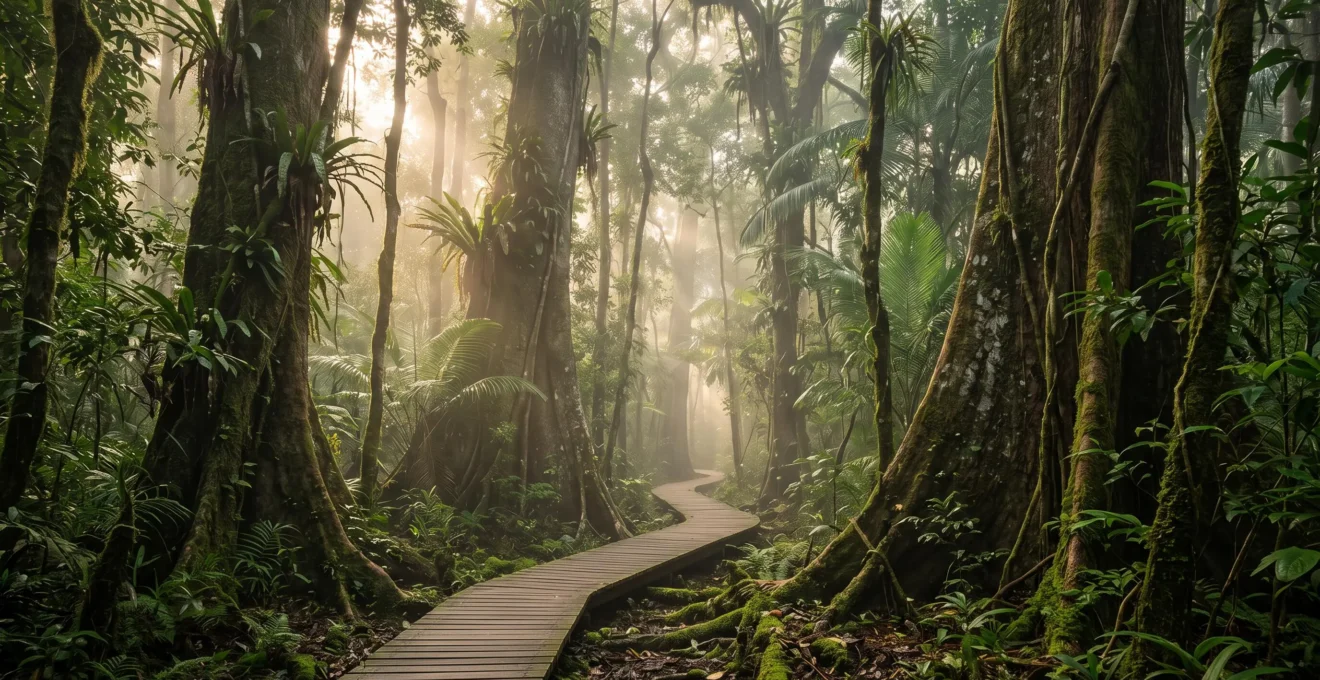
Many eco-conscious travellers visit the Daintree fearing they might inadvertently harm its ancient ecosystem. This guide shifts that perspective from fear to empowerment. The key to truly responsible exploration isn’t just following rules, but understanding the deep ecological science behind them. By learning why this forest has survived for 180 million years, how its species depend on each other, and what lies beneath the boardwalk, you transform from a simple visitor into an informed guardian of this living museum.
To stand within the Daintree Rainforest is to feel time itself slow down. It’s a world of emerald light, strange bird calls, and the damp scent of life and decay that has persisted for millennia. As an ecologist, I’ve seen the awe on people’s faces as they first step under its canopy. But I’ve also seen the quiet anxiety: how can I experience this profound place without leaving a scar? The standard advice— »stay on the path, » « pack it in, pack it out »—is essential, but it’s only the surface layer.
These rules are the « what » of responsible tourism. This guide, however, is about the « why. » It’s about looking deeper, past the breathtaking scenery, to the intricate, often invisible web of life that makes the Daintree a global treasure. We will touch upon its Gondwanan origins, the incredible co-dependencies between its flora and fauna, and the living culture of the Kuku Yalanji people who have been its custodians for thousands of years. But what if the key to protecting this forest wasn’t just avoiding negative impacts, but actively engaging with its story?
This is the shift in mindset this guide proposes. We’re moving from a passive « leave no trace » mentality to one of active, informed guardianship. By understanding the ancient ecology that your every footstep interacts with, you don’t just see the Daintree; you become part of its ongoing story of survival. This journey will reveal how to spot living fossils, why leaving the boardwalk is so damaging, how to choose experiences that support genuine conservation, and why the forest canopy is a world unto itself. Prepare to explore one of Earth’s oldest ecosystems not just with your eyes, but with a newfound understanding.
To help you navigate this deep dive into the Daintree’s ecological heart, this article is structured to build your knowledge layer by layer. The following sections will guide you from its ancient origins to practical choices you can make on the ground.
Summary: A Guide to the Daintree’s Ancient Ecology and Responsible Exploration
- Why Daintree Is the Oldest Living Rainforest Ecosystem on Earth
- How to Spot Daintree’s Ancient Plant Species That Existed Before Flowers Evolved
- Self-Guided Walks or Aboriginal-Guided Tours: Which Unlocks Daintree’s Secrets Better?
- The Boardwalk-Leaving Mistake That Damages Daintree’s Fragile Root Networks
- When to Visit Daintree for Wildlife and When Wet Season Floods Close Trails
- The Leave No Trace Mistake 70% of Visitors Make in Australian National Parks
- Why Rainforest Canopy Tours Reveal Ecosystems You Cannot See from the Ground
- How to Choose Canopy Tours That Balance Thrills with Genuine Rainforest Interpretation
Why Daintree Is the Oldest Living Rainforest Ecosystem on Earth
The Amazon rainforest is often called the « lungs of the planet, » but the Daintree is its memory. While the Amazon is a relative newcomer at around 55 million years old, scientists estimate the Daintree is around 180 million years old, making it the world’s oldest continually surviving tropical rainforest. Its incredible age is not an accident but a story of resilience and geography. It is a direct, living link to the supercontinent of Gondwana, which started breaking apart around the same time this forest was taking root.
The secret to its longevity lies in a concept known as « refugia. » During dramatic climate shifts, such as the ice ages, most of Australia dried out, and rainforests vanished. However, the Daintree’s unique location—tucked into a narrow coastal strip with steep mountains—created a stable microclimate. These mountains trapped moisture-laden air from the Coral Sea, ensuring a constant supply of rain. Pockets of the forest survived in these sheltered, humid valleys, acting as life rafts or « refugia » for ancient species.
From these refugia, the forest could expand again when conditions became favorable. This process is more than just a historical footnote; it’s a living conservation strategy. Modern efforts, like Rainforest Rescue’s nursery program, mimic this natural process by restoring genetic diversity to replanted areas. By understanding the concept of refugia, you grasp that the Daintree isn’t just a single, static forest but a dynamic mosaic of ancient survivors that has clung to life through millions of years of planetary change. This is why protecting every valley and every stream is critical; each could be a modern-day refugium vital for its future survival.
How to Spot Daintree’s Ancient Plant Species That Existed Before Flowers Evolved
Walking through the Daintree is like stepping into a botanical time machine. It holds a higher concentration of ancient, « primitive » flowering plant families than anywhere else on Earth. These are not just old trees; they are living relicts from a time before flowers as we know them had evolved. One of the most famous examples is the *Idiospermum australiense*, or the « Idiot Fruit. » It represents one of the earliest lineages of flowering plants, offering a window into a 120-million-year-old evolutionary experiment.
These ancient plants often have large, heavy seeds that simply fall to the ground, a primitive dispersal method compared to modern fruits designed to be carried far and wide. This is where the Daintree’s most iconic resident, the Southern Cassowary, plays an irreplaceable role. This giant, flightless bird is one of the few creatures capable of swallowing these large seeds whole. A Charles Darwin University study confirmed that cassowaries are critical dispersers in the Wet Tropics, acting as the forest’s « gardeners. » Their digestive system uniquely prepares the seeds for germination. For one rare tree, a study found that cassowary digestion increased the germination rate from 4% to an incredible 92%. This is a perfect example of ecological interdependence; the ancient plant needs the « living dinosaur » bird to reproduce.
So, how do you spot these botanical treasures? Look for primitive characteristics: simple, large, waxy leaves and flowers that may look more like clusters of petals than a modern rose or daisy. The Idiot Fruit itself is large, brown, and looks unremarkable, but it is a powerhouse of evolutionary history. As botanist Stuart Worboys noted, this unique plant is a symbol of the forest’s global significance.
Idiospermum provides a focus for the region’s flora – its beauty, its rarity, its relictual nature, and its significance on a world scale.
– Stuart Worboys, The Conversation
When you see a cassowary, remember you’re not just looking at a big bird; you’re witnessing a vital, ancient relationship in action. Protecting the cassowary is a direct act of protecting the Daintree’s most ancient flora.
Self-Guided Walks or Aboriginal-Guided Tours: Which Unlocks Daintree’s Secrets Better?
The Daintree offers many accessible boardwalks and trails, allowing for beautiful self-guided walks. You can explore at your own pace, soaking in the atmosphere of the forest. This freedom is wonderful, but it provides only one layer of experience—the scenic one. You see the forest, but you may not understand it. To truly unlock the Daintree’s secrets, nothing compares to seeing it through the eyes of its Traditional Custodians, the Eastern Kuku Yalanji people.
An Aboriginal-guided tour transforms the rainforest from a collection of plants and animals into a cultural landscape. A tree is no longer just a tree; it becomes a source of food, medicine, tools, or part of a creation story. The landscape is read like a book, filled with meaning and history. This is not simply a tour; it’s a lesson in seeing. Operators that are 100% Aboriginal-owned and operated, such as Walkabout Cultural Adventures, offer an authentic connection to country (bubu) that cannot be replicated. They provide a direct link to thousands of years of accumulated ecological knowledge.
The choice isn’t about one being « better » than the other, but about the depth of connection you seek. A self-guided walk is an introduction. An Aboriginal-guided tour is an immersion. For the eco-conscious traveler, the ideal approach is often both. Use a self-guided walk to find your quiet moments of awe, then join a guided tour to give that awe context and meaning. Engaging with Kuku Yalanji guides is also a direct and respectful way to support the local community and ensure that tourism benefits the people who have protected this land for millennia.
Action Plan: Respectful Engagement on Kuku Yalanji Country
- Observe, Don’t Disturb: Do not harm or remove any cultural or natural artefact, plant, or animal you encounter. Remember you are a guest in a living home.
- Respect Protected History: Understand that all historical and archaeological items are protected by Australian law. Never trade, buy, or remove them from the country.
- Embrace Living Culture: Approach your guide with an openness to learn about the land (bubu) as a living, storied entity, not just as static scenery.
- Ask Relational Questions: Instead of only asking « What is that called? », ask questions that invite deeper knowledge, such as « What is the story of this place? » or « How is this plant used? ».
- Support Authenticity: Prioritize tour operators that are owned and operated by Traditional Owners to ensure your investment directly supports the community.
The Boardwalk-Leaving Mistake That Damages Daintree’s Fragile Root Networks
Every visitor to the Daintree is told to « stay on the boardwalk. » It seems like a simple, obvious rule. But to an ecologist, this isn’t just about preventing people from getting lost or trampling plants. It’s about protecting the forest’s most vulnerable and vital organ: its incredibly delicate, shallow root system. The mistake isn’t just stepping on a plant; it’s crushing a complex, life-sustaining network you can’t even see.
Unlike forests where trees anchor themselves with deep taproots, the Daintree’s soils are ancient, weathered, and nutrient-poor. To survive, the trees have evolved to cast a wide, shallow net of fine feeder roots right at the surface to catch any falling leaves, fruits, or animal droppings the moment they begin to decompose. This dense mat of roots, often interwoven with fungal mycelium, is the forest’s digestive system. This is the zone of subsurface fragility, a living web of nutrient cycling that is the secret to the rainforest’s lushness on such poor soil.
When you step off the boardwalk, your body weight compacts the soil. This single act can snap thousands of these fine, hair-like roots and crush the air pockets in the soil that they need to breathe. It severs the connection between the trees and their food source. A single set of footprints, repeated by others, can create a « dead zone » where the root mat is destroyed, and nothing can grow back for years. The boardwalks are not there to restrict you; they are designed to float you above this fragile, living skin. They allow us to venture into the heart of the forest without severing its lifelines. Seeing the boardwalk this way transforms it from a cage into a respectful gesture—a conscious decision to tread lightly on an ancient and delicate system.
When to Visit Daintree for Wildlife and When Wet Season Floods Close Trails
Choosing when to visit the Daintree involves a trade-off between lushness and accessibility, and it significantly impacts your wildlife spotting opportunities. The region has two distinct seasons: the « wet » (summer, roughly November to April) and the « dry » (winter, roughly May to October).
The dry season is the most popular time to visit for good reason. The weather is more pleasant, with lower humidity and cooler temperatures. All roads and walking trails are typically open, and accessibility is at its peak. For wildlife, this season can be excellent for spotting birds, as many species are actively breeding. Mammals like wallabies and bandicoots are also readily seen. Because water sources are scarcer, animals tend to congregate around the remaining creeks and waterholes, which can make them easier to find.
The wet season, however, is when the rainforest truly comes alive. The landscape transforms into a vibrant, super-saturated green, the creeks and waterfalls are thunderous, and the air is electric. This is the best time to see amphibians and reptiles, which thrive in the damp conditions. It’s the season of transformation. However, it comes with challenges. Heavy rainfall can cause flash flooding, leading to road closures—most notably at the Daintree River ferry and creek crossings like Cooper Creek. Trails can become muddy, slippery, or completely submerged. It’s also the peak season for marine stingers along the coast, making swimming at rainforest beaches unwise without a protective suit. While a visit in the wet season can be a powerful, immersive experience, it requires flexibility and a willingness to have plans changed by nature.
Ultimately, there is no « best » time. If your priority is comfortable exploration and reliable access, aim for the dry season. If you are an adventurous soul who wants to witness the raw, powerful force of the rainforest at its most dynamic, the wet season will not disappoint—just be prepared with a good raincoat and a flexible itinerary.
The Leave No Trace Mistake 70% of Visitors Make in Australian National Parks
The « Leave No Trace » principle seems straightforward: pack out everything you pack in. Most visitors are diligent about not leaving behind plastic wrappers or bottles. However, there’s a more subtle and widely misunderstood mistake many well-intentioned people make: leaving behind organic waste. An apple core, a banana peel, or the crust of a sandwich might seem harmless. « It’s natural, it will biodegrade, » is the common thinking. In a hyper-sensitive and ancient ecosystem like the Daintree, this is a dangerous assumption.
Firstly, your « natural » food is not natural to this specific environment. An apple is not a native Daintree species. Its discarded core could potentially sprout, introducing a non-native plant that could compete with the local flora. More insidiously, fruit peels and seeds can carry microscopic pathogens or fungi that are foreign to this ecosystem and could devastate ancient plant species that have no natural immunity. It’s a form of biological pollution that is just as damaging as a plastic bag, but far less visible.
Secondly, leaving food scraps habituates wildlife. When animals like the normally shy cassowary or smaller mammals learn that humans are a source of food, their behaviour changes. They can become aggressive or dependent, losing their ability to forage naturally. They may also congregate near roads and trails, increasing their risk of being hit by vehicles. What seems like a harmless act of « returning food to nature » is actually an act that disrupts the delicate balance of the entire food web. The core principle of Leave No Trace is to leave the environment exactly as you found it. This means everything—even the biodegradable items—must be packed out with you. The Daintree has survived for 180 million years without your apple core; it doesn’t need it now.
Why Rainforest Canopy Tours Reveal Ecosystems You Cannot See from the Ground
From the forest floor, the rainforest canopy appears as a dense green ceiling. But that ceiling is, in fact, an entirely separate world—a « city in the sky » teeming with life that never touches the ground. Ecologists refer to this as vertical stratification, where the rainforest is layered into distinct habitats from the floor to the emergent trees that break through the canopy. Up to 70-90% of life in a rainforest can be found in the treetops, making a canopy tour not just a fun activity, but a genuine ecological expedition.
The canopy is where the majority of photosynthesis happens. This abundance of light and energy supports a completely different community of species than the dark, damp understory. Here you will find a profusion of epiphytes—plants like orchids and ferns that grow on the branches of other trees, creating their own miniature ecosystems. These epiphytes trap soil and water, providing a home for a huge variety of insects, frogs, and lizards. This is also the domain of specialist birds and mammals that have adapted to a life high above the ground.
By taking a canopy tour, whether it’s a slow-moving aerial walkway or a guided zipline, you are gaining access to this hidden biosphere. You can see flowers and fruits that are invisible from below, witness birds at eye level, and get a true sense of the forest’s three-dimensional structure. It provides a perspective that fundamentally changes your understanding of what a rainforest is. It’s no longer just a collection of trunks on the ground, but a complex, multi-layered habitat. A journey into the canopy is a journey into the forest’s energetic and biological heart.
Key Takeaways
- The Daintree’s 180-million-year survival is due to « refugia »—moist, sheltered valleys that acted as life rafts during climate change, a principle that guides modern conservation.
- True responsible tourism goes beyond rules; it involves understanding the deep ecological reasons behind them, turning you into an informed guardian.
- Your actions have direct consequences on ancient systems, from a footstep crushing fragile surface roots to a discarded fruit peel disrupting the food web.
How to Choose Canopy Tours That Balance Thrills with Genuine Rainforest Interpretation
Canopy tours in the Daintree range from high-speed zipline circuits to gentle, elevated boardwalks. While all offer a unique perspective, for the eco-conscious traveler, the goal is to find an experience that prioritizes genuine ecological interpretation over pure adrenaline. A thrill ride is fun, but a guided journey through the canopy is transformative. Choosing the right operator is key to ensuring your adventure also contributes to your understanding and the forest’s preservation.
First, look at the role of the guides. A great tour isn’t about the speed or height; it’s about the knowledge shared. Are the guides trained ecologists or naturalists? Do they stop to point out specific orchids, nesting birds, or signs of animal life? The best tours are run in small, intimate groups, allowing for questions and a more personal experience. An operator focused on interpretation will market their tours based on the expertise of their guides and what you will learn, not just the length of their cables.
Next, investigate the company’s conservation credentials. Do they hold advanced eco-certification? Do they actively participate in or fund local research and reforestation projects? A truly sustainable tour operator sees the forest as their greatest asset and invests in its protection. Their infrastructure should also be designed for minimal impact, with platforms built to avoid damaging host trees. By choosing an operator that balances thrills with education, you are not only enriching your own experience but are also voting with your wallet for a model of tourism that respects and supports the very ecosystem it depends on.
Your journey into the Daintree is more than a holiday; it’s an opportunity to connect with a living piece of Earth’s deep history. By applying these principles, you move beyond being a tourist and become a conscious participant in its preservation. Plan your visit not just around what you want to see, but around how you can best honour this ancient, irreplaceable world.