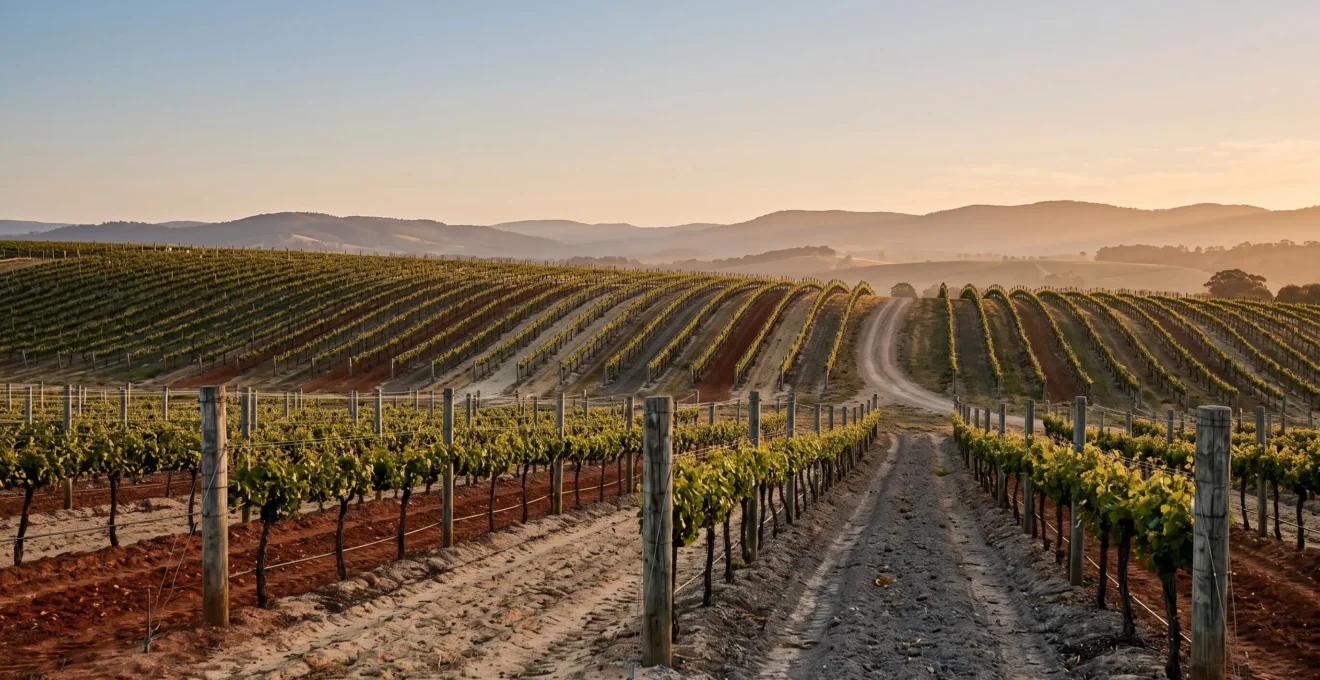
Planning an Australian wine trip based on famous names is a mistake; the real magic lies in strategically navigating its climatic contrasts.
- Focus on « hub-and-spoke » logistics from cities like Adelaide or Melbourne to efficiently combine diverse regions.
- Prioritize cool-climate regions (Yarra Valley, Tasmania) for elegance, not just warm-climate power (Barossa).
Recommendation: Always book tastings in advance, especially for the boutique wineries that offer the most authentic terroir experiences.
Planning a wine tour of Australia often conjures images of sun-drenched vineyards in the Barossa Valley, a glass of powerful Shiraz in hand. While this is an essential part of the story, it’s only one chapter. Many enthusiasts create itineraries based on big-name recognition alone, unknowingly missing the incredible diversity that defines modern Australian wine. They fall into the trap of assuming regions are close together or that the best cellar doors welcome walk-ins, leading to exhausting travel days and missed opportunities.
The common advice to simply « visit the Barossa » or « stick to Shiraz » overlooks the quiet revolution that has taken place in Australian viticulture. The real story is one of dramatic contrasts, from the bold, sun-ripened reds of South Australia to the delicate, acid-driven whites and Pinot Noirs of the cool southern coasts. But what if the key to a truly memorable wine journey wasn’t about ticking off the most famous wineries, but about understanding and experiencing this very diversity of terroir? This means planning with climate, soil, and logistics in mind.
This guide moves beyond the surface-level tour. We will deconstruct the geography and climate of Australia’s key wine zones to help you build a smarter itinerary. We’ll explore how to strategically group regions, why booking ahead is non-negotiable for authentic experiences, and how the country’s food scene has evolved to perfectly complement its innovative wines. Prepare to discover an Australia that is nuanced, elegant, and far more diverse than you ever imagined.
To help you navigate this rich landscape, this article breaks down the essential strategies for planning a rewarding Australian wine tour. From understanding regional differences to mastering cellar door etiquette, you’ll find everything you need to design a trip that reveals the country’s true oenological soul.
Summary: A Strategic Guide to Planning Your Australian Terroir Tour
- Why Australian Cool-Climate Wines Now Rival European Premium Regions
- How to Route Australian Wine Regions Without Exhausting Travel Between Scattered Zones
- Barossa or McLaren Vale: Which South Australian Wine Region Suits Your Taste?
- The Cellar Door Walk-In Mistake That Gets You Turned Away from Boutique Wineries
- When to Visit Australian Wine Regions for Harvest Experiences or Avoid Vintage Closures
- Perth’s Swan Valley or Margaret River: Which Western Wine Region Deserves Your Day Trip?
- Why Australian Food Is Now Asian-Indigenous Fusion, Not British Pub Fare
- How to Recognize Australian Cuisine as Fusion Innovation, Not British Colonial Food
Why Australian Cool-Climate Wines Now Rival European Premium Regions
For decades, Australian wine was synonymous with big, bold, warm-climate Shiraz. But a significant shift is underway. The country’s cool-climate regions are now producing wines of such elegance, complexity, and finesse that they are drawing direct comparisons to the premium heartlands of Europe, like Burgundy and Champagne. These regions, often defined by higher altitudes or coastal influences, benefit from a longer, slower ripening season. This allows grapes to develop intense flavours while retaining crucial acidity, the backbone of any world-class, age-worthy wine.
Regions like Tasmania, the Yarra Valley, the Adelaide Hills, and the Mornington Peninsula are at the forefront of this movement. Tasmania, for instance, boasts a climate so cool that its 15.6°C mean January temperature is Australia’s lowest, creating perfect conditions for sparkling wines and Pinot Noir that rival those from Champagne and Burgundy. These are not simply lighter versions of Australian classics; they are distinct expressions of terroir, showcasing bright fruit, subtle minerality, and structural elegance.
Even traditional regions are revealing cool-climate expressions. As Wine Australia notes about the Adelaide Hills, a region just a short drive from the warm plains of the Barossa:
In recent years the region has become a leader in cool climate Australian Shiraz, producing wines with elegance, length and balance.
– Wine Australia, Wine Australia – Adelaide Hills Regional Profile
This evolution means that a modern Australian wine tour must include these cooler zones. To focus only on the warm, historic regions is to miss half the story—the dynamic, sophisticated, and exciting future of Australian wine. It’s in these cooler pockets that you’ll find the vibrant acidity and nuanced flavours that showcase the country’s true viticultural range.
How to Route Australian Wine Regions Without Exhausting Travel Between Scattered Zones
Australia is a continent, and its premier wine regions are scattered across vast distances. One of the biggest mistakes travellers make is underestimating the time and energy required to travel between them. A flight from Sydney (near the Hunter Valley) to Adelaide (the hub for South Australian regions) takes two hours, not including airport transit. Driving from Melbourne to Margaret River would take over 35 hours. The key to a successful and enjoyable tour is not to see everything, but to plan strategically using a « hub-and-spoke » model.
This approach involves basing yourself in a major city and exploring the diverse cluster of regions accessible from that hub. This minimizes long-haul travel days and maximizes your time tasting wine. Two primary hubs offer the most rewarding combinations:
- The Melbourne Hub: Base yourself in Melbourne to explore the Yarra Valley (renowned for Pinot Noir and Chardonnay) and the Mornington Peninsula. This combination offers a deep dive into Australia’s premier cool-climate styles, complemented by Melbourne’s vibrant food scene and design-led accommodation.
- The Adelaide Hub: Adelaide is the gateway to a classic Australian wine experience. From here, you can easily access the powerful, historic Barossa Valley, the coastal and Mediterranean-influenced McLaren Vale, and the high-altitude, cool-climate Adelaide Hills. This hub provides a perfect « compare and contrast » of warm versus cool-climate expressions in one compact area.
This table puts the travel reality into perspective, showing why choosing a hub is far more efficient than attempting a cross-country trek.
| City Hub | Wine Region | Approx. Distance | Drive Time |
|---|---|---|---|
| Adelaide | Barossa Valley | 76 km | ~1–1.5 hours |
| Adelaide | McLaren Vale | ~38 km | ~40 minutes |
| Melbourne | Yarra Valley | ~50 km | ~1 hour |
| Sydney | Hunter Valley | N/A | Less than 3 hours |
| Perth | Margaret River | 280 km (174 mi) | ~3 hours |
| Perth | Swan Valley | N/A | ~20–25 minutes |
By focusing on one hub, you can explore two or three distinct regions with minimal transit fatigue. For example, a trip based in Adelaide allows you to experience the rich Shiraz of the Barossa one day and the elegant Chardonnay of the Adelaide Hills the next, all while returning to the same base. This strategy turns your tour from a logistical challenge into a deep, comparative exploration of terroir.
Barossa or McLaren Vale: Which South Australian Wine Region Suits Your Taste?
For visitors based in Adelaide, the choice often comes down to two of Australia’s most celebrated red wine regions: the Barossa Valley and McLaren Vale. While both are famed for their powerful Shiraz, they offer distinctly different experiences shaped by their unique terroirs. As the experts at Wine with Seth point out, the decision is not about which is « better, » but which style of wine and landscape you prefer.
Barossa Valley and McLaren Vale are Australia’s two most celebrated warm-climate red wine regions… Choosing between them is less about quality and more about the style of power you prefer.
– Wine with Seth, WineWiki – Barossa Valley vs McLaren Vale
The Barossa Valley is defined by its history and continental warmth. Located northeast of Adelaide, it’s home to some of the world’s oldest grapevines. The climate is warmer and drier, producing Shiraz that is typically rich, full-bodied, and opulent, with deep notes of dark chocolate, plum, and spice. The landscape feels historic and established, with rolling hills and a strong German heritage visible in its architecture and food.
In contrast, McLaren Vale, to the south of Adelaide, is defined by its proximity to the coast. The Mediterranean climate is moderated by cooling sea breezes from the Gulf St Vincent, which help preserve acidity in the grapes. This results in a Shiraz that is often brighter and more savoury, with notes of raspberry, dark olive, and a characteristic hint of salinity or minerality. With over 40 distinct soil types, the region offers incredible diversity, and the vibe is often more relaxed and coastal.
This table breaks down the key differences at a glance:
| Feature | Barossa Valley | McLaren Vale |
|---|---|---|
| Distance from Adelaide | ~48 km northeast | ~38 km south |
| Area | 578 km² | 433 km² |
| Climate | Warm Mediterranean to semi-continental | Mediterranean, moderated by Gulf sea breezes |
| Soil diversity | Over 15 documented soil types | Over 40 distinct soil types |
Ultimately, your choice depends on your palate. If you seek classic, powerful, and richly textured reds with a sense of history, head to the Barossa. If you prefer reds with a touch more brightness, savoury complexity, and a coastal backdrop, McLaren Vale will be a better fit. For the dedicated enthusiast, visiting both provides a fascinating lesson in how terroir shapes a single grape variety.
The Cellar Door Walk-In Mistake That Gets You Turned Away from Boutique Wineries
The romantic notion of spontaneously discovering a charming, family-run winery and being welcomed in for a tasting is largely a relic of the past in Australia’s premier regions. While large commercial wineries with expansive cellar doors may accommodate walk-ins, the smaller, boutique producers—often the ones making the most interesting, terroir-driven wines—almost universally require appointments. Simply showing up unannounced is the quickest way to be politely turned away, not out of rudeness, but out of necessity.
These small operations often have tiny tasting rooms or none at all, with the winemaker or their family members personally conducting the tastings. They lack the staff and space to handle unexpected guests. In a popular region like the Barossa, with over 150 wineries and more than 80 cellar doors, the competition for attention is high, and boutique producers focus on providing meaningful, in-depth experiences for a small number of pre-booked visitors.
Booking ahead is not just a courtesy; it’s a strategy. It transforms your visit from a rushed, transactional tasting at a crowded bar into a seated, educational, and conversational experience. It guarantees you a spot and often provides access to the very people who pruned the vines and fermented the grapes. To make the most of this, it’s wise to limit your daily visits to avoid palate fatigue.
Checklist for Securing a Meaningful Boutique Tasting
- Plan Your Anchor: Start by booking one major, well-known cellar door to anchor your day’s itinerary.
- Select Your Boutiques: Research and select two or three smaller, appointment-only wineries that specialize in varietals or styles you’re passionate about. Book these tastings at least a week in advance, or more during peak season.
- Limit Your Visits: Keep your final list to a maximum of three to five wineries for the entire day. This prevents palate fatigue and allows for unhurried, meaningful conversations at each stop.
- Confirm Your Appointment: Reconfirm your booking a day or two before your visit, especially if it was made far in advance.
- Arrive on Time: Respect the winemaker’s schedule. Arriving on time or even a few minutes early shows you value their time and the experience they have prepared for you.
By treating cellar door visits as planned appointments rather than spontaneous stops, you unlock a deeper, more rewarding layer of Australian wine culture. You gain access to limited-production wines and the stories behind them, which is the true essence of a terroir-focused tour.
When to Visit Australian Wine Regions for Harvest Experiences or Avoid Vintage Closures
Choosing the right time to visit an Australian wine region can dramatically shape your experience. Many travellers aim for the harvest season, or « vintage » (typically February to April), hoping to see the vineyards buzzing with activity. While vintage is an exciting time, with the air thick with the smell of fermenting grapes, it can be a double-edged sword for the wine tourist.
During this intense period, winemakers and their small teams work around the clock. Consequently, many boutique cellar doors operate on a skeleton crew, offer limited visiting hours, or close to visitors entirely to focus on the critical task of bringing in the grapes. Furthermore, harvest timing is not a fixed event; it varies each year based on weather conditions. For example, some years are smaller and earlier than others, with one recent year seeing the smallest vintage crushed since 2000, proving you can’t always predict the peak action. Visiting during vintage may mean you witness the energy but miss out on personal interaction.
For a more relaxed and intimate experience, consider the « shoulder seasons. » Autumn (April–May), just after harvest, offers beautiful golden vineyard landscapes and mild weather, with many regions hosting food and wine festivals. Winter (June–August), while cooler, is often considered the « insider season. » The regions are quiet, cellar doors are less crowded, and you’re far more likely to spend quality time chatting with a winemaker by a crackling fire. This is the best time for in-depth conversations and a peaceful exploration of the winemaking process.
This table summarizes what to expect during each key season:
| Season | Months | What to Expect |
|---|---|---|
| Harvest / Vintage | February–April | Bustling atmosphere, hand-picking and crush activity, but many small wineries have limited visitor access |
| Autumn (post-harvest) | April–May | Golden vine colours, mild days, cooler nights, festivals like the Barossa Vintage Festival |
| Winter (pruning season) | June–August | Quiet cellar doors, fires lit, more relaxed time with winemakers |
If you choose a winter visit, remember to pack accordingly. Southern regions like Tasmania and the Yarra Valley can be quite cool and wet, so layers, a waterproof jacket, and sturdy shoes are essential. The reward, however, is a more personal and authentic glimpse into the life of the winery, free from the crowds of peak season.
Perth’s Swan Valley or Margaret River: Which Western Wine Region Deserves Your Day Trip?
For visitors to Perth, the question of which wine region to visit on a day trip presents a clear-cut choice dictated almost entirely by logistics: the historic Swan Valley or the premium Margaret River. Many tourists, hearing of Margaret River’s global acclaim, mistakenly assume it’s an easy day trip. This is a critical planning error. As Tourism Australia’s official guide clarifies, Margaret River is located approximately 280 km (174 mi) south of Perth, a three-hour drive each way. A day trip would involve six hours in the car, leaving precious little time to explore.
Margaret River is a world-class destination for premium Cabernet Sauvignon and Chardonnay, set against a stunning backdrop of surf beaches and karri forests. It absolutely deserves a visit, but it requires a minimum of two to three days to do it justice. Trying to squeeze it into a single day is a recipe for exhaustion and a superficial experience.
The Swan Valley, by contrast, is the perfect Perth day trip. Located just a 20-25 minute drive from the city, it is Western Australia’s oldest wine region. While it may not have the same premium reputation as Margaret River, it offers a delightful and convenient food and wine trail experience. Here, you can explore dozens of wineries, breweries, and artisanal food producers in a compact loop, making it ideal for a relaxed, self-guided tour.
This table highlights the fundamental differences that should guide your decision:
| Feature | Swan Valley | Margaret River |
|---|---|---|
| Drive from Perth | ~20–25 minutes | ~3 hours (280 km) |
| Founded | First vines planted 1829, one year after settlement | Modern era, globally recognised since the late 20th century |
| Ideal trip length | Half-day to full day | Minimum 2–3 days |
| Signature appeal | Historic self-drive food and wine trail | Premium wine, surf beaches, karri forests |
The choice is clear. If you have only one day, the Swan Valley offers a rich, historic, and incredibly convenient wine-tasting experience. Save the world-renowned Margaret River for when you have a long weekend or more, allowing you the time to truly immerse yourself in one of the world’s great wine and travel destinations.
Key Takeaways
- Strategic planning is essential; use a « hub-and-spoke » model based in cities like Adelaide or Melbourne to explore multiple regions efficiently.
- Look beyond the famous warm-climate regions; Australia’s cool-climate zones like Tasmania and the Yarra Valley produce elegant, world-class wines.
- Always book cellar door tastings in advance, especially at smaller boutique wineries, to guarantee a personal and in-depth experience.
Why Australian Food Is Now Asian-Indigenous Fusion, Not British Pub Fare
Just as Australian wine has evolved beyond powerhouse Shiraz, its culinary scene has undergone a profound transformation. The old stereotype of Australian food being limited to British colonial staples—meat pies, fish and chips, and hearty pub fare—is woefully outdated. Today, Modern Australian cuisine, or « Mod Oz, » is a vibrant, innovative, and globally recognized culinary movement defined by a dynamic fusion of Asian influences and Indigenous ingredients.
This evolution was driven by several waves of immigration, particularly from Southeast Asia (Vietnam, Thailand, Malaysia) and East Asia (China, Japan), which introduced new flavours, techniques, and ingredients. Chefs began to move away from heavy European sauces and embrace the clean, aromatic, and fresh profiles of Asian cooking. This was not simple imitation but a true integration, applying sophisticated techniques to high-quality local produce.
Simultaneously, a growing cultural awareness has sparked a renaissance in the use of native Australian ingredients. For thousands of years, Indigenous Australians have utilized a rich pantry of flora and fauna. Chefs are now collaborating with Indigenous communities to sustainably source and incorporate these unique flavours into modern dishes. Ingredients like lemon myrtle (a citrusy herb), finger limes (with citrus pearls often called « citrus caviar »), wattleseed (with a nutty, coffee-like flavour), and saltbush (a salty, herbaceous plant) are no longer novelties but staples in top restaurant kitchens.
The result is a cuisine that is uniquely Australian: a dish might feature locally caught barramundi seasoned with native pepperberry, served on a bed of rice noodles with a Thai-style green curry sauce. It’s a style that is light, fresh, and complex, making it a perfect partner for the country’s increasingly elegant and nuanced wines. A crisp Riesling from the Clare Valley cuts through the spice of a Szechuan-inspired dish, while a cool-climate Pinot Noir complements the earthy notes of kangaroo with wattleseed.
How to Recognize Australian Cuisine as Fusion Innovation, Not British Colonial Food
For the travelling wine enthusiast, connecting with Australia’s modern culinary identity completes the terroir experience. The same principles of place, climate, and character that define the wines are mirrored on the plate. Recognizing this innovative fusion cuisine means looking beyond the pub and seeking out the cafes, bistros, and restaurants where « Mod Oz » thrives. This final step transforms your trip from a simple wine tour into a holistic cultural and sensory journey.
So, how do you find and identify this food? Look for menus that proudly list their local suppliers and feature a blend of familiar and unfamiliar ingredients. Keywords to watch for include « native, » « locally sourced, » and specific regional produce. Don’t be surprised to see Italian pasta served with kangaroo bolognese, or Japanese-style sashimi of Kingfish garnished with native finger lime. These juxtapositions are the hallmark of fusion innovation.
Seek out restaurants in wine regions that describe their food as « regional » or « seasonal. » These establishments are often at the forefront of the movement, working directly with local farmers and foragers to create dishes that perfectly reflect the surrounding landscape. They provide the most direct and delicious link between the wine in your glass and the food on your plate. Pairing a Yarra Valley Chardonnay with a dish featuring local river trout and native herbs is an experience that speaks volumes about the region’s specific terroir.
Ultimately, experiencing Modern Australian cuisine is about approaching it with an open mind. It’s a celebration of a multicultural society and a deep connection to an ancient land. By moving beyond the cliché of colonial fare, you not only enjoy more exciting and delicious meals but also gain a deeper appreciation for the creativity and diversity that define Australia today—in both its kitchens and its vineyards.
Now that you are equipped with the strategies to look beyond the obvious, it’s time to start crafting an itinerary that uncovers the true, diverse, and delicious soul of Australian wine country.