The persistent idea that Australian food is a bland echo of British colonial cooking is fundamentally wrong; its true identity is a dynamic fusion of ancient Indigenous ingredients and vibrant Asian culinary techniques.
- Post-war migration, particularly from Southeast Asia, introduced foundational flavour profiles like lemongrass, fish sauce, and coriander that reshaped the nation’s palate.
- A long-overdue recognition of Aboriginal « bush tucker » as sophisticated ecological knowledge—not just simple foraging—has empowered chefs to build menus around unique, native Australian produce.
Recommendation: To experience authentic modern Australian food, skip the tourist traps and seek out chef-owned restaurants that highlight native ingredients and the multicultural neighbourhoods where these flavours first took root.
For many food-loving travelers, Australian cuisine conjures images of meat pies, barbecued snags, and a lingering attachment to British pub fare. This perception, while rooted in colonial history, misses the explosive and innovative culinary transformation the country has undergone in the last fifty years. The expectation of a simple, sunburnt version of English food means visitors often overlook the real story being told on the plate—a story of profound cultural and demographic change.
While the foundations of a Sunday roast or fish and chips are undeniably part of Australia’s past, they are no longer its present or future. The nation’s modern culinary identity was not gently stirred in a ‘melting pot’; it was forged in the dynamic, high-heat collision of two powerful forces. The first was the wave of Asian migration that began in the 1970s, bringing with it a completely new lexicon of flavour. The second, arriving much later, was the growing respect and understanding for the 65,000 years of Indigenous ecological knowledge, unlocking a pantry of native ingredients that are uniquely Australian.
To truly understand Australian food today is to recognize it as a distinct fusion cuisine, one defined by Asian techniques and Indigenous produce. This guide will deconstruct that fusion, showing you how to identify its key components, where to find its most authentic expressions, and why the knowledge behind « bush tucker » represents an advanced ecological science. It’s time to look past the colonial stereotypes and discover the vibrant, complex, and utterly unique identity of modern Australian dining.
This article provides a roadmap to understanding the true nature of Australian food. From the historical events that shaped its palate to the specific ingredients that define it, you will learn to see and taste the nation’s cuisine in a new light. The following sections break down this culinary evolution.
Table of Contents: Deconstructing Australia’s True Culinary Identity
- Why Australian Food Is Now Asian-Indigenous Fusion, Not British Pub Fare
- How to Recognize the 10 Dishes That Define Modern Australian Cuisine
- Indigenous Ingredients or Asian Techniques: Which Fusion Element Defines Australian Cuisine?
- The Cuisine Stereotype That Misses Indigenous Ingredients in Fine Dining Innovation
- When to Dine at Australian Restaurants for Chef Innovation, Not Tourist Menus
- Cabramatta or Footscray: Which Multicultural Neighborhood Delivers Genuine Asian-Australian Life?
- Why Aboriginal Bush Tucker Knowledge Is Advanced Ecology, Not Basic Foraging
- How to Experience Australia’s Multicultural Neighborhoods Like a Respectful Cultural Explorer
Why Australian Food Is Now Asian-Indigenous Fusion, Not British Pub Fare
The pivot away from a purely British-based food culture was not a gradual evolution; it was a seismic shift driven by post-war migration. The end of the Vietnam War in 1975 triggered a profound demographic change in Australia. The scale of this transformation is staggering; historians document that the Vietnamese-born population exploded from fewer than 700 people in 1975 to approximately 150,000 by 1992. This influx of refugees, primarily from Vietnam, brought with them a culinary heritage that was entirely new to the Australian mainstream: the complex interplay of sweet, sour, salty, and spicy, built on ingredients like lemongrass, fish sauce, mint, and coriander.
Initially, these flavours were confined to the suburban enclaves where refugee families settled and opened small, family-run eateries. However, their influence began to permeate the broader food scene. Young chefs, tired of the constraints of classic European cooking, were drawn to the vibrancy and complexity of these new flavour profiles. This « flavour profile migration » from suburban kitchens to high-end dining was the genesis of what would become Modern Australian cuisine. As celebrated chef Neil Perry recalls, it was a moment of profound change for his generation of cooks.
There were guys like Phillip Searle, Cheong Liew and then Chris Manfield, David Thompson — we were really influenced by that whole Asian explosion of flavours.
– Neil Perry, Powerhouse Museum, Australian Culinary Archive interview
This was not a superficial adoption of a few exotic ingredients. It was a fundamental re-engineering of the Australian palate. The British model of a single protein star with subservient side dishes was replaced by a more communal, balanced approach where herbs, sauces, and textures played an equally important role. The culinary collision had occurred, and Australian food would never be the same.
How to Recognize the 10 Dishes That Define Modern Australian Cuisine
While it can be difficult to name a single « national dish, » modern Australian cuisine is easily identifiable through its recurring combinations of ingredients and techniques. The term « Modern Australian » itself, formally coined around 1994, describes this very fusion: European cooking methods (like a French sauce reduction) applied to a mix of Asian and native Australian ingredients. Instead of looking for ten specific dishes, it’s more useful to recognize ten signature hallmarks of innovation on a menu. These are the signs that a chef is practicing true modern Australian cuisine, not just serving up Anglicised fare.
Look for these indicators:
- Seafood with Asian flavours: Think barramundi steamed with ginger and shallots, or scallops served with a nam jim dressing.
- Native herbs and greens: Ingredients like warrigal greens (a type of native spinach), saltbush, or lemon myrtle used in place of traditional European herbs.
- Game meats with native fruits: Kangaroo or wallaby paired with the sweetness of a quandong or Davidson’s plum sauce.
- « Bush tucker » as a feature: Ingredients like finger lime « caviar », bunya nuts, or wattleseed used for texture and flavour, not just garnish.
- European techniques, Asian ingredients: A classic Italian risotto, for example, but flavoured with shiitake and miso.
- Deconstructed desserts: Pavlova, a classic, might be reimagined with tropical fruits like mango and passionfruit and infused with a native botanical.
- Local sourcing emphasis: Menus that explicitly name the farm or region where the produce comes from.
- Fermented elements: House-made ferments like kimchi or kombucha appearing alongside classic dishes.
- Shared plate formats: Encouraging a more communal dining style borrowed from many Asian cultures.
- Textural contrasts: The use of crispy, crunchy elements (like fried saltbush leaves) against soft or creamy textures.
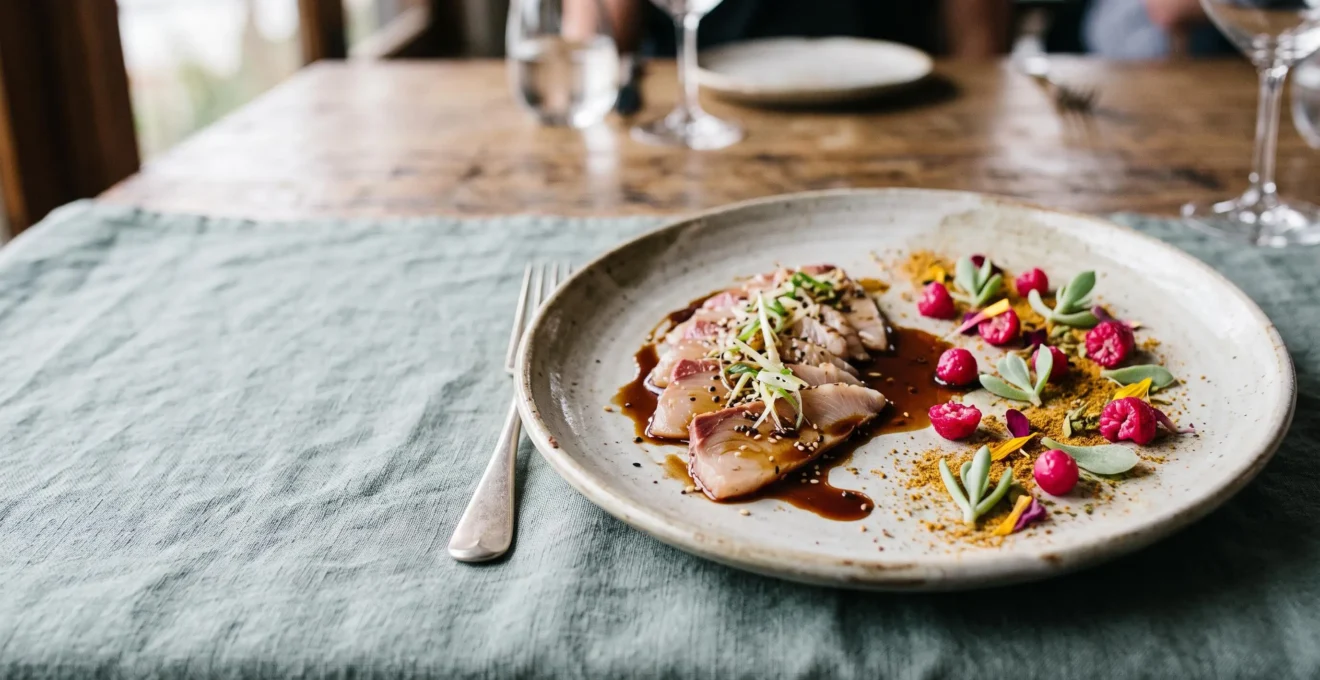
This approach is perfectly illustrated by contemporary tasting menus that showcase a plate’s micro-geography, combining local seafood like Corner Inlet rock flathead with native sea cabbage and warrigal greens, all prepared with international techniques. The result is a dish that could only exist in Australia, at this specific moment in its culinary history.
This visual fusion of native ingredients and refined plating is a core tenet of the cuisine. It’s a celebration of place, moving far beyond the boundaries of its colonial roots and creating something entirely new.
Indigenous Ingredients or Asian Techniques: Which Fusion Element Defines Australian Cuisine?
To ask whether modern Australian food is defined more by its native ingredients or its Asian techniques is to miss the point: its identity lies in the symbiotic relationship between the two. One cannot be separated from the other. The cuisine’s genius is found in the interplay—the way an Asian cooking method can unlock a new aspect of a native ingredient, or how a native herb can bring a uniquely Australian accent to a classic Asian dish. This dynamic is what separates it from other fusion cuisines around the world.
A perfect example of this is the story chef Kylie Kwong tells about serving a dish to Neil Perry. She prepared stir-fried native saltbush—a plant with a unique, savoury, and herbaceous character—using the classic Cantonese technique with ginger and shiro shoyu. Perry, a pioneer of the cuisine, was so struck by the flavour that he immediately came to the kitchen to understand where the ingredient came from. It was a moment of recognition: an Indigenous ingredient, elevated by an Asian technique, creating a flavour that was both new and deeply Australian.
On the other end of the spectrum are chefs like Ben Shewry of Attica. His journey illustrates a deep commitment to the ingredient side of the equation. After reading Bruce Pascoe’s landmark book *Dark Emu*, which presented compelling evidence of Aboriginal peoples as sophisticated farmers and agriculturalists, Shewry was inspired to transform his menu. His kitchen began to focus almost exclusively on native ingredients like wallaby, kangaroo, and foraged fruits, moving away from the imported, hard-hoofed animals of European tradition. This wasn’t about novelty; it was a profound shift in philosophy, aiming to cook with ingredients that have belonged to the Australian continent for millennia. The authentic innovation comes from applying world-class techniques to this uniquely local pantry.
The Cuisine Stereotype That Misses Indigenous Ingredients in Fine Dining Innovation
A common stereotype, even among those who acknowledge Australia’s fusion identity, is that Indigenous ingredients are a novelty—a decorative garnish or a token « foraged » leaf on the side of the plate. This view fundamentally misunderstands the structural role these ingredients now play in the country’s most innovative kitchens. Far from being a fleeting trend, the integration of native produce is being supported by new, sustainable supply chains and a philosophical commitment from leading chefs to make it the cornerstone of their cooking.
Enterprises like Outback Pride are a testament to this shift. Established in part to create employment and training opportunities in Aboriginal communities, the company supplies high-end restaurants with a consistent source of quality native ingredients, from saltbush to rosella flowers. This ensures that chefs can build entire menus around these products, rather than relying on them as a one-off special. It moves the use of « bush tucker » from a symbolic gesture to a viable economic and culinary practice. This represents a maturing of the cuisine, where innovation is supported by infrastructure.
Nowhere is this more evident than at a restaurant like Attica, where the menu is an explicit celebration of Indigenous knowledge. Dishes like saltbush scrolls, bunya-nut miso, and even possum-sausage sandwiches are not presented as exotic curiosities. Instead, they are framed as an honouring of Australian native produce. This approach directly confronts the colonial mindset by treating these ingredients with the same respect and technical rigor as a French chef would treat a truffle or a Japanese chef would treat high-grade tuna. The innovation lies not just in using the ingredient, but in deeply understanding its cultural and ecological context. The stereotype of novelty misses this profound shift towards ingredient-led authenticity.
When to Dine at Australian Restaurants for Chef Innovation, Not Tourist Menus
Finding authentic, innovative Australian cuisine requires looking beyond the waterfront restaurants with large signs advertising « Aussie BBQ. » The real culinary action happens in smaller, often chef-owned establishments where the menu is a direct reflection of a personal vision, a commitment to local suppliers, and the seasonal availability of produce. These are the places that are actively contributing to the evolution of the cuisine, rather than serving a fossilized version of it to tourists.
The first signal of an innovative kitchen is a dynamic, seasonal menu. If a menu is short, changes frequently, and highlights what is currently available from local farms, it’s a strong sign that the chef is engaged with their environment. A static, laminated menu that offers the same dishes year-round is a red flag. The second indicator is the language used. Look for specific sourcing details— « Hawkesbury River squid » or « Tasmanian mountain pepper »—which show a deep connection to the produce. Vague terms like « fresh local fish » are less convincing.
Finally, seek out restaurants in neighbourhoods known for their food culture rather than just their scenic views. Often, the most exciting food is found a few blocks back from the main tourist strip, in places where locals actually eat. Dining during the week, especially for a « chef’s selection » or tasting menu, can also provide a better window into a kitchen’s creativity than a busy Saturday night service. It’s about finding the places where food is treated as a craft, not just a commodity. This approach allows you to taste the story of modern Australia, not just its postcard image.
Action Plan: Finding an Innovative Australian Restaurant
- Analyze the Menu Online: Before booking, check their website. Look for a short, frequently changing menu. Do they use keywords like « native, » « foraged, » « local supplier, » or name specific farms?
- Research the Chef: Do a quick search for the head chef. Have they worked in other respected kitchens? Do interviews or articles reveal a philosophy focused on seasonality and local sourcing?
- Check the Location: Is the restaurant in a major tourist hub, or is it in a neighbourhood known for its dining scene and frequented by locals? Explore food blogs and local guides for recommendations.
- Read Reviews for Substance: Ignore generic reviews. Look for comments that mention specific, unusual dishes, the use of native ingredients, or the creativity of the flavour combinations.
- Book a Tasting Menu: If available, opt for the tasting or « set » menu. This is the most direct way to experience the chef’s full vision and is where the most innovative cooking is usually showcased.
Cabramatta or Footscray: Which Multicultural Neighborhood Delivers Genuine Asian-Australian Life?
To understand the Asian-flavour pillar of modern Australian cuisine, one must go to its source: the vibrant multicultural neighbourhoods that became the first homes for waves of migrants. For Vietnamese-Australians, two suburbs stand out as primary cultural and culinary hubs: Cabramatta in Sydney and Footscray in Melbourne. Asking which one is « better » is the wrong question; they are not competitors but parallel universes, each offering a deep and authentic lens into the community’s story and its profound impact on Australian life.
Cabramatta, in Sydney’s south-west, is often described as a city within a city. Its town centre is dense with Vietnamese-owned businesses, from fabric stores to jewellers and, of course, hundreds of restaurants and grocers. The air is thick with the aroma of pho broth and grilled pork. Exploring Cabramatta is an immersive experience; it reveals how a community transplanted its culture and built a thriving economic and social ecosystem. It is a powerful testament to the resilience and entrepreneurial spirit of refugees who arrived with nothing.
Footscray, in Melbourne’s inner-west, offers a slightly different flavour. While also home to a significant Vietnamese community, it is more of a multicultural mosaic, with a strong presence of Horn of Africa and South Asian communities as well. The Footscray Market is a bustling, chaotic, and joyous celebration of this diversity. Here, you can find everything from fresh sugarcane juice and Vietnamese mint to Ethiopian injera bread. Footscray demonstrates how different migrant cultures coexist and interact, creating a unique urban texture. The depth of the Vietnamese community is reflected in census figures showing that by 2016, there were 219,357 Vietnam-born people in Australia, with strong concentrations in these very suburbs. Both neighbourhoods are living museums of flavour, telling the story of how Australia’s palate was forever changed.
Why Aboriginal Bush Tucker Knowledge Is Advanced Ecology, Not Basic Foraging
The term « bush tucker » is often misleading, conjuring images of simple, opportunistic foraging for witchetty grubs or berries. This colonial-era perspective fundamentally misunderstands and diminishes what is, in reality, a deeply sophisticated system of ecological knowledge and land management cultivated over 65,000 years. Aboriginal food systems are not about randomly ‘finding’ food; they are about systematically managing the landscape to ensure a sustainable and predictable yield of plants and animals. It is, in effect, a form of agriculture perfectly adapted to the Australian environment.
This re-evaluation of Indigenous knowledge has been a game-changer for many non-Indigenous Australians, including leading chefs. For Ben Shewry, reading *Dark Emu* was a moment of revelation.
It totally flipped the script. It dismantled the lie of Aboriginal people being solely hunter-gatherers and presented them as farmers—which, of course, they were.
– Ben Shewry, Smithsonian Magazine
This understanding transforms ingredients from mere ‘things’ into products of a complex cultural practice. A perfect example is « fire-stick farming. » This is not arson, but a highly controlled use of cool-burning fires to clear out undergrowth. This practice prevents the build-up of fuel that leads to catastrophic wildfires. Furthermore, the patchwork burning creates a mosaic of different habitats, encouraging biodiversity and promoting the growth of specific food plants and grazing areas for animals like kangaroos. Documented research shows these traditional practices produce measurable ecological outcomes, including less intense wildfires and healthier landscapes. To call this ‘basic foraging’ is to ignore the science, planning, and multi-generational knowledge embedded within it.
This knowledge is the bedrock of the native ingredient movement. When a chef uses a native ingredient, they are not just using a plant; they are tapping into a library of ecological wisdom that has sustained people on the world’s driest inhabited continent for millennia.
Key takeaways
- Australian cuisine’s identity is not British; it’s a fusion defined by the historical impact of Asian migration and the use of native Indigenous ingredients.
- To find authentic ‘Mod Oz’ food, look for chef-driven restaurants with seasonal menus that explicitly feature native produce and Asian techniques.
- « Bush tucker » is not simple foraging but an advanced system of ecological knowledge that has been cultivated for over 65,000 years.
How to Experience Australia’s Multicultural Neighborhoods Like a Respectful Cultural Explorer
Visiting neighbourhoods like Cabramatta or Footscray is more than a food tour; it’s an opportunity for cultural immersion. To experience them respectfully means approaching them with curiosity and an understanding of their history. Many of the first Vietnamese restaurants were not started by professional chefs, but by families turning their home-cooking skills into a source of income. As one expert notes, « Most cooks were amateurs who turned to cooking to earn a modest income. » This context changes your perspective; you’re not just a customer, but a guest participating in a living history of community resilience.
The best way to explore is to engage multiple senses. Start by simply walking. Look at the produce in the grocery stores and markets—the bundles of fresh herbs, the exotic fruits, the different cuts of meat. This is the pantry of the community, and it tells a story before you’ve even ordered a meal. Listen to the languages being spoken. The existence of these vibrant, self-contained ecosystems is a direct result of decades of community-building; in Victoria alone, there are now over 68,000 Vietnam-born residents, many with roots in these neighbourhoods.
When it’s time to eat, be adventurous. Point to something on the menu you don’t recognize. Try the specialty of the house. Engage with the staff if they’re not too busy; ask what they recommend. Remember that these establishments are often small, family-run businesses. Your patronage supports a local economy and helps preserve a culinary heritage that has profoundly enriched Australia. A respectful explorer leaves with more than a full stomach; they leave with a greater appreciation for the stories, struggles, and triumphs that are cooked into every single dish.
Ultimately, to recognize Australian cuisine is to read the story of the country’s modern identity. It’s a tale of migration, adaptation, and a long-overdue conversation with its own ancient past. By moving beyond the colonial clichés and seeking out the vibrant fusion at its heart, you will not only eat better, but you will also gain a far deeper understanding of Australia itself. The next time you plan a trip, use this knowledge to seek out the restaurants and neighbourhoods that tell the real story of its innovative, multicultural soul.