In summary:
- Australia’s coffee culture prioritises espresso quality and milk texture; forget complex syrups and excessive size options.
- Master local terms like ‘flat white’, ‘long black’, and Melbourne’s ‘Magic’ to order with confidence.
- The best coffee is served during the morning rush (7-10 am) when baristas are at their peak and supplies are freshest.
- Explore residential neighbourhood cafés, not just city-centre laneways, to find the true heart of local coffee rituals.
- Align your visit with major events like the Melbourne International Coffee Expo (MICE) to see the industry’s top talent in action.
Stepping into an independent Australian café for the first time can be a bewildering experience for anyone raised on a diet of Starbucks or Costa. The menu seems deceptively simple, yet the language is cryptic. There are no Venti or Grande sizes, no pumpkin spice, and asking for « a regular coffee » is met with a polite but firm « What kind of coffee would that be? » This isn’t just a different menu; it’s a different value system, one so robust that it famously rejected one of the world’s largest coffee chains.
Many guides will tell you to just order a flat white and point you towards a few famous laneway spots. But this only scratches the surface. The reality is that Australian café culture is a sophisticated system built on respect for the bean, mastery of milk texture, and a close-knit ecosystem of roasters and baristas. True integration isn’t about memorising a few drink names; it’s about understanding the principles of quality and the rituals that define the experience. It’s about learning to read a café’s signals and engaging in a dialogue, not just a transaction.
But if the real key isn’t the ‘what’ but the ‘why’ and ‘how’, where do you begin? This guide is your educator. We will deconstruct this system, moving from the foundational rejection of global chains to the specific language you need to order with precision. We’ll explore the subtle but crucial differences in milk texture, the unspoken rules of timing your visit, and how to find authentic experiences far from the tourist trail. By the end, you won’t just be ordering coffee; you’ll be participating in one of the world’s most dynamic and respected coffee cultures.
This article provides a complete roadmap to mastering Australia’s coffee scene. Below, the table of contents outlines each step of your journey, from understanding the culture’s innovative roots to a practical five-day immersion plan.
Summary: A Guide to Australian Café Culture Mastery
- Why Australian Café Culture Now Leads Global Specialty Coffee Innovation
- How to Order Coffee in Australian Cafés Using Local Terms, Not Starbucks Language
- Flat White or Cappuccino: Which Australian Coffee Suits Your Taste and Texture Preference?
- The Café Timing That Gets You Tourist Coffee, Not Barista Peak Performance
- When to Visit Australian Cities for Coffee Festivals and Championship Events?
- How to Order Coffee in Melbourne Without Looking Like a Tourist
- Why Residential Neighborhood Stays Reveal More Real Australia Than CBD Hotels
- How to Experience Melbourne’s Arts and Laneway Culture Like a Local in 5 Days
Why Australian Café Culture Now Leads Global Specialty Coffee Innovation
To understand Australian coffee, you must first understand what it isn’t. It’s not a culture of sugary, oversized, highly modified drinks. The most powerful evidence of this is the dramatic failure of Starbucks. The global behemoth entered the market with high hopes but was met with a collective shrug from a populace already accustomed to high-quality, espresso-based coffee made by skilled baristas. The company’s expansion was a textbook case of market misjudgment, proving that brand power cannot overcome an ingrained culture of quality.
The numbers tell a stunning story of cultural rejection. After an initial expansion, the brand’s footprint collapsed almost overnight. A deep-dive analysis reveals that after growing to 90 locations, the number of Starbucks outlets in Australia fell to just 23 in 2008, a swift and brutal market verdict. This wasn’t just a business failure; it was a defence of ‘coffee integrity’. Australians didn’t need a third space decorated with logos; they already had authentic community hubs built around a superior product.
This event solidified Australia’s position not as a follower, but as a leader in global coffee trends. The local ‘barista-roaster ecosystem’ thrives on a direct relationship between the person making the coffee and the person sourcing and roasting the beans. This fosters rapid innovation, focusing on extraction techniques, milk science, and showcasing the unique notes of single-origin beans. While other countries were learning to order a Frappuccino, Australian cafés were perfecting microfoam and debating the merits of a ‘ristretto’ shot. This deeply rooted expertise is the foundation upon which the entire culture is built.
How to Order Coffee in Australian Cafés Using Local Terms, Not Starbucks Language
Ordering coffee in Australia is a lesson in precision and minimalism. Forget brand-specific jargon like ‘Venti’ or ‘Macchiato’ in the chain-coffee sense. Here, the name of the drink dictates the size and composition. Your goal is to develop ‘café literacy’, starting with the core vocabulary. Think of it as a progressive journey into the local dialect of coffee, where each new term unlocks a deeper level of appreciation for the barista’s craft.
The journey begins with milk-based espresso drinks, the heartland of Australian café menus. From there, you can explore black coffee variations and finally, the insider-only orders that signal true understanding. This structured approach will build your confidence and your palate.
- Step 1 – Master the basics: Start with a ‘flat white’ or a ‘café latte’. Both are built on a shot of espresso and topped with steamed milk, but the flat white typically has a thinner, more velvety layer of microfoam and is often served in a ceramic cup.
- Step 2 – Explore black coffee options: A ‘long black’ is the local standard. It’s two shots of espresso poured over hot water, which preserves the crema (the rich, golden-brown foam on top of the espresso). A ‘short black’ is simply a straight shot of espresso.
- Step 3 – Go insider: Once comfortable, ask for a ‘piccolo latte’—a full espresso shot in a small glass with less milk, resulting in a stronger coffee flavour. In Melbourne, you can go a step further and ask for a ‘Magic’. As founder Lily Fairhall recalls about its origin, « So many people ordered it, and we named it Magic. »
- Step 4 – Engage further: To show real interest, ask the barista, « What filter or batch brew do you have on today? » This refers to drip-style coffee, which has seen a major resurgence and is an excellent way to taste the nuanced flavours of a specific single-origin bean.
By using these terms, you are speaking the local language. You are showing respect for the barista’s expertise and signaling that you are there for the quality of the coffee, not just a caffeine hit. This simple shift in language is the single biggest step you can take to move from tourist to participant.
Flat White or Cappuccino: Which Australian Coffee Suits Your Taste and Texture Preference?
Once you’ve learned the basic names, the next level of café literacy is understanding texture. In Australia, the quality of a milk-based coffee is judged heavily on the skill of the barista in steaming the milk. The distinction between a flat white, a latte, and a cappuccino is less about ingredients and more about the textural experience. As coffee expert Lily Fairhall notes, the difference can be subtle: « I don’t think that there’s that much difference between a latte and a flat white, just the type of cup that you put them in. » The real differentiator is the foam.
A great Australian café prides itself on creating perfect ‘microfoam’—a silky, velvety steamed milk with bubbles so small they are invisible, giving the drink a glossy surface and a rich mouthfeel. A cappuccino will have a much deeper, airier foam, while a flat white’s foam is a thin, integrated layer. Understanding these nuances allows you to order based on the experience you’re seeking: a comforting, foamy treat or a smooth, espresso-forward beverage.
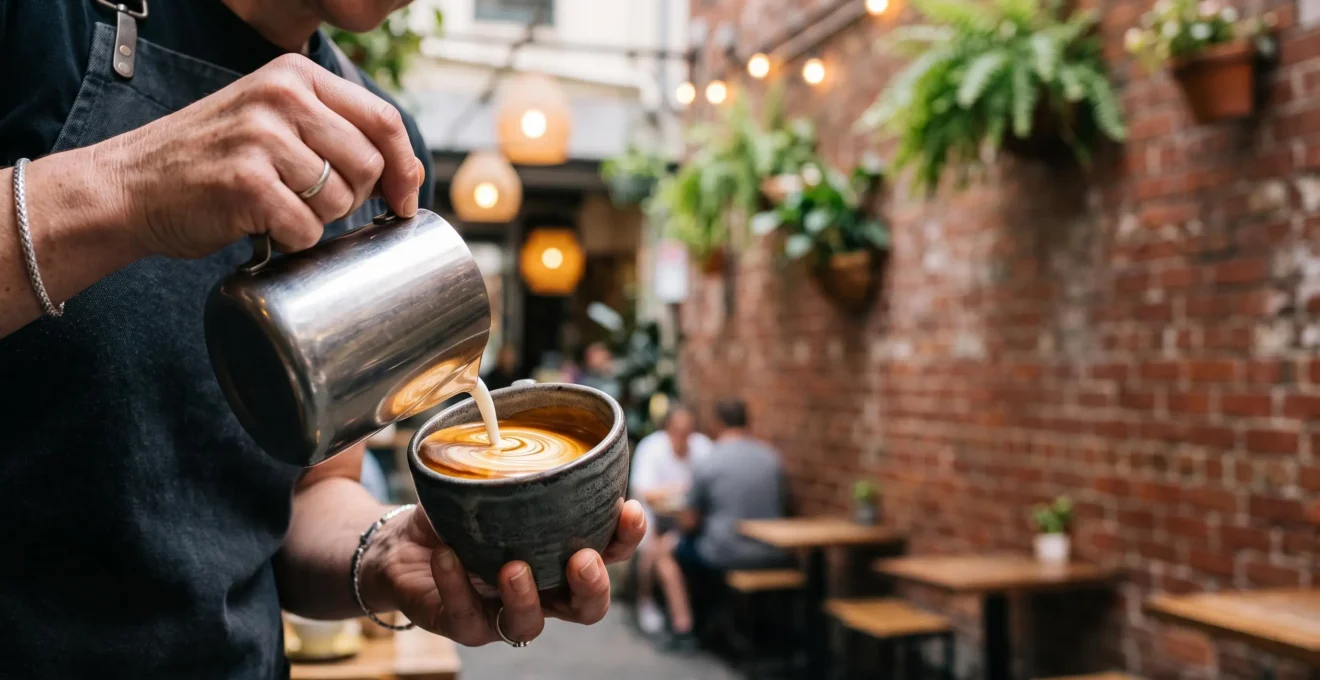
As the image above illustrates, the quality is in the detail of the pour. This focus on texture over sugary flavourings is a hallmark of the culture. The table below breaks down the key differences to help you make an informed choice that matches your preference for texture and coffee intensity.
This comparative data, based on an expert breakdown of Australian coffee styles, helps clarify the distinct role each drink plays.
| Drink | Milk Texture | Espresso Character | Best Occasion |
|---|---|---|---|
| Flat White | Silky, velvety microfoam, minimal froth | Espresso-forward, showcases the coffee | Purist’s morning choice |
| Cappuccino | Airy, pillowy foam, often dusted with chocolate | Softened by more foam, comfort-oriented | Afternoon treat |
| Piccolo / Magic | Small amount of silky steamed milk over a double ristretto | Concentrated, intense espresso hit | Quick fix for espresso lovers |
The Café Timing That Gets You Tourist Coffee, Not Barista Peak Performance
In a culture that views coffee as a ritual rather than mere fuel, *when* you visit a café is almost as important as *what* you order. A common tourist mistake is to wander in during the quiet mid-afternoon lull, expecting the same quality as the morning peak. While you’ll still get a decent coffee—the quality floor is remarkably high—you’ll miss the café at its best. According to the local experts at Saltrove, « Melbourne coffee is a year-round pursuit, but different windows suit different goals. »
The real magic happens during the morning rush. This is when the machine has been dialled in to perfection, the milk is at its freshest, and the A-team of baristas is working in seamless harmony. Navigating this peak time like a local means understanding the flow and having your order ready. It’s a fast-paced but deeply rewarding experience, placing you right in the middle of the city’s daily rhythm. Waiting until the rush is over might mean a shorter queue, but you’re getting a performance that is past its peak.
To experience Australian café culture authentically, you need to time your visit strategically. Each day and time window offers a different experience, from the high-energy buzz of the weekday commute to the relaxed pace of a Sunday morning. Here’s how to time your visit for peak performance:
- 7am-10am: This is the golden window. You’ll find the highest concentration of baristas behind the machines, the best crema on the espresso shots, and the freshest milk of the day. This is when you’ll get the café’s absolute best work.
- Weekday Mornings: Be aware of the waves of office workers. Arriving just before or after a major peak (e.g., at 8:15 am instead of 8:30 am) can give you top-quality coffee with a more manageable queue.
- Saturdays: This is peak brunch time. Famous spots will have long queues, but this is a great opportunity to explore excellent backstreet or neighbourhood cafés, which will still be busy but more accessible.
- Sundays: Generally the quietest day. Many cafés close by early afternoon (around 2 or 3 pm), so it’s ideal for a slower, more conversational coffee experience in the morning. Don’t leave it too late.
When to Visit Australian Cities for Coffee Festivals and Championship Events?
To witness the pinnacle of Australia’s coffee expertise, plan your visit to coincide with one of its major industry events. This is where the ‘barista-roaster ecosystem’ is on full display, transforming from a daily service into a competitive sport. These festivals are not just for industry insiders; they are vibrant, accessible celebrations of coffee, offering a unique opportunity to taste award-winning beans and watch the nation’s best talent at work.
The most significant event on the calendar is the Melbourne International Coffee Expo (MICE). It’s one of the largest and most respected specialty coffee events in the Asia-Pacific region, acting as a gathering point for the entire industry. The scale is immense; in a recent year, the Melbourne International Coffee Expo welcomed over 31,708 visitors, from café owners to passionate consumers. Visiting during MICE gives you a front-row seat to the trends, technologies, and tastes that will define the next year in coffee.
These events offer far more than just free samples. They are where the industry’s competitive pulse is most tangible, providing a thrilling spectacle for any coffee enthusiast.
Case Study: Barista Battles and Roaster Competitions at MICE
A recent MICE featured the MILKLAB Roaster Royale Finals, where Australian roasters competed to craft the ultimate blend from supplied green beans. The event culminated in the MILKLAB International Barista Battle, pitting the newly crowned national champion against top international baristas. For a visitor, this illustrates how the industry is in constant, fierce competition to innovate and improve. Attending allows you to witness this high-stakes creativity firsthand and taste the results of championship-level roasting and brewing, connecting you directly to the source of the culture’s excellence.
As Sarah Baker of Global Coffee Report puts it, « Australia is a bucket-list destination for many people. It’s a commitment in distance, but once you’re there, it really is a land of opportunity – and a coffee lover’s paradise. » Timing your trip with a festival like MICE ensures you experience that paradise at its most dynamic.
How to Order Coffee in Melbourne Without Looking Like a Tourist
While the general rules of Australian coffee etiquette apply nationwide, Melbourne operates on another level of specificity. As the undisputed heartland of the country’s specialty coffee scene, the city has its own dialect and unspoken rules. Ordering coffee here correctly is the ultimate sign of an informed visitor. It’s about demonstrating a deeper understanding of the local craft and moving with the city’s confident, coffee-centric rhythm.
The most common tourist mistakes in Melbourne are related to sizing and specificity. The culture is built around the integrity of the drink itself, not customisable sizes. Ordering a ‘medium flat white’ will immediately mark you as an outsider. You order the drink, and the café dictates the (usually single) size. The key is to be concise and clear. To help you blend in, here are the crucial do’s and don’ts of Melbourne ordering etiquette:
- Do ask specifically for a ‘Magic’. This Melbourne-born drink—a double ristretto topped with a small amount of silky, steamed milk in a 160ml cup—is often not on the menu. Asking for it shows you’re in the know.
- Avoid ordering ‘a regular coffee’ without any other details. This is not a recognised order and will force the barista to start a game of 20 questions to figure out what you actually want.
- Avoid using American-style sizing like ‘medium’ or ‘large’. A ‘coffee’ is a single, standard size. If you want more, you simply come back later for another one.
The ‘Magic’ is a particularly strong shibboleth for quality. It’s a test of both the customer’s knowledge and the café’s credentials. As the editors of one guide bluntly state, « If the café doesn’t know what a magic is, you’re in the wrong café. » It’s a perfect, potent summary of the city’s high standards.
Why Residential Neighborhood Stays Reveal More Real Australia Than CBD Hotels
While Melbourne’s CBD laneways are an essential starting point, the true, beating heart of Australian café culture is found in its residential neighbourhoods. Staying in an Airbnb or boutique hotel in suburbs like Fitzroy in Melbourne or Surry Hills in Sydney offers a more profound and authentic experience than a city-centre hotel ever could. This is where coffee is not a tourist attraction, but a daily ritual woven into the fabric of community life. It’s where the barista knows regulars by name and the quality is consistently exceptional, away from the hype.
These suburban outposts are not second-tier; they are often the incubators of innovation and home to some of the city’s best roasters and baristas. The quality is so deeply embedded that, as one local guide aptly puts it, « The quality floor is astonishingly high — even a random suburban café usually pulls a better espresso than most cities’ best. » These are not just places to get coffee; they are highly successful small businesses that are vital to their communities. In fact, market analysis shows that these small independent cafés generate 34% higher revenue per square metre than conventional shopfronts, proving their cultural and commercial power.
But how do you spot an authentic neighbourhood gem versus a generic one? You can learn to « audit » a café’s identity by paying attention to its signals—the same way a brand strategist would. It’s about looking for signs of coherence, passion, and community connection.
Your Action Plan: Auditing a Café for Authenticity
- Points of contact: List all the signals the café sends out. Is the signage hand-painted or corporate? Is the music curated or generic pop? Does the furniture feel personal or mass-produced?
- Collection: Inventory the key elements. Note the specific brand of beans being used (is it a local roaster?), the type of pastries (local bakery?), and the art on the walls (local artists?).
- Coherence: Does it all fit together? Does the minimalist aesthetic match the focus on single-origin filter coffee, or is there a disconnect? A coherent identity signals clear values.
- Memorability/emotion: What makes this place unique? Is it the barista’s warm welcome, a signature drink, or a particularly beautiful ceramic cup? Identify the one thing you would tell a friend about.
- Integration plan: Based on your audit, decide. Is this a place that expresses a genuine passion for coffee and community, or is it just going through the motions? A truly authentic café feels like a complete, integrated system.
By choosing to stay in and explore these neighbourhoods, you move beyond being a spectator of the coffee scene and become a temporary part of its daily rhythm.
Key takeaways
- Coffee quality is judged on milk texture and espresso integrity, not size or flavour additions.
- Mastering local terminology is the first and most important step to integrating into the culture.
- The best coffee experience happens during the 7-10 am morning rush, not in the quiet afternoon.
How to Experience Melbourne’s Arts and Laneway Culture Like a Local in 5 Days
Now that you have the language, the etiquette, and the strategy, it’s time to put it all into practice. This five-day framework is not just a coffee crawl; it’s a progressive immersion into Melbourne’s interwoven arts, food, and coffee culture. Each day builds on the last, taking you from the bustling city centre to the creative hubs where the coffee is roasted, and finally to a state of confident, independent exploration. This is your roadmap to experiencing the city’s laneways like a seasoned local.
The journey is designed to connect the dots between the cup in your hand and the city around you. You’ll witness the entire ecosystem, from the high-speed service of a CBD espresso bar to the scientific precision of a roastery. The goal is to understand the context, as described in one travel guide, where places like Hardware Lane function as the birthplace of laneway culture, while neighbourhoods like Collingwood act as the city’s modern roasting laboratory. This itinerary guides you through that living history.
Follow this progressive plan to build your palate and confidence:
- Day 1: The CBD Espresso Bar. Start in a classic city laneway between 7-10 am. Order a short black or a flat white. The goal is to experience the speed, efficiency, and quality of the morning rush.
- Day 2: The Filter Brew Comparison. Return to a high-quality CBD roaster-café. This time, order their batch brew or a pour-over. Compare the taste of these beans to the espresso blend you had yesterday. Notice the difference in flavour clarity.
- Day 3: The Roastery Pilgrimage. Head out to an inner-city neighbourhood like Collingwood or Brunswick. Visit a roastery-café where you can see the roaster in action, often through a viewing window, connecting the industrial process to the refined product.
- Day 4: The ‘Magic’ Moment. Now that your palate is more developed, it’s time to order a Melbourne ‘Magic’ at a respected suburban or inner-city café. This is your graduation day, ordering an off-menu drink with confidence.
- Day 5: The Independent Exploration. Armed with your new knowledge, pick a neighbourhood you haven’t visited. Walk its streets, use your audit skills to pick a promising café, and order whatever you feel like. You are no longer a tourist; you are a participant.
This itinerary provides a structure for discovery, but its true purpose is to empower you to create your own coffee adventures, both in Melbourne and beyond.
Armed with this cultural and practical knowledge, your next step is to step into a local Australian café, approach the counter with confidence, and begin your own coffee journey, one perfectly crafted cup at a time.
Frequently Asked Questions on Australian Café Culture
What does ‘cuppa’ mean when a local invites you?
It’s a casual invitation to share a cup of coffee or tea together, reflecting the relaxed, social nature of Australian café culture. It’s an offer of conversation and company.
What does it mean if someone offers to ‘shout’ you a coffee?
It means they are offering to pay for your drink. This is a common and friendly gesture in Australian social settings, including cafés. The polite response is to accept graciously and perhaps offer to ‘shout’ the next round.