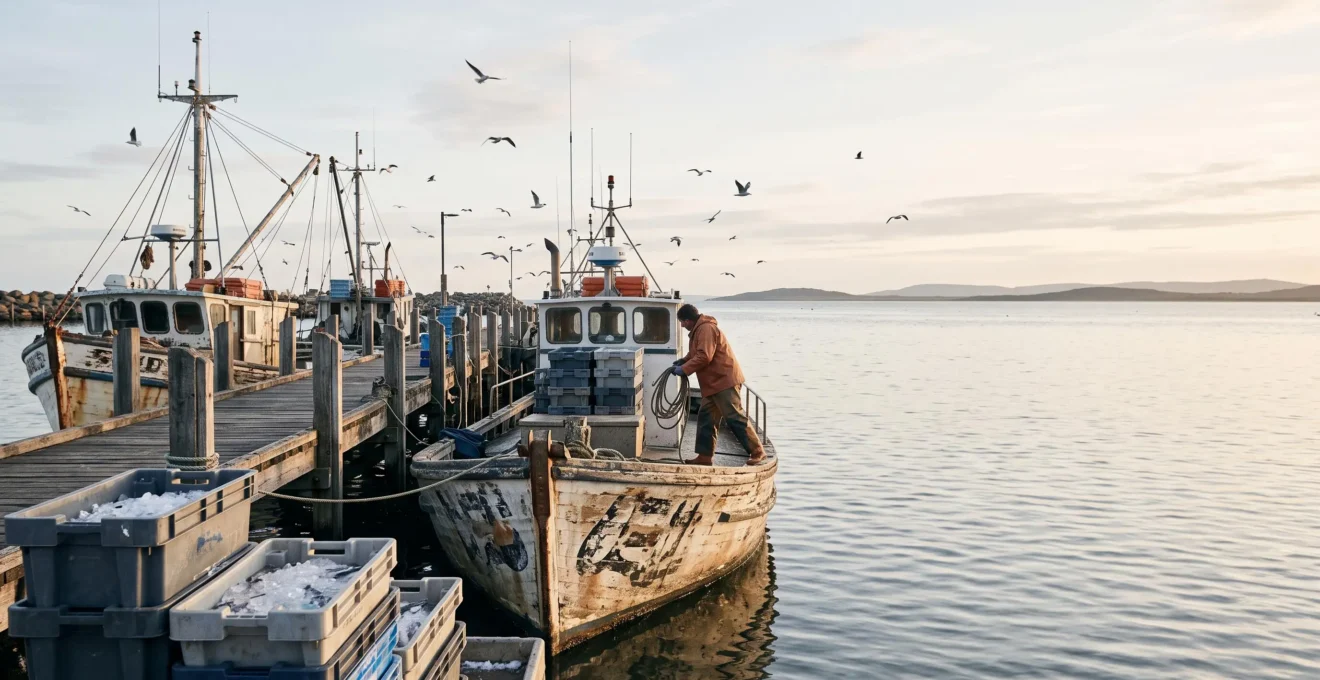
Most seafood served in Australian coastal cities is imported, meaning your « fresh catch » is likely a well-traveled tourist myth.
- True freshness requires intercepting the supply chain by visiting regional fishing ports and co-ops, not just big-city markets.
- Mastering the seasonal clock of local species and learning to read new menu labels are essential skills for any seafood purist.
Recommendation: Prioritise the source over the setting. A humble fishing co-op will almost always deliver a fresher, more authentic seafood experience than a waterfront restaurant.
The image of enjoying freshly caught fish by the water is a cornerstone of the Australian coastal dream. Seafood purists travel across the world, drawn by the promise of pristine waters and unique marine life. Yet, a disappointing reality often awaits: the beautiful barramundi on your plate in a Sydney harbour restaurant might have been farmed in Asia, and the prawns in your pasta may have travelled further than you did. The common advice—visit a famous market or trust the « catch of the day »—often leads you straight to the end of a long, cold supply chain, not to the source.
The truth is, accessing Australia’s freshest seafood isn’t about finding the right restaurant; it’s a skill. It involves understanding port-to-plate logistics and bypassing the mainstream distribution networks that cater to convenience over quality. This requires a shift in mindset, from being a passive consumer to an active sourcer. It means learning to think like a local who knows the rhythms of the tides, the schedules of the trawlers, and the subtle cues that separate a genuine local catch from a defrosted import.
This guide is built on that principle of supply chain interception. We will dismantle the tourist-facing myths and provide a direct-sourcing framework. You will learn why Australia’s marine bounty is so unique, how to strategically approach regional fishing ports for catch-fresh quality, and why the timing of your purchase is just as important as the location. It’s time to stop eating at the end of the line and start sourcing from the boat.
To navigate this journey from tourist traps to trawler-side treasures, this guide breaks down the essential knowledge into clear, actionable steps. You’ll discover the secrets of Australia’s marine biodiversity, the practicalities of port markets, and the simple joy of cooking your catch like a true coastal local.
Summary: A Purist’s Guide to Sourcing Seafood in Australia
- Why Australian Waters Deliver Seafood Species You Cannot Find in Europe or America
- How to Visit Fishing Port Markets for Freshest Catch Straight from Boats
- Sydney Fish Market or Regional Fishing Ports: Which Delivers Fresher Seafood Experiences?
- The Restaurant Mistake of Ordering Imported Seafood in Australian Coastal Cities
- When to Eat Each Australian Seafood Species for Peak Season Flavor
- Why the Coral Sea Delivers Marine Biodiversity the Caribbean Cannot Match
- How to Cook Fresh Seafood on Public Beach BBQs Like Coastal Locals
- How to Join Australian Beach BBQ Culture with Contemporary Techniques, Not Just Sausages
Why Australian Waters Deliver Seafood Species You Cannot Find in Europe or America
Australia’s geographic isolation is its greatest culinary asset. Surrounded by the Indian, Pacific, and Southern Oceans, its waters are a cradle for marine life that evolved in unique ecosystems, free from the species crossover common in the Northern Hemisphere. This results in seafood with distinct textures and flavours you simply won’t encounter elsewhere. Think of the sweet, firm flesh of the Moreton Bay Bug, a type of slipper lobster, or the rich, oily profile of wild-caught Barramundi from the country’s north. These are not just different fish; they are different eating experiences.
The country’s robust fishery management also plays a critical role in quality. With a strong focus on sustainability, Australia maintains a healthy balance in its wild stocks. While no system is perfect, the 2024 Status of Australian Fish Stocks Report found that 63% of stocks were assessed as sustainable and not subject to overfishing. This management allows species like the iconic Western Rock Lobster to thrive, developing a dense, almost crunchy texture and deep flavour that is a world away from its spiny lobster cousins in the Caribbean or Europe.
This unique biodiversity is what makes the effort of direct sourcing so rewarding. While you can find salmon or tuna anywhere, you can only experience the briny snap of a freshly shucked Sydney Rock Oyster or the delicate flake of a pan-fried King George Whiting right here. Accessing these species at their peak requires bypassing the long-haul routes that compromise their fragile textures, connecting you directly to the source of their unparalleled quality.
How to Visit Fishing Port Markets for Freshest Catch Straight from Boats
The most effective way to secure truly fresh seafood is through supply chain interception. This means getting as close to the returning boat as legally and logistically possible. Forget supermarkets and even many city-based fishmongers; your target is the fishing co-operative or boat-side outlet located directly at a regional fishing port. These are the nerve centres of the local seafood economy, where the catch is landed, processed, and sold, often within hours.
Finding these ports requires a little research. Look for towns along the coast with active fishing fleets—names like Port Lincoln (SA), Mooloolaba (QLD), or Lakes Entrance (VIC) are legendary. Once there, search for the « Fishermen’s Co-op » or « Seafood Co-op. » These are member-owned organisations that provide a direct outlet for their fishermen’s catch. The key is to check their opening hours, which often align with when the boats return. An early morning or mid-afternoon visit can yield seafood that was swimming in the ocean that very day.
When you arrive, the experience is more functional than fancy. Expect concrete floors, the smell of saltwater, and staff with genuine expertise. This is your opportunity to ask the most important question: « What came in this morning? » Unlike a generic fish shop, they can give you a precise answer. This is also where you’ll often get a better price, but the real value is in the unparalleled quality and the connection to the source. You’re not just buying fish; you’re buying the story of the day’s catch directly from the community that caught it.
Sydney Fish Market or Regional Fishing Ports: Which Delivers Fresher Seafood Experiences?
The Sydney Fish Market (SFM) is an impressive spectacle. It’s a bustling hub of tourism, dining, and wholesale trade. Every morning, the market’s Dutch auction system moves over 50 tonnes of seafood to hundreds of buyers. While it offers an incredible variety and is a vital part of the industry, for the purist seeking ultimate freshness, it represents a point of mass distribution, not a point of origin. Seafood here has already been transported, held, and auctioned. It’s fresh, but it’s one step removed from the boat.
In contrast, regional fishing ports offer a fundamentally different, more direct experience. These are working harbours where the transaction is between the fishing community and you. The scale is smaller, the pace is slower, and the connection to the catch is immediate. There is no complex auction system or long-distance cold chain between you and the trawler docked just metres away.
This difference is perfectly illustrated by comparing the SFM to a regional powerhouse. While Sydney is a marketplace, a smaller town can be the engine of production itself.
Case Study: Port Lincoln, South Australia’s Seafood Engine
Port Lincoln is home to the largest fishing fleet in the Southern Hemisphere and is the heart of the Eyre Peninsula, from which more than 60 per cent of Australia’s seafood is produced. Its entire economy revolves around the fishing industry. Visiting the co-ops here means you are at the absolute epicentre of the catch for species like Southern Bluefin Tuna and King Prawns. This direct access provides a « port-to-plate » experience that a large, secondary market like Sydney, despite its variety, simply cannot replicate in terms of sheer, unadulterated freshness and local connection.
The Restaurant Mistake of Ordering Imported Seafood in Australian Coastal Cities
It is the ultimate paradox for the visiting seafood lover: sitting at a waterfront restaurant in a famous Australian coastal city, you are statistically more likely to be eating imported seafood than local. The convenience and price-point of frozen, imported products are often too tempting for the hospitality industry to resist. In fact, official figures show that more than 60% of all seafood consumed in Australia is imported. This creates a widespread « tourist vs. trawler » seafood divide, where menus cater to an expectation of freshness while often relying on a globalised supply chain.
This reality is often hidden from the consumer, leading to the frustrating experience of paying a premium for what is assumed to be a local product. The disconnect between Australia’s reputation and the reality on the plate can be stark. As Sydney-based seafood exporter and former restaurant owner Joe De Belin commented to ABC News, the figure could be even higher in restaurants.
I reckon 85 to 90 per cent is imported.
– Joe De Belin, Sydney-based seafood exporter and former restaurant owner, ABC News
Fortunately, new country of origin labelling laws for the hospitality sector are bringing much-needed transparency. Learning to read these new labels is the single best tool for exercising menu literacy and ensuring you get what you pay for. This simple system empowers you to make an informed choice directly from the menu.
Your Checklist for Decoding Australian Seafood Menu Labels
- Check for the ‘A’, ‘I’, ‘M’ system: Look for a single letter next to seafood items. ‘A’ stands for Australian, ‘I’ for Imported, and ‘M’ for a Mixed dish containing both.
- Look for a business statement: Instead of individual labels, a venue might use a clear statement on its menu, like ‘We proudly serve 100% Australian seafood’.
- Identify mixed-source dishes: A seafood marinara or paella is a classic candidate for an ‘M’ classification, often using cheaper imported squid or prawns alongside local fish.
- Ask about wild vs. farmed status: These origin rules do not yet mandate disclosure of whether the seafood is wild-caught or farmed. If this is important to you, you still need to ask the staff directly.
- Vote with your wallet: If a menu lacks any origin information, be sceptical. Choosing venues that are transparent supports a more honest industry.
When to Eat Each Australian Seafood Species for Peak Season Flavor
True seafood sourcing is not just about location; it’s about timing. Just like fruits and vegetables, every seafood species has a seasonal clock—a peak time of year when its fat content, texture, and flavour are at their absolute best. Eating seafood out of season can mean you’re getting a product that is smaller, has a softer texture, or is potentially a frozen and stored item from the previous year’s catch. Aligning your consumption with this natural cycle is the final layer of sourcing expertise.
For example, Eastern Rock Lobsters are typically at their peak in the warmer months (October-March), while the iconic giant Queensland Mud Crabs are best during the northern dry season (April-September) when their shells are full and hard. Scallops from Tasmania are often sweetest in the cold winter months. Following this clock ensures you experience each species at its prime and supports sustainable fishing practices that avoid targeting species during their spawning periods. As acclaimed chef Ben Shewry of Attica notes, sustainability and quality are inextricably linked.
If I don’t have most sustainable menu I can have in terms of shellfish and seafood – then I am contributing to the problem.
– Ben Shewry, Chef at Attica and GoodFish Project Ambassador, GoodFish – Australia’s Sustainable Seafood Guide
Navigating this seasonal clock can seem daunting, but excellent resources are available. The most comprehensive is Australia’s GoodFish guide, an independent initiative that provides up-to-date sustainability ratings and seasonality information. It is an indispensable tool for the conscious consumer, turning a complex web of information into simple, actionable advice. The guide, which assesses over 160 species and covers 90% of the market, allows you to check the status of a species in real-time, ensuring your choice is not only delicious but also responsible.
Why the Coral Sea Delivers Marine Biodiversity the Caribbean Cannot Match
To truly grasp why Australian seafood is so distinct, one must look to its primary engine room of biodiversity: the Coral Sea. This vast expanse off Australia’s northeast coast, encompassing the Great Barrier Reef, is one of the most evolutionarily significant marine environments on Earth. While the Caribbean is a beautiful and popular marine destination, its biodiversity pales in comparison to the sheer scale and richness found in Australian waters. The Coral Sea is simply in a different league.
The numbers are staggering. Home to vibrant coral gardens and deep oceanic trenches, the broader Coral Sea region is home to over 1,500 reef fish species and thousands of mollusc and crustacean species. This incredible genetic library creates a downstream effect, seeding the entire eastern coastline with a variety of life that is unparalleled. This isn’t just about quantity; it’s about unique evolutionary paths that have produced species like the vividly coloured Coral Trout and the prehistoric-looking Humphead Maori Wrasse.
The concentration of this biodiversity is what truly sets it apart. Specific micro-regions within the Great Barrier Reef ecosystem contain more species than entire seas elsewhere in the world, making it a hotspot of global significance.
Case Study: The Capricorn Reefs’ Hyper-Diversity
The Capricorn-Bunker Group of reefs, at the southern end of the Great Barrier Reef, illustrates this point perfectly. Although this small section makes up only 3% of the reef’s total area, it supports an astonishing 859 species of fish. This level of richness is comparable to the plant diversity of the entire nation of Costa Rica, a country four times larger. Furthermore, a source like the Oceans Atlas notes that the entire Mediterranean Sea supports less than a quarter of the fish species found on the Great Barrier Reef, underscoring just how uniquely concentrated Australia’s marine biodiversity truly is.
How to Cook Fresh Seafood on Public Beach BBQs Like Coastal Locals
You’ve successfully intercepted the supply chain and have a bag of pristine, peak-season seafood. Now what? The most authentic way to honour that ingredient is to embrace one of Australia’s great culinary traditions: the public beach barbecue. These free, electric hot plates are a fixture of coastal parks and reserves, offering a simple, direct way to cook your catch with the sound of the ocean in the background. It is the final, perfect step in the port-to-plate journey.
Cooking on these public BBQs requires a simple kit and a bit of know-how. First, always clean the hot plate before you start. Bring a scraper or long tongs holding a paper towel soaked in oil to wipe it down. Essential items to bring include: a bottle of cooking oil (like canola or grapeseed), salt and pepper, lemon wedges, and a roll of aluminium foil. The foil is your secret weapon: it can be used to create a barrier for delicate fish fillets or to fashion a small tray for cooking prawns or calamari with garlic and herbs, preventing them from falling through any gaps.
The technique is all about simplicity. For a whole fish, score the skin, rub with oil and salt, and cook for a few minutes on each side until the flesh is opaque. For fillets, place them on foil to prevent sticking and cook until they flake easily. Prawns need only a minute or two per side until they turn bright pink. The goal is not to over-complicate things; it’s to let the unbeatable freshness of the seafood be the star. This is not gourmet cooking; it’s a rustic, elemental experience that connects you, the food, and the environment.
Key Takeaways
- The majority of seafood in Australian restaurants is imported; true freshness requires sourcing directly from coastal fishing co-ops.
- Mastering the seasonal peaks of different species is as crucial as finding the right location to buy them.
- The public beach BBQ is the most authentic and rewarding way to cook your fresh catch, celebrating simplicity and the ingredient itself.
How to Join Australian Beach BBQ Culture with Contemporary Techniques, Not Just Sausages
The Australian beach barbecue is often stereotyped as a simple affair of sausages and onions. While that holds a cherished place in the culture, embracing it with fresh, high-quality seafood elevates the experience from a casual snag-fest to a true culinary event. It represents the culmination of your sourcing journey—a celebration of the pristine ingredient you worked to find. This is where the principles of « port-to-plate » become a tangible, delicious reality.
To join this culture with a contemporary edge, think beyond simply grilling a fish fillet. Use the hot plate to explore different techniques. Marinate calamari tubes in garlic, parsley, and olive oil before flash-grilling them for less than a minute. Steam mussels or clams in a foil parcel with a splash of white wine and a knob of butter. The hot plate is versatile enough for searing scallops, charring octopus tentacles, or even warming freshly shucked oysters just enough to release their briny liquor.
This approach is about respecting the ingredient. You’ve gone to the effort of finding seafood at its absolute peak; the cooking should be minimal and focused. It’s a philosophy that values flavour over fuss, and community over complexity. Sharing a platter of freshly grilled prawns and fish cooked on a public BBQ, with sand between your toes, is to participate in the modern Australian identity in its most authentic form. It moves beyond the cliche and connects you to a deeper appreciation for the country’s incredible marine bounty.
Start planning your coastal trip not around restaurants, but around the small fishing towns that dot the map. Your next, and best, seafood meal is waiting for you at the source.