Accessing Tasmania’s real wilderness isn’t about brute force or expensive gear; it’s about smart preparation and a respectful mindset.
- The greatest risks aren’t snakes or spiders, but underestimating the rapidly changing weather and rugged trail conditions.
- Layering clothes correctly and building trail-specific fitness are far more crucial for safety and enjoyment than owning a 4WD.
Recommendation: Focus on becoming self-reliant for a single day trip, and you will unlock profound landscapes most people only ever see in photos.
When you picture the Tasmanian wilderness, you likely see sweeping, dramatic landscapes that feel a million miles from anywhere. And you’re right. For over two decades, I’ve guided people into these ancient places, and I’ve seen a common thread of intimidation. Many believe these realms are reserved for hardcore adventurers with rugged four-wheel drives and the fitness of a mountain goat. They see the epic photos and think, « That’s not for me. »
Let me tell you a secret I’ve learned from thousands of hours on the trail: that’s a myth. The real key to unlocking Tasmania’s soul isn’t about what you drive or how fast you can hike. It’s about adopting a specific ‘wilderness mindset’—a blend of preparation, humility, and environmental awareness. Many common approaches focus on destinations, but they miss the most important part: preparing your mind and your pack for an environment that commands respect.
This isn’t about conquering the wilderness; it’s about learning to be a quiet, well-prepared guest within it. This guide is built on that philosophy. We’re going to bypass the intimidating myths and focus on the practical skills and knowledge that truly matter. We’ll cover why this landscape feels so different, how to prepare for its unique challenges, and ultimately, how to experience its profound, transformative beauty safely and respectfully, leaving the 4WD at home.
To help you navigate this journey, this guide breaks down the essential knowledge for safely and deeply experiencing Tasmania’s wild places. From understanding its unique character to practical steps on preparation and conservation, here is your roadmap.
Summary: How to Experience Tasmania’s True Wilderness Without a Four-Wheel Drive or Extreme Fitness
- Why Tasmania’s Wilderness Feels Rawer Than Any Mainland National Park
- Why Australian National Parks Demand More Preparation Than European or American Parks
- How to Pack for Tasmania’s Four-Seasons-in-One-Day Mountain Weather
- How to Build Hiking Fitness for Australian Heat and Distance in 12 Weeks
- The Trail Assumption That Injures 40 Hikers Yearly in Tasmania
- Guided Wilderness Tours or Solo Exploration: Which Unlocks Tasmania’s Hidden Landscapes?
- When to Visit Tasmanian Wilderness for Total Solitude: The Shoulder Season Secret
- How to Experience Australian National Parks Without Damaging Ecosystems or Risking Safety
Why Tasmania’s Wilderness Feels Rawer Than Any Mainland National Park
The first thing you need to understand is that ‘wilderness’ in Tasmania is not just a marketing term. It’s a tangible feeling. It’s the silence, broken only by the wind or a birdcall. It’s the scent of damp earth and ancient trees. Unlike many mainland parks, which can feel curated, Tasmania’s wild places possess a profound, untamed quality. A huge part of this is scale and protection; the Tasmanian Wilderness World Heritage Area covers an immense 1.58 million hectares, a staggering figure that represents approximately 20 per cent of the state.
This isn’t just a big park; it’s a living museum of Gondwanan heritage, with geology and flora that have remained unchanged for millennia. You are walking through landscapes shaped by ice ages, on trails that cross billion-year-old rock. This rawness is what pioneer wilderness photographer Olegas Truchanas was referring to when he described it as:
A shining beacon in the dull, uniform and largely artificial world.
– Olegas Truchanas, Parks & Wildlife Service Tasmania
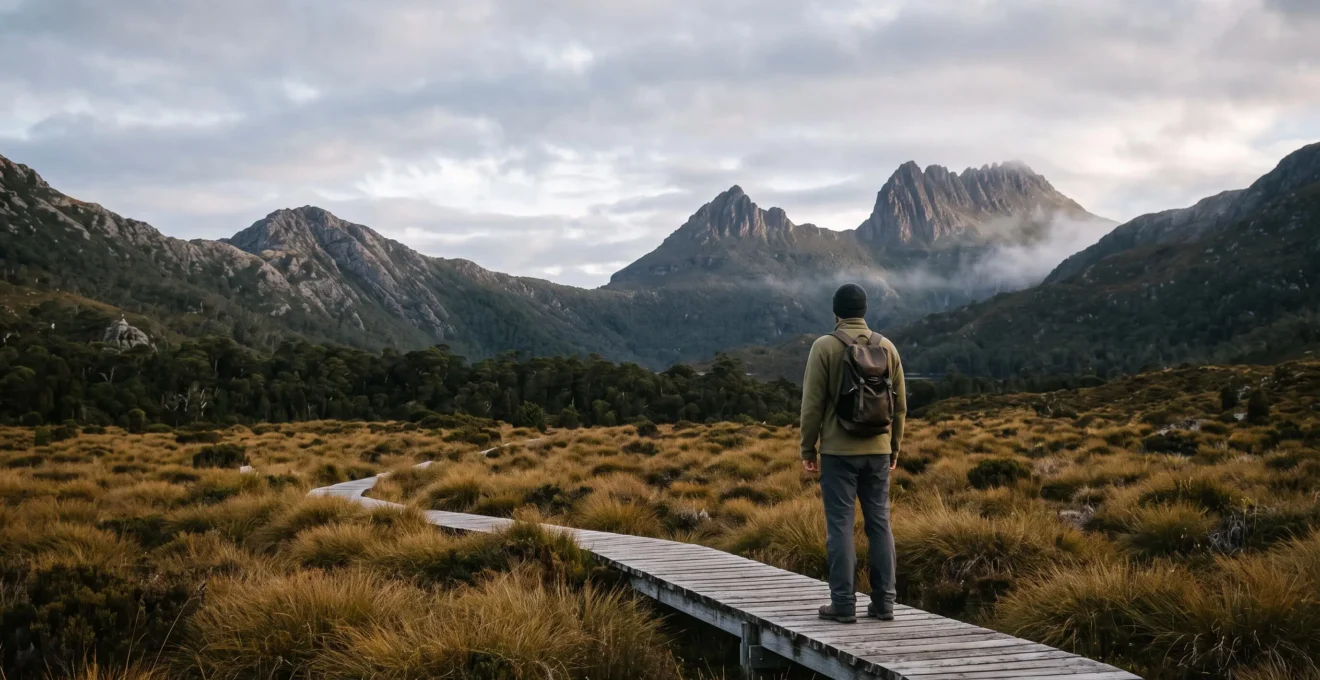
This authenticity means the environment dictates the terms. There are fewer handrails, fewer cafes, and more moments where you feel like a small part of a vast, powerful system. The very air feels ancient. Embracing this rawness, rather than being intimidated by it, is the first step in your journey. The visual scale of these landscapes, with trails winding along immense valleys, is a constant reminder of your place within this ancient world.
As you can see, the experience is defined by a sense of immense space and solitude. This is not a landscape to be rushed through. It asks for your full attention and respect. This feeling of being a visitor in an ancient, powerful place is the very essence of the Tasmanian wilderness experience, and it’s completely accessible without needing extreme gear.
Why Australian National Parks Demand More Preparation Than European or American Parks
A common mistake visitors make is applying the same expectations they have for European or North American parks to the Australian bush, especially in Tasmania. In many international parks, you are rarely far from a lodge, a road, or reliable phone signal. The infrastructure is designed for high-volume tourism. Here, the philosophy is different. It’s one of calculated self-reliance. The environment is the main attraction, not the amenities.
This often creates a disconnect between perceived risk and actual risk. Tourists might worry about Australia’s famous venomous creatures, but the reality is quite different. For instance, while the country has a reputation for deadly snakes, statistics show that on average only two people die from snakebites in Australia per year, a tiny number compared to other parts of the world. The real dangers are far more mundane and insidious: dehydration, getting lost just a few hundred metres from a track, and exposure to a sudden, dramatic drop in temperature.
The lack of extensive infrastructure means you are responsible for your own safety, warmth, and navigation from the moment you leave the car park. There is no alpine hut to stumble into if the weather turns. Your shelter is what you carry on your back. This isn’t meant to scare you; it’s meant to empower you. By understanding that you are the solution to your own safety, you can prepare properly and move through this landscape with confidence, not fear. It’s a shift from a consumer mindset to one of active participation in your own adventure.
How to Pack for Tasmania’s Four-Seasons-in-One-Day Mountain Weather
If there is one non-negotiable skill for Tasmanian hiking, it’s mastering the layering system. The weather here is famously fickle, especially in the mountains. A glorious, sunny morning can turn into a gale-force wind with freezing rain in less than 30 minutes. I’ve seen it happen hundreds of times. Forgetting a proper jacket isn’t an inconvenience; it can be a genuine survival situation. Your clothing is your primary life-support system.
The key is not to wear one big, warm jacket, but to use a three-part system that you can adapt as conditions change. This « trinity » of layers allows you to manage both temperature and moisture, which is critical for staying safe and comfortable.
- Base Layer: This is the layer against your skin. Its job is to wick sweat away to keep you dry. Merino wool is the gold standard here. Cotton is extremely dangerous as it holds moisture and chills you to the bone once you stop moving.
- Mid Layer: This is your insulation. A lightweight fleece or synthetic puffy jacket is perfect. It traps your body heat. You’ll likely take this layer on and off multiple times during a single walk as you climb, descend, or as the sun appears and disappears.
- Shell Layer: This is your armour against the elements. It must be genuinely waterproof and windproof. A cheap « water-resistant » poncho won’t cut it when the wind is driving rain sideways on an exposed ridge. This is the most critical piece of gear you will carry.
Finally, pay close attention to your feet. As Philip Le Grove, President of the Hobart Walking Club, notes, « In Tasmania, a lot of the tracks are rocky so you need a really solid pair of shoes. » The trails are often uneven, muddy, and covered in slippery tree roots. Lightweight runners that might be fine for a manicured mainland track can lead to a rolled ankle here. Choose sturdy shoes or boots with good grip and ankle support. Your feet are your engine; protect them.
How to Build Hiking Fitness for Australian Heat and Distance in 12 Weeks
You don’t need to be an elite athlete, but you do need a specific type of fitness for Tasmanian trails. It’s not about speed; it’s about resilience and endurance. The terrain is often uneven, with lots of short, steep ups and downs that tax your stability muscles. The goal is to be able to walk at a steady, conversational pace all day without getting exhausted or injured. If you can’t talk while you’re walking, you’re going too fast.
Building this trail-specific fitness is straightforward and can be done at home. A simple 12-week program can make a world of difference, turning a gruelling day into an enjoyable one. The focus should be on stability, endurance on inclines, and exposure to uneven ground.
- Weeks 1-4 — Stability Foundation: Start by preparing your ankles and knees for the terrain. Practice single-leg balance holds (aim for 30 seconds each side) and simple step-ups onto a low box or stair. This directly mimics stepping up onto rocks and roots.
- Weeks 5-8 — Endurance Building: This phase is about your engine. Find a set of stairs and do repeated climbs and descents. This is the single best way to simulate the « natural stairs » found on many Tasmanian mountain tracks. Carry a light pack to get used to the weight.
- Weeks 9-12 — Strength and Terrain Exposure: Incorporate bodyweight squats and lunges to build leg strength. Most importantly, get off the pavement. Go for regular walks on the most uneven ground you can find locally—a sandy beach, a rocky path, or even just walking off-path in a park. This trains your brain and body to work together.
Throughout this process, practice the ‘rest step’. This is a classic mountaineering technique where you briefly lock your back leg straight with each step on an incline, allowing your skeleton to take the weight for a split second. It feels slow, but it’s a crucial technique for conserving energy over a long day. Remember, the goal is all-day endurance, not a short burst of speed.
The Trail Assumption That Injures 40 Hikers Yearly in Tasmania
The single most dangerous assumption you can make in the Tasmanian wilderness is that a short walk is an easy walk. On the mainland, a « 2-hour loop » often means a wide, flat path. Here, it can mean a steep, muddy, and poorly marked route where a simple navigation mistake can have serious consequences. Every year, dozens of hikers, both local and international, need to be rescued, and it’s rarely on epic multi-day expeditions. It’s often on these seemingly innocuous day walks.
According to official figures, in some years as many as 44 bushwalkers had to be rescued in Tasmania. The reasons are almost always the same: a twisted ankle on an uneven track, getting caught by a sudden weather change without proper gear, or making a simple navigational error. As one search and rescue constable noted, « You see people that make some simple navigation mistakes ». A wrong turn can lead you into incredibly dense, disorienting terrain just metres from the official track.
This risk is not abstract. The wilderness here is unforgiving of complacency, and it’s vital to understand that even a short walk requires your full respect and preparation.
Case Study: The Philosopher Falls Disappearance
The case of a 31-year-old Belgian backpacker who went missing on the short, popular walk to Philosopher Falls is a sobering reminder of this reality. Despite extensive searches in the dense rainforest terrain, no trace of her was ever found. It serves as a stark illustration of how quickly a seemingly manageable walk can turn into a life-threatening situation, far from help and with no margin for error. This isn’t to create fear, but to instil a deep respect for the environment.
The lesson is clear: never judge a trail by its length. Always carry the ‘3-Layer Trinity’, extra food and water, a physical map, and a personal locator beacon (PLB) if heading into more remote areas, even for a walk that’s advertised as only an hour long. This mindset of preparedness is your shield against assumption.
Guided Wilderness Tours or Solo Exploration: Which Unlocks Tasmania’s Hidden Landscapes?
With a healthy respect for the environment established, the next question is how to approach your exploration. Do you join a guided tour or venture out on your own? The answer depends entirely on your confidence and what you want to get out of the experience. There is no right or wrong choice, but a 4WD is not a prerequisite for either.
Going solo offers an unparalleled sense of freedom and solitude. With a network of over 2,800 km of marked walking tracks spanning more than 880 different walks, Tasmania is incredibly accessible to the prepared independent hiker. The key is to start small. Pick a well-marked, popular short walk, apply all the principles of preparation, and build your confidence from there. This allows you to move at your own pace and connect with the landscape on your own terms.
On the other hand, a good guided tour can be a fantastic way to access the wilderness without the stress of logistics and navigation. A knowledgeable local guide can bring the landscape to life, pointing out subtle details in the flora, fauna, and geology that you might otherwise miss. They handle the safety, allowing you to focus purely on the experience. However, not all tours are created equal. A great tour is an intimate, interpretive journey; a poor one is just a bus ride between photo stops. Vetting the operator is crucial.
Your Checklist for Vetting a Wilderness Tour
- Focus: Ask what the guide’s primary focus is. Is it about covering maximum distance, or is it about interpreting the environment along the way?
- Group Size: Enquire about the maximum group size. A smaller group (under 8 people) means a more personal, attentive, and slower-paced experience.
- Activity Level: Clarify how much time is spent actively walking outside the vehicle versus just stopping at scenic viewpoints.
- Interpretation: Ask about the guide’s background. Are they a trained naturalist, a historian, a geologist? Their expertise shapes the story you’ll hear.
- Skill Transfer: Use the guided walk as a learning experience. Pay attention to how the guide reads the weather and the terrain, then apply that knowledge to a solo walk on a similar, well-marked trail later.
Ultimately, the best approach might be a hybrid one. Start with a high-quality guided tour to build your confidence and local knowledge, then use that foundation to embark on your own small, solo adventures.
When to Visit Tasmanian Wilderness for Total Solitude: The Shoulder Season Secret
Many people automatically plan their trip for the peak summer months of December to February. The weather is generally at its most stable, and everything is open. However, this is also when the most popular tracks, like those around Cradle Mountain and Freycinet, can feel crowded. If your goal is to experience the profound solitude and quietness that is so central to the Tasmanian wilderness, the secret lies in the shoulder seasons.
The shoulder seasons—autumn (March to May) and spring (September to November)—offer a magical trade-off. You might encounter more unpredictable weather, but your reward is a landscape that you can often have almost entirely to yourself. The crowds thin out, the light is often softer and more beautiful for photography, and the environment reveals a different character. In autumn, the turning of the Fagus (Australia’s only native deciduous beech) sets the high country ablaze with gold and red. In spring, wildflowers and roaring waterfalls bring the landscape to life after the winter rains.
Interestingly, data shows that overall visitor numbers to Tasmania have remained relatively stable, suggesting the pressure on parks isn’t just about more people, but about everyone visiting at the same time. By choosing the shoulder season, you are not only gaining a more intimate experience but also helping to reduce the environmental pressure on popular sites during peak times. It’s a strategic choice that benefits both you and the wilderness. Of course, visiting in the shoulder season requires an even greater commitment to being prepared for cold and wet weather, but the payoff in solitude is immense. It’s the difference between seeing the wilderness and truly feeling it.
Key Takeaways
- Tasmania’s wilderness is defined by its rawness and scale; respect for the environment is more important than gear.
- The real risks are weather and terrain, not wildlife. Self-reliance is the core safety principle.
- A three-layer clothing system and trail-specific fitness are your most essential tools for comfort and safety.
How to Experience Australian National Parks Without Damaging Ecosystems or Risking Safety
Experiencing this incredible wilderness comes with a profound responsibility. The final piece of the ‘wilderness mindset’ is understanding that your presence has an impact, and learning how to make that impact as close to zero as possible. This goes beyond the global ‘Leave No Trace’ principles and into specific, local threats that are devastating Tasmania’s unique ecosystems. The most critical of these is Phytophthora cinnamomi, or root rot.
This microscopic, waterborne mould is invisible to the naked eye but is lethal to many of Tasmania’s native plants. It attacks the root systems, killing ancient trees and delicate alpine herbs alike. Tragically, over 170 native species are known hosts, including 27 that are already threatened. The worst part? It is spread almost exclusively by humans, hitching a ride in the mud and soil on our boots, gear, and vehicles.
As the Parks & Wildlife Service of Tasmania vividly puts it, « Hidden in mud, root rot can hitch a ride on vehicles, boots and foot wear, machinery, gaiters and tent pegs. » This means that biosecurity is not an optional extra; it is a fundamental duty for every single person who steps onto a trail. Protecting the wilderness is as much a part of the experience as enjoying the views. Thankfully, the steps are simple but require diligence.
- Clean Your Gear: You must clean all visible soil and mud from your boots, walking poles, and tent pegs before and after every single walk. Don’t wait until the end of your trip.
- Use Cleaning Stations: Many park entrances have boot-cleaning stations. Use them. They are there for a critical reason. Don’t walk past them.
- Stay on the Track: Cutting corners and walking across vegetation, especially in moorland or heathland, can spread spores into uninfected areas. Stick to the hardened path.
By adopting these simple hygiene habits, you shift from being a potential threat to an active guardian of the very landscape you came to admire. This is the ultimate expression of respect, and it is the final, crucial key to experiencing the wilderness in a way that is both safe and sustainable.
Now that you are equipped with the right mindset and practical knowledge, the final step is to put it all into practice. Start by planning a single, accessible day trip and focus on getting your preparation perfect. This hands-on experience is the best teacher there is.