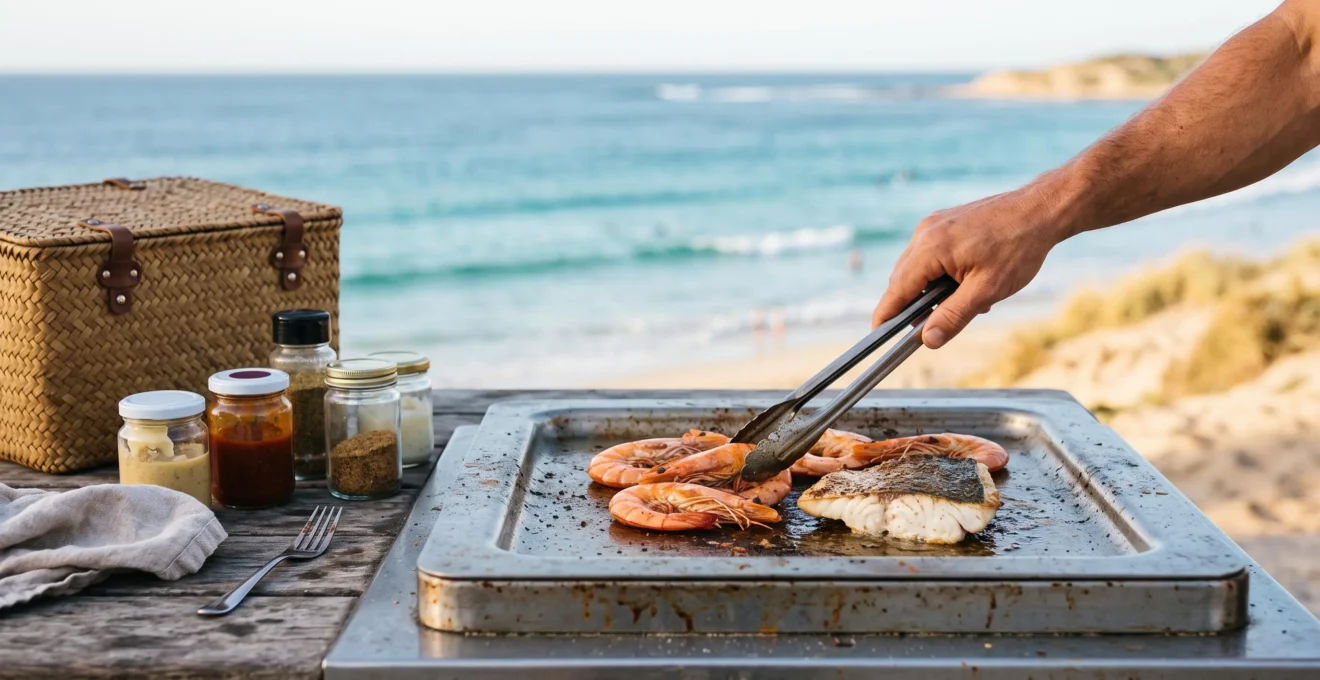
Contrary to the cliché of cheap sausages, the modern Australian beach barbecue is a sophisticated expression of coastal-gourmet cooking focused on fresh, high-quality seafood.
- Success depends on mastering the technique of cooking on public electric hotplates, not just grilling.
- Sourcing fresh catch directly from fishing port markets is the foundational step for an authentic experience.
Recommendation: Prioritise learning the local etiquette and hotplate cleaning protocols; this is the true mark of someone who respects the culture, more so than what you cook.
The image of an Australian beach barbecue is iconic: sun, sand, and the sizzle of something on a public grill. For many visitors, this image is filled with stereotypes of simple sausages (« snags ») in white bread. While this casual « sausage sizzle » has its place, it barely scratches the surface of a culinary practice that has undergone a quiet but profound evolution. The true contemporary Australian beach BBQ culture has moved far beyond cheap meat, transforming into a form of accessible gourmet outdoor cooking, with a strong focus on fresh, local seafood and refined techniques.
This shift reflects a broader maturation in Australia’s food scene, where provenance, quality, and skill are now celebrated from the city’s finest restaurants to the most remote coastal parks. To truly participate in this culture is not to replicate a tired cliché, but to engage with it on its modern terms. It means understanding the nuances of sourcing the freshest catch, mastering the unique challenge of a public electric hotplate, and, most importantly, respecting the unwritten rules of a cherished shared space. This isn’t just about grilling; it’s about connecting with the coastal environment through its produce.
This guide provides the roadmap for the food-adventurous traveler. We’ll explore why the Aussie BBQ is now a gourmet affair, detail the specific techniques for cooking seafood like a local, and cover the crucial etiquette that will earn you nods of approval rather than frustrated glares. It’s time to trade the sausages for freshly caught fish and learn the art of the modern Australian beach barbecue.
To help you navigate this delicious cultural landscape, this article breaks down the essential knowledge into distinct, practical sections. From the philosophy behind the shift to the on-the-ground logistics, here’s what we’ll cover.
Contents: Mastering the Contemporary Australian Beach BBQ
- Why Australian Beach BBQ Is Now Gourmet Outdoor Cooking, Not Just Grilled Meat
- How to Cook Fresh Seafood on Public Beach BBQs Like Coastal Locals
- Charcoal or Electric Beach BBQs: Which Australian Coastal Cooking Method Delivers Better Flavor?
- The Beach BBQ Etiquette Mistakes That Frustrate Australian Locals at Shared Facilities
- When to Arrive at Beach BBQ Facilities to Secure Spots at Popular Coastal Parks?
- How to Visit Fishing Port Markets for Freshest Catch Straight from Boats
- Why Australian Café Culture Now Leads Global Specialty Coffee Innovation
- How to Find Australia’s Freshest Seafood at Fishing Ports, Not Tourist Restaurants
Why Australian Beach BBQ Is Now Gourmet Outdoor Cooking, Not Just Grilled Meat
The transformation of the beach barbecue from a simple cookout to a gourmet event is rooted in a nationwide shift in how Australians think about food, particularly seafood. The old mindset of accepting mediocre quality simply because you’re by the beach has vanished. This change is powerfully articulated by pioneering chefs whose philosophies have trickled down from high-end dining to everyday culinary culture. Their influence has set a new benchmark for quality and respect for ingredients.
Case Study: The « Fin-to-Gill » Revolution
Chef Josh Niland’s Sydney restaurant Saint Peter and his Fish Butchery are at the forefront of this movement. By pioneering a holistic, « fin-to-gill » approach to preparing and dry-aging fish, Niland has set new global standards for no-waste seafood cookery. This philosophy, which treats fish with the same respect as prime cuts of meat, has fundamentally altered expectations. According to a profile on his methods, this no-waste approach has since filtered down into the amateur cooking scene, inspiring home cooks and beach-goers to think beyond a simple fillet and consider the full potential of their catch.
This new standard means that the quality of seafood is paramount. The focus is now on provenance and freshness, celebrating the unique species available along Australia’s vast coastline. Instead of masking poor-quality ingredients with heavy sauces, the modern beach BBQ aims to highlight the natural flavour of a perfectly cooked piece of fish, a handful of local prawns, or calamari seared to tender perfection. It’s a culinary practice that honors the ingredient, the environment, and the shared experience.
As Chef Josh Niland himself noted, the bar has been permanently raised. This sentiment captures the essence of the new coastal food culture perfectly:
It’s no longer acceptable to be serving AUS$12 (£7) fish and chips at a local fish and chipper.
– Josh Niland, The Irish News
This elevation from simple grilling to a more refined outdoor cooking experience redefines what it means to « have a barbie » and invites travelers to participate in a much more rewarding culinary tradition.
How to Cook Fresh Seafood on Public Beach BBQs Like Coastal Locals
Cooking delicate seafood on a public electric hotplate—the standard for most Australian beach parks—is a skill. Unlike a home BBQ, these surfaces have been used by countless others and require specific preparation to ensure a clean, successful cook. Locals know that the secret isn’t in complex recipes, but in mastering the hotplate technique and coming prepared. The goal is a quick, clean sear that respects the texture of the seafood, whether it’s fish fillets, prawns, or calamari rings.
Before any food touches the surface, the hotplate needs a thorough pre-clean and pre-heat. Most locals will turn it on to its highest setting, splash it with a little water, and use a wad of paper towel held with tongs to scrub off any residue from the previous user. This sanitises the surface and prevents your beautiful fresh seafood from picking up the charred remains of someone else’s sausages. Once clean, a light coating of a high-smoke-point oil (like canola or grapeseed) or butter creates a non-stick surface, ready for searing.
As the image above shows, the key is achieving a perfect, caramelised sear. This requires high, consistent heat. You must also bring your own toolkit: long-handled tongs, a metal spatula, paper towels, oil, and your chosen seasonings are non-negotiable, as public facilities provide nothing but the heat. When sharing the hotplate, always be courteous. Keep your food to one side and ask before placing your items near someone else’s. This respect for shared space is a cornerstone of the culture.
Ultimately, a successful beach seafood BBQ is defined by this preparation and technique, turning a potentially tricky cooking environment into an opportunity for a delicious, fresh meal.
Charcoal or Electric Beach BBQs: Which Australian Coastal Cooking Method Delivers Better Flavor?
When planning a beach barbecue, you’re faced with a fundamental choice: use the free, convenient public electric hotplates or bring your own portable charcoal BBQ. While both can produce a fantastic meal, they offer vastly different experiences in terms of flavour, convenience, and legality. Understanding the trade-offs is key to planning the perfect coastal cookout. The decision often comes down to a balance between the quest for smoky, charred flavour and the need for simplicity and compliance with local rules.
Public electric hotplates are the default for a reason. They are ubiquitous, free or coin-operated, and always permitted for use where installed. They provide consistent, even heat, making them reliable for cooking delicate items like fish fillets or prawns without the risk of flare-ups. However, their major drawback is the lack of any smoke or charcoal character. The flavour you get is clean and direct, coming entirely from the ingredient and any marinades you use. As one guide notes, it’s always critical to check local rules before using any public BBQ space, but electric ones are generally the safest bet.
A portable charcoal BBQ, on the other hand, is the purist’s choice for flavour. The smoke from the coals imparts a deep, complex, and unmistakably « barbecued » taste that a hotplate simply cannot replicate. However, this comes with significant logistical and legal hurdles. You must transport your own unit and fuel, and their use is heavily restricted. Most coastal councils enforce total fire bans during hot, dry, and windy conditions, especially in summer, making open-flame cooking illegal and dangerous. Always check the local council’s website and the Rural Fire Service for the current fire danger rating before even considering packing a charcoal BBQ.
The following table breaks down the key differences to help guide your decision, based on a comparative analysis of BBQ culture.
| Criterion | Public Electric Hotplate | Portable Charcoal BBQ |
|---|---|---|
| Cost & Access | Usually free or coin-operated, widely available at councils’ beach reserves | Requires owning and transporting your own unit and fuel |
| Time Limits | Often auto-shuts off after 10-15 minutes, needing restarts | No forced time limit once lit |
| Legality | Always permitted where installed | Subject to council total fire bans and open-flame restrictions |
| Flavor Profile | Clean, consistent heat but no smoke character | Adds smoky, charred flavor to proteins |
For visitors, the electric hotplate is almost always the more practical and respectful choice, allowing you to focus on the food and the experience without worrying about complex regulations.
The Beach BBQ Etiquette Mistakes That Frustrate Australian Locals at Shared Facilities
Participating in Australia’s beach BBQ culture is about more than just food; it’s about engaging in a community activity governed by a strong, albeit unwritten, code of conduct. The biggest mistake a visitor can make is treating the public facility like their own private property. These are shared culinary spaces, and respecting them is paramount. The number one point of friction? Leaving the hotplate dirty. It is an absolute rule to leave the BBQ cleaner than you found it. This isn’t just a polite suggestion; it’s the cornerstone of the entire system’s functionality.
Beyond cleaning up after yourself, there are other nuances. Don’t « hog » the BBQ; cook your food efficiently and make way for the next group. If people are waiting, it’s poor form to cook one sausage at a time over an hour. Similarly, avoid sprawling your eskies (coolers), bags, and food prep across all the available bench space. Be mindful that others need room to prepare their meals too. It’s also worth noting that many popular beach parks have restrictions on alcohol consumption, so check local council signage before you open a beer. A little spatial awareness and consideration go a long way.
The cleaning process itself should be taken seriously. A quick, flimsy wipe is not enough. You should use a scraper (a metal spatula works well) to remove all baked-on food scraps, followed by a thorough wipe-down with paper towels. For a truly professional approach, some locals even use a bit of lemon juice or vinegar on the hot hotplate to help steam off stubborn residue. Importantly, avoid harsh chemicals. As BBQ maintenance experts advise, it’s best to use only PH-neutral cleaning compounds to avoid damaging the cooking surface for future users.
Your Action Plan: Professional-Grade BBQ Hotplate Cleaning
- Inspect: Before you even start cooking, inspect the hotplate for pre-existing grease and burnt-on residue from previous users.
- Pre-clean: Use food-safe methods like splashing with water and scraping with a spatula to remove loose debris, preventing cross-contamination with your food.
- Post-cook Scrape: Immediately after you finish cooking, while the plate is still hot, use your spatula or tongs to scrape off all your own food remnants and grease.
- Final Wipe: Give the surface a final, thorough wipe with a clean paper towel to leave a fresh, clean surface for the next person in line.
- Final Inspection: Do a final check. The goal is to leave the surface as clean, or even cleaner, than you found it.
Following this etiquette demonstrates respect for the local culture and ensures these fantastic public facilities remain a welcoming place for everyone to enjoy.
When to Arrive at Beach BBQ Facilities to Secure Spots at Popular Coastal Parks?
On a sunny weekend or public holiday, public barbecues at popular Australian beaches are prime real estate. Simply showing up at midday with a cooler full of food and expecting an empty grill is a recipe for disappointment. Securing a spot requires strategic planning and, above all, an early start. The golden rule is simple: the better the weather and the more popular the beach, the earlier you need to arrive. For prime locations like Sydney’s Bronte or Melbourne’s St Kilda, this can mean arriving as early as 9 or 10 a.m. to claim a table and a BBQ.
A common local strategy is to send a scout ahead. One member of the group arrives early with a picnic blanket, a couple of chairs, and a cooler to « claim » a desirable spot near a BBQ. This reserves the space while the rest of the group arrives later with the main food supplies. This is a perfectly acceptable tactic, provided you are genuinely setting up for a group and not just holding a spot « just in case. » Once you’ve finished your cooking, it’s also considered good form to consolidate your gathering and free up the BBQ for the next group waiting patiently.
The timing is everything. On a weekday outside of school holidays, you’ll have much more flexibility and can often find a free BBQ in the early afternoon. However, for a weekend lunch, you are competing with countless other families and groups. Arriving before the lunchtime rush, ideally before 11 a.m., dramatically increases your chances. This gives you time to do your pre-clean, get the hotplate up to temperature, and cook your meal at a relaxed pace before the peak-hour queues form. The tranquil scene of an empty BBQ area at dawn is a reminder that the early bird truly gets the grill.
Planning your arrival time with the same care you put into your menu is the final step in ensuring a stress-free and enjoyable coastal cooking experience.
How to Visit Fishing Port Markets for Freshest Catch Straight from Boats
The foundation of a gourmet beach barbecue is an unimpeachable ingredient, and for coastal cooking, that means seafood sourced directly from the people who caught it. While supermarkets offer convenience, they can’t compete with the freshness, quality, and variety of a dedicated fishing port market or a fisherman’s co-op. Visiting these places is an experience in itself, connecting you directly to the local marine ecosystem and guaranteeing you the best possible product for your BBQ. It’s the difference between cooking a generic fillet and searing a piece of fish that was swimming in the ocean that morning.
To find these markets, look for fishing harbours in coastal towns. Places like the Sydney Fish Market, the Fremantle Fishing Boat Harbour in Western Australia, or smaller co-ops along the NSW and Queensland coasts are hubs of activity, especially in the early mornings. The key is to go when the boats come in. Talk to the fishmongers, ask them what’s freshest, what they recommend, and how to cook it. They are a font of knowledge and are usually passionate about their produce. This is how you discover lesser-known local species that are often more sustainable and flavourful than the common commercial varieties.
Engaging with these markets also means becoming a more discerning consumer. You learn to look for the signs of true freshness: bright, clear eyes, firm flesh, and a clean smell of the sea, not a « fishy » odour. This active participation in sourcing aligns with the habits of dedicated local seafood lovers. For instance, data from the industry shows a core group of passionate consumers drives demand for quality. A report referenced by Safe Food Production Queensland found that 33% of frequent eaters consume 77% of all seafood, highlighting a community deeply invested in sourcing the best.
By making the trip to a fishing port, you are not just buying food; you are participating in the coastal culture at its most authentic source.
Why Australian Café Culture Now Leads Global Specialty Coffee Innovation
To understand the evolution of the beach BBQ, it helps to look at another Australian culinary export: café culture. The same forces that transformed the simple grill-up into a gourmet affair—a focus on quality, technique, and a relaxed but discerning atmosphere—also propelled Australian-style coffee onto the global stage. Australia’s café scene is widely recognized as a world leader in specialty coffee innovation, creating a blueprint that has been replicated from London to New York.
This leadership is built on a foundation of meticulously trained baristas, a commitment to high-quality beans, and the invention of signature drinks like the flat white. The flat white, a perfect balance of espresso and velvety microfoam, has become a global standard. In Australia, its dominance is clear; recent industry data shows that flat whites account for 26-28% of all espresso-based orders. But it’s more than just one drink; it’s the entire ecosystem of the café—the design, the food pairing, the knowledgeable service—that defines the experience.
Case Study: The « Australian Café » as a Global Export
The mainstream adoption of the flat white by Starbucks in 2015 was a tipping point, but the real influence was seen on the streets of global cities. In London’s trendiest neighbourhoods like Shoreditch and Fitzrovia, independent cafés began to explicitly model themselves on the scenes in Melbourne’s Fitzroy or Sydney’s Surry Hills. This turned the « Australian café » into a distinct and recognizable global category, synonymous with excellent coffee and a vibrant, quality-focused brunch culture.
This parallel story of coffee innovation reinforces the central theme: Australian food culture has matured. The expectation of quality is no longer confined to formal restaurants. Just as locals won’t accept a poorly made coffee, they are no longer satisfied with a generic sausage at a beach BBQ. This cultural shift provides the context for why learning contemporary BBQ techniques is so essential for any visitor wanting to engage authentically with modern Australian life.
The gourmet beach BBQ is simply another expression of this national passion for doing casual things exceptionally well.
Key Takeaways
- The modern Australian beach BBQ is a gourmet cultural practice focused on fresh seafood, not just sausages.
- Mastering the pre-cleaning and pre-heating of public electric hotplates is the most critical technical skill.
- Etiquette, especially cleaning the BBQ thoroughly after use, is the cornerstone of this shared community activity.
How to Find Australia’s Freshest Seafood at Fishing Ports, Not Tourist Restaurants
We’ve covered the techniques, the etiquette, and the cultural context. Now we return to the most crucial element: the ingredient. The ultimate way to elevate your beach barbecue from a simple meal to a memorable culinary event is to bypass tourist traps and mainstream retailers. Sourcing your seafood directly from fishing ports is the single most impactful step you can take. It’s here, at the water’s edge, that you’ll find unparalleled freshness and connect with the true spirit of Australia’s coastal-gourmet culture.
Tourist restaurants often rely on frozen or supply-chain-aged products, but at a fisherman’s co-op, you are buying seafood that is hours, not days, old. This is where you can practice the « fin-to-gill » philosophy in a practical way. Ask for the « catch of the day, » and you might discover delicious species you’ve never heard of, often at a better price and with a more sustainable footprint. The choice to seek out this quality is driven by more than just economics; it’s a commitment to flavour and authenticity.
As experts from Safe Food Production Queensland point out, consumer behaviour in this area is sophisticated. They state that « the data is in and seafood choice among consumers is not purely economic. » This observation confirms that a growing number of people are making choices based on quality, freshness, and provenance. By visiting a fishing port, you are joining this discerning group and taking control of the most important variable in your cooking.
Your journey into authentic Australian coastal cooking begins not at the BBQ, but at the fishing port. Use the insights from this guide to confidently select your catch, master the hotplate, and respect the shared space. This is how you transform a simple beach day into a truly delicious and respectful cultural experience.